Compliance · 5 min read
Charity DMs: The Messages That Must Never Meet a Bot

Most advice about automating a nonprofit inbox assumes the inbox is full of supporters. Donors asking how to give, volunteers asking how to sign up, a company asking about a CSR partnership. All of that is real and most of it is safely automatable.
But a charity account is public, and it posts about the thing it exists for. Which means somewhere in that inbox, at some point, is a message from a person who needs the help rather than a person offering it.
That message is the reason this post is structured around refusals.
The disclosure
It does not arrive labelled. It arrives at 1am, often long, often unpunctuated, sometimes as three messages in a row. Somebody describing a situation at home. Somebody who has run out of money. Somebody who found your account because of a post about exactly what is happening to them.
An automated reply to that is not neutral. "Thanks for reaching out! Here is our donation link" underneath a disclosure of hardship is the single worst thing this software can do, and it is a completely ordinary configuration mistake — a broad keyword, a general fallback, an automation somebody built for donors and pointed at the whole account.
The other half of that setting is one people miss. Switch capture-to-Leads off on anything that could catch a disclosure. A CSV of people describing the worst fortnight of their life, sitting in a downloads folder on a volunteer's laptop, is a safeguarding problem you created by leaving a toggle on.
Capture is a marketing feature. Point it at donors, never at the people your organisation exists to help.
Who can open this account
Charities run on volunteers and volunteers rotate. Before automating anything, count the number of people who currently have access to the Instagram login, and then count how many of them are still involved.
That number is usually wrong and usually larger than anyone expected. It matters more here than at a bakery because of what is in the inbox. Automation does not change who can read those messages — it changes how much traffic arrives, which means more messages sitting in an account with an access list nobody has audited since a campaign two years ago.
Asking for money in a DM, honestly
Here is what the tool can and cannot do, so you can plan around it rather than around a pitch.
It cannot take a donation. There are no payment links, no checkout, no recurring giving, nothing that touches money. What an automated reply can contain is your donation page, exactly as you would put it in a bio.
It also cannot tell you whether that worked. There is no attribution and no analytics product. You will know a reply was sent. You will not know whether the link was tapped, and nothing flows back from your payment provider. If somebody sells you a nonprofit funnel with a number attached to it, that number is not coming from here.
What is worth thinking about is which posts should carry an ask at all. A campaign post about a match-funding window is a reasonable place for one. A post about a beneficiary's story is a much worse place, because the people most likely to comment on it are people who recognise themselves in it. Use the specific-posts setting rather than running the ask account-wide.
Three audiences, one inbox
The donor pile, the volunteer pile, and the institutional pile behave completely differently and want completely different replies.
- Donors. Mostly logistics: how to give, whether you accept international transfers, what happens to the money, what proportion goes where if that is published. All fixed facts. All templates.
- Volunteers. Highest volume, most seasonal, and the pile that suffers most from slow replies. What the roles are, the minimum commitment, whether it is remote or in person, whether there is a background check, where the form lives. One good template beats the current situation, which in most small charities is that half of them get no answer.
- Institutional. A company asking about CSR, a foundation, a school wanting a speaker. Low volume, high value, and it should never meet a template. Negative-keyword
CSR,partnership,grant,foundation,sponsorand let a human take it.
On receipts and tax treatment: publish only what your own registration paperwork already states, and nothing beyond it. Rules on charitable giving vary by jurisdiction and change, and a reply automation is a bad place for a donor to learn about their own tax position. "Here is what our receipt covers, please check your own position" is the honest template.
Read what got stopped
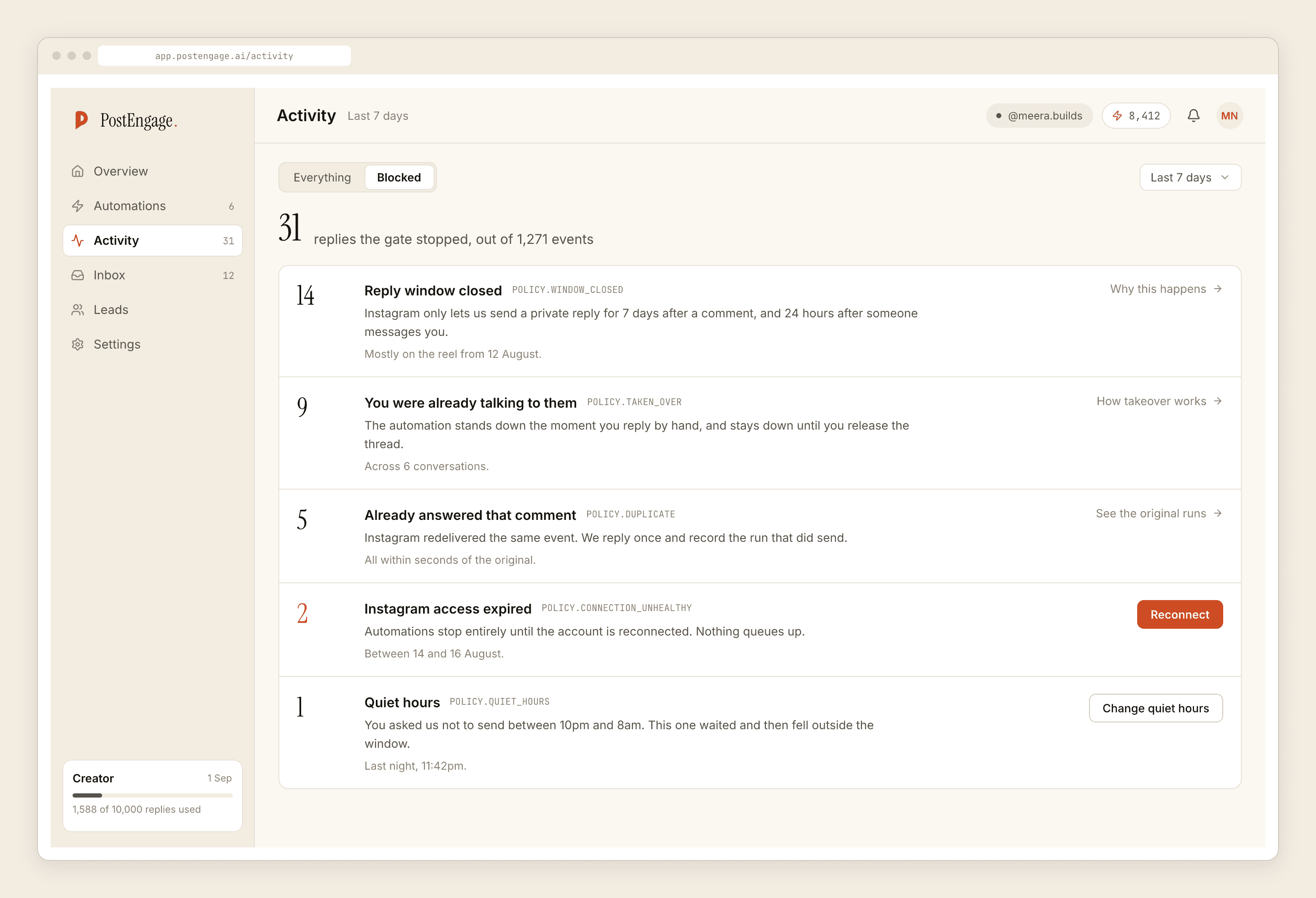
Read it weekly for the first month. You are checking two things: that the distress keywords are catching what they should, and that nothing personal is being caught by a capture rule you forgot to switch off.
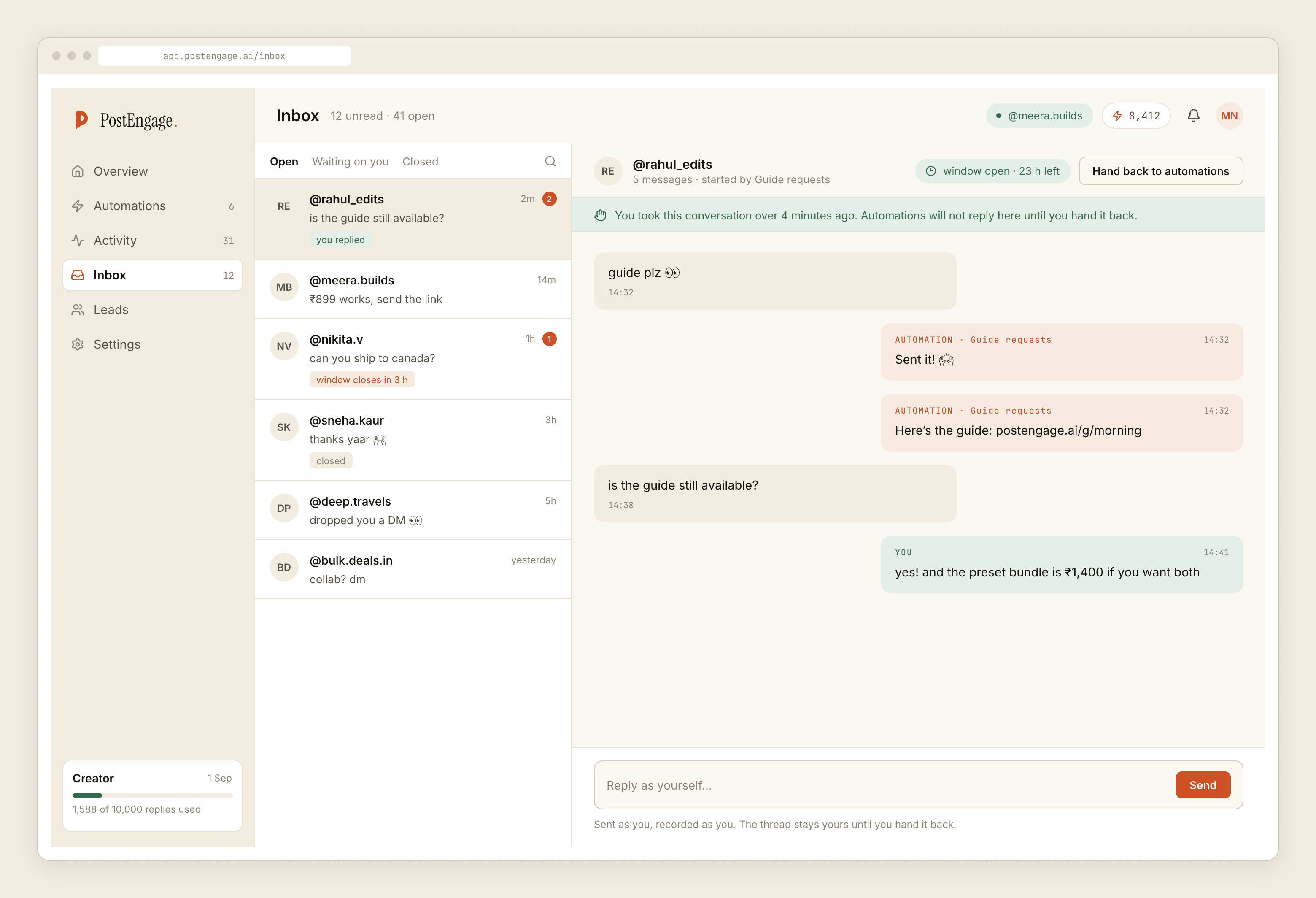
Takeover helps here more than anywhere. The moment a volunteer replies by hand, automation is out of that thread permanently — so a careful human answer is never followed by a template.
The costs and the edges
Templated replies are free and unlimited; a credit is spent only when the AI writes a new reply. A charity inbox is almost entirely template-shaped, so a small organisation may live inside the free tier of 100 credits with no card indefinitely. Packs start at ₹499.
No payments, no calendar, no CRM, no WhatsApp, no messaging anyone who has not written first. Leads export as a CSV. Comments stay answerable for seven days, DM threads for twenty-four hours, and that clock restarts only when they message you again.
Build the stand-down first, then the volunteer template, and read what actually blocks a reply before a campaign rather than during one. If your cause touches wellbeing directly, the wellness brands post covers the tone problem in more depth, and crisis handling covers the week a post goes wrong.