Playbooks · 5 min read
What Content Agencies Owe the Inbox Their Reels Fill

A content agency's failure mode is not a bad reel. It is a good one.
The reel lands, the client's phone lights up, four hundred people comment some version of "price?" and "link?", and the client's team answers thirty of them over the next week. Then the client looks at the invoice and says the reel did not convert. They are not lying. The reel worked and the business behind it did not, and because you made the reel, the gap between those two facts is now your reputational problem.
Worth saying at the top what we are not: we do not publish, schedule, generate captions, pick hashtags or predict performance. None of that exists here and none of it is coming. You keep making the content wherever you make it. This is only about what happens underneath it after you post.
The clock nobody in the content team knows about
Two windows govern every reply, and they are Meta's, not ours.
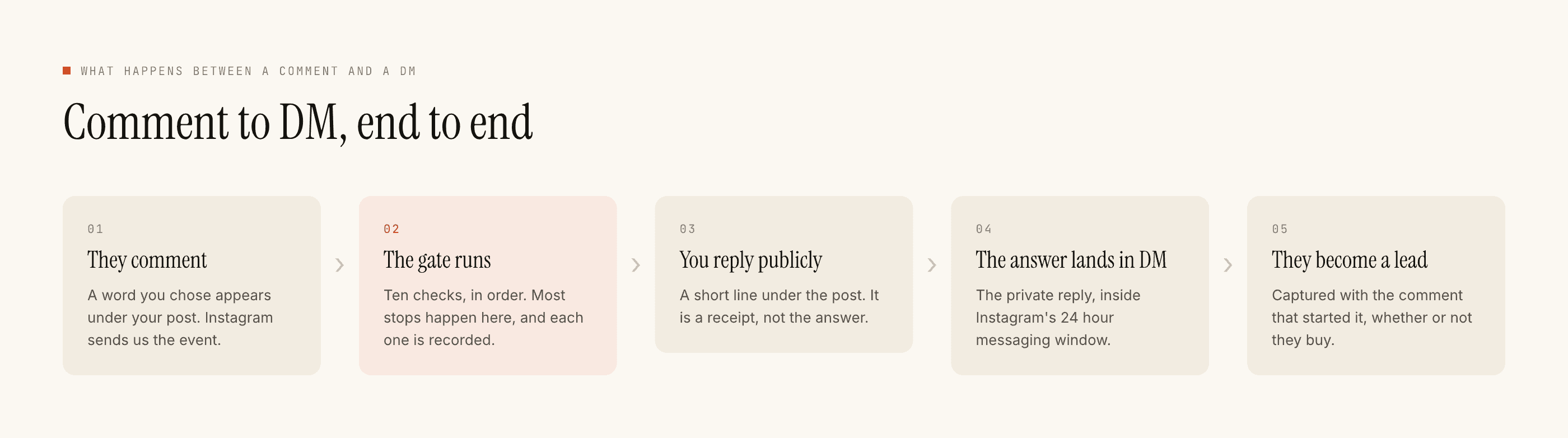
A comment can be replied to for seven days. A DM can be sent within twenty-four hours of that person's last message to the account, and only their message restarts it. Nobody can message a stranger.
This is why a reel that finds a second life in week three is, from a reply standpoint, mostly unreachable. The people commenting on day nine can still be seen. They cannot be answered by the automation. If you build a content strategy around evergreen reels resurfacing — a good strategy, generally — you have to accept that its inbox value decays on a timer that has nothing to do with the algorithm.
The trigger word is a content decision, and it is yours
This is the part that makes automation a content agency's problem rather than the client's ops problem.
An automation fires on a keyword under a specific post. The keyword only exists if someone told the audience to type it, and the person who writes the caption is the person who decides that. "Comment PRICE and I'll DM you" is a line of copy. It belongs in the script and the caption, next to the hook, decided by whoever decides those.
So the honest change to your deliverable is small and structural: every reel ships with its trigger word and the two answers behind it. Not a strategy document. A word and two sentences.
- The word. Short, unambiguous, not something people would type by accident. Matching ignores case and punctuation, so
Price?andpriceare the same. Avoid words that appear in ordinary praise — a reel where "love" is the trigger will reply to everyone who liked it. - The public reply. A few words under the post. "Sent you a DM." It is a receipt, not the answer, and it is visible to everyone including people who did not comment.
- The private reply. The actual answer, which is the thing the client has to supply and usually has not written down anywhere.
- The negative keywords. Words that mean do not reply. "Not interested" is the one everyone forgets. A reel that travels brings people who are not customers, and some of them are hostile.
Who owns the answers
This is the contract question and it decides whether the whole thing works.
If you run the workspace, you own the reply set and you are on the hook when the client changes their price and forgets to tell you. If the client runs it, you hand over the trigger word and the recommended copy with the reel, and their team builds it. Both are fine. What is not fine is the arrangement where nobody said which one it is, which is the default arrangement.
Agency runs it
Client runs it
Test on yourself before the reel goes up, not after
There is a Test on myself button that runs the whole pipeline — trigger match, the ten checks, the reply, the send — and delivers the result to your own account. Nothing is faked.
Do this while the reel is still scheduled. Read the private reply on a phone, as a stranger. The most common thing you will catch is tone: templates get written formally because writing a template feels like writing a document, and then a client whose whole brand is casual sends "Thank you for your enquiry. Kindly find the details below." If the client would actually type "haan available hai, DM check karo", that is what should go out.
What to add to the delivery note
Three lines, and they change the conversation about performance.
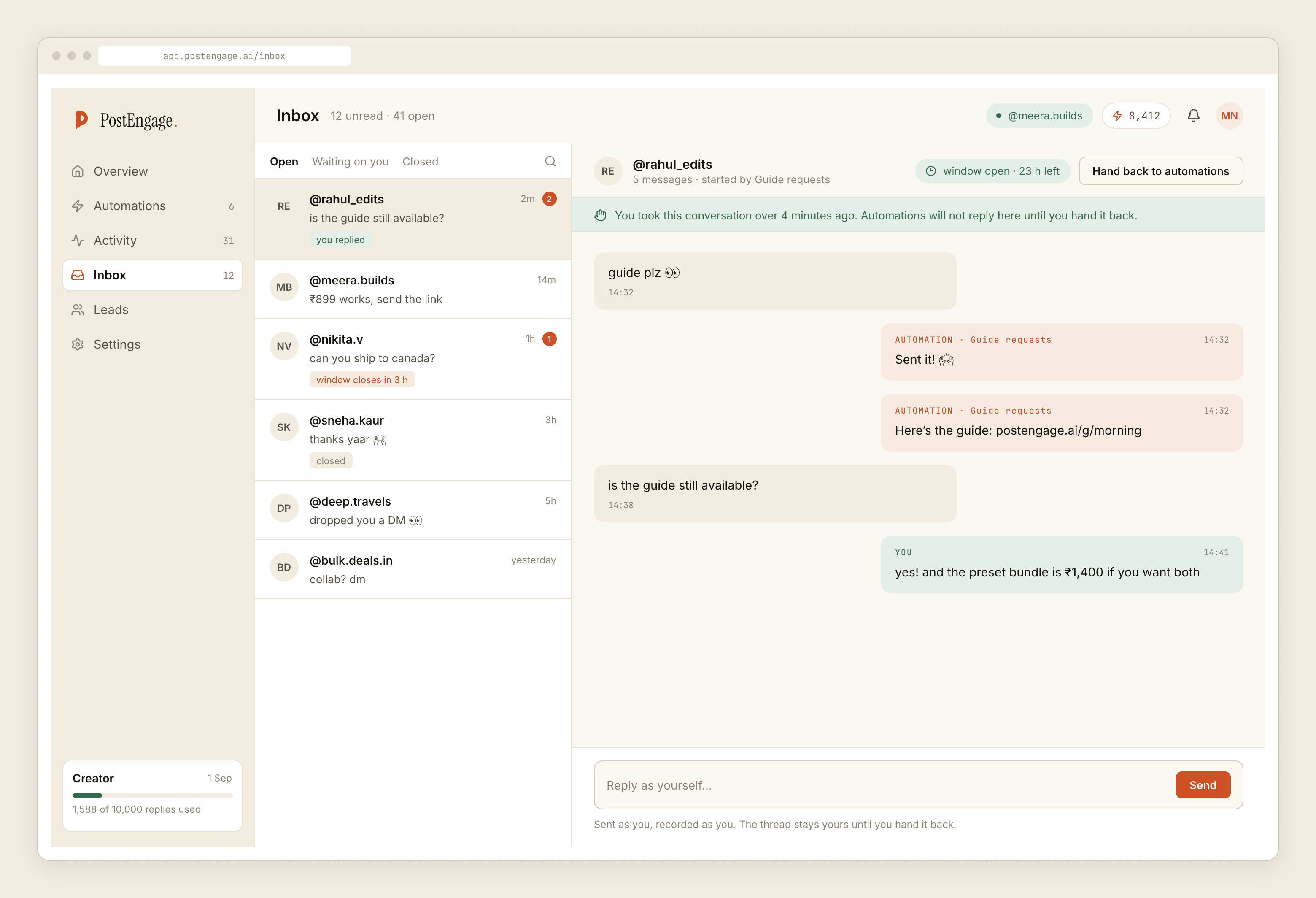
The trigger word. The two replies. And the sentence that says what happens to the people the automation will not answer — the ones outside the window, the ones the negative keywords caught, the ones who commented twice and got one reply because of dedupe. Those people exist and the client will meet them. Better they meet them in your delivery note first.
The mechanics of the flow itself are covered properly in the comment-to-DM walkthrough, and if reels are the bulk of what you ship, the reels-specific version goes further into what breaks at volume. For the operational side of running this across a client roster, that is a different post.