Lead generation · 5 min read
The Reels to DM Funnel: Built for Strangers and Spikes

A Reel is the only surface on Instagram that routinely shows your work to people who do not follow you, and it does it unevenly — nothing for a week, then forty thousand views in a night. Both of those facts change how the automation behind it should be built, and neither of them applies to your other posts.
Everything below is what a Reel funnel needs that a normal comment funnel does not.
The ask has to work with the sound off
Most Reels are watched muted, at least at first. If the instruction to comment a word only exists in the voiceover, a large part of your reach never learns there is anything to type.
Put it in three places: on screen as text, in the caption, and said out loud. Redundant is correct here. And keep the word short and unambiguous — someone is holding a phone in one hand while the next video is already trying to start. PRICE. LINK. PLAN. Not SENDMEDETAILS.
Matching ignores case and punctuation, so you are not maintaining a list of spellings, but you should still add the variants people actually invent. On a Hinglish audience that reliably includes things like bhejo, chahiye and the misspelling of whatever word you chose.
Your public reply is a shopfront
On a Reel that travels, the public reply is the most-read thing you write. People scrolling the comments see it dozens of times, and it is often their first impression of what kind of account this is.
Two consequences. First, keep it short and human — a wall of emoji repeated under two hundred comments looks like a bot farm even when it is not. Second, vary nothing about it that matters, but do make sure it reads well standing alone, because it will be seen without the comment that triggered it.
The 7 days start from the comment, not the post
This is the detail that changes what you do with old Reels. You have 7 days to reply to a comment, counted from when the comment was made. A Reel posted in March that resurfaces in June and picks up new comments is still perfectly serviceable — each new comment opens its own 7 day window.
So the correct habit is the opposite of the one most people have: do not switch off automations on older Reels. A Reel that revives is free distribution for an ask you already wrote, and the only thing that stops it working is you having turned the trigger off for tidiness.
Spikes, and why the cap is the point
The failure case for this surface is success. A Reel goes overnight, two thousand comments are waiting by morning, and without an hourly limit two thousand DMs leave as fast as the API will take them. A share of those people report the messages, and the account picks up a delivery problem that outlives the Reel by a long way.
With a rate budget in place the same two thousand become a queue that drains over hours. The last person still gets their DM well inside the 7 day comment window, and nothing about the account changes. The blocked entries you will see in Activity that morning are the cap doing its job, which is the one situation where a large pile of refusals is good news.
The cap only ever looks like a limit on your best day. That is precisely the day it is protecting you.
The first DM meets someone with no context
This is the real difference between a Reel funnel and every other one. A commenter from your own audience knows who you are. A commenter from the recommendation feed watched eleven seconds of a video and typed a word.
So the first message needs one line of orientation before the answer. Not a biography — a clause. "Hi! Main [account] chalata hoon, hum handmade lamps banate hain — price list yeh rahi." Then the thing they asked for. Then a question, because their reply restarts your 24 hour window and silence closes it permanently.
Negative keywords also matter more here than anywhere else, because a travelling Reel brings people who are not your audience at all. not interested, the obvious spam patterns, and anything you have seen trolls type. Under Advanced, first-time senders only is worth switching on if you post Reels often — it stops the same follower getting greeted under every single one.
Where this sits against the other inbound surface
Reels: reach, publicly
Stories: intent, privately
They are not substitutes and the setups genuinely differ — the story version has fewer moving parts and much less time, which is a different funnel rather than the same one on another surface.
The order to fix things in
When a Reel funnel underperforms, the cause is almost always upstream of the software. In order: whether the ask was visible with sound off, whether the keyword was typeable, whether the offer was worth typing for, and only then the automation itself.
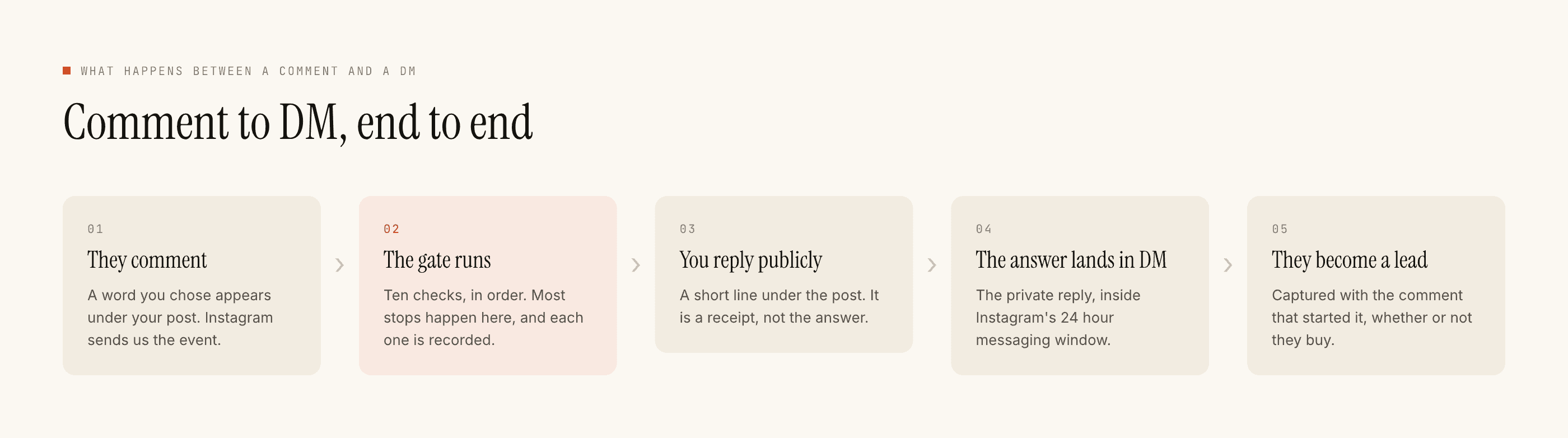
If you want the stage-by-stage version of where people fall out between the comment and the conversation, the comment to DM funnel is mapped in six steps. And if the trigger words themselves are what is losing people — which is more common than anyone expects on a mixed-language audience — that is its own problem worth an afternoon.