Playbooks · 5 min read
You Made the Post That Broke Their Inbox. Arm It First
On this page
Eleven at night, and the client messages the group: "bhai inbox phat gaya, kya karein". The reel you shipped that morning has gone further than anything on their account and there are eleven hundred comments, most of them some version of price and link.
You caused that. It is the best day the account has had. And the reason it feels like a problem is that a spike is not a marketing event, it is a capacity event, and nobody planned capacity because everybody was planning content.
What the deliverable owes the inbox — the trigger word, the two replies, and the question of who owns the answers — is a separate post and it is the one to read first. This is about the day the post actually works.
A spike has a shape and the shape is short
Comments land in hours. Each one can be replied to for seven days from when it was posted, so the comment side of a spike is not urgent in the way it feels.
The DM side is. A DM thread stays open for twenty-four hours from that person's last message, and only their next message restarts it. Nobody can message a person who has not written first.
Put those together and the arithmetic is unforgiving. The people who commented in hour two, got a DM, and did not reply are unreachable by the following evening. Whatever the client wanted them to have — the price, the link, the address of the showroom — had to be in that first message. There is no follow-up on your schedule, no broadcast, no sequence, no WhatsApp fallback.
The value of a spike is spent inside a day, and it is spent by whatever you wrote before the post went up.
Arming happens before publish, and access is the part that fails
The predictable failure is not the copy. It is that on the night it matters, nobody at the agency can get in.
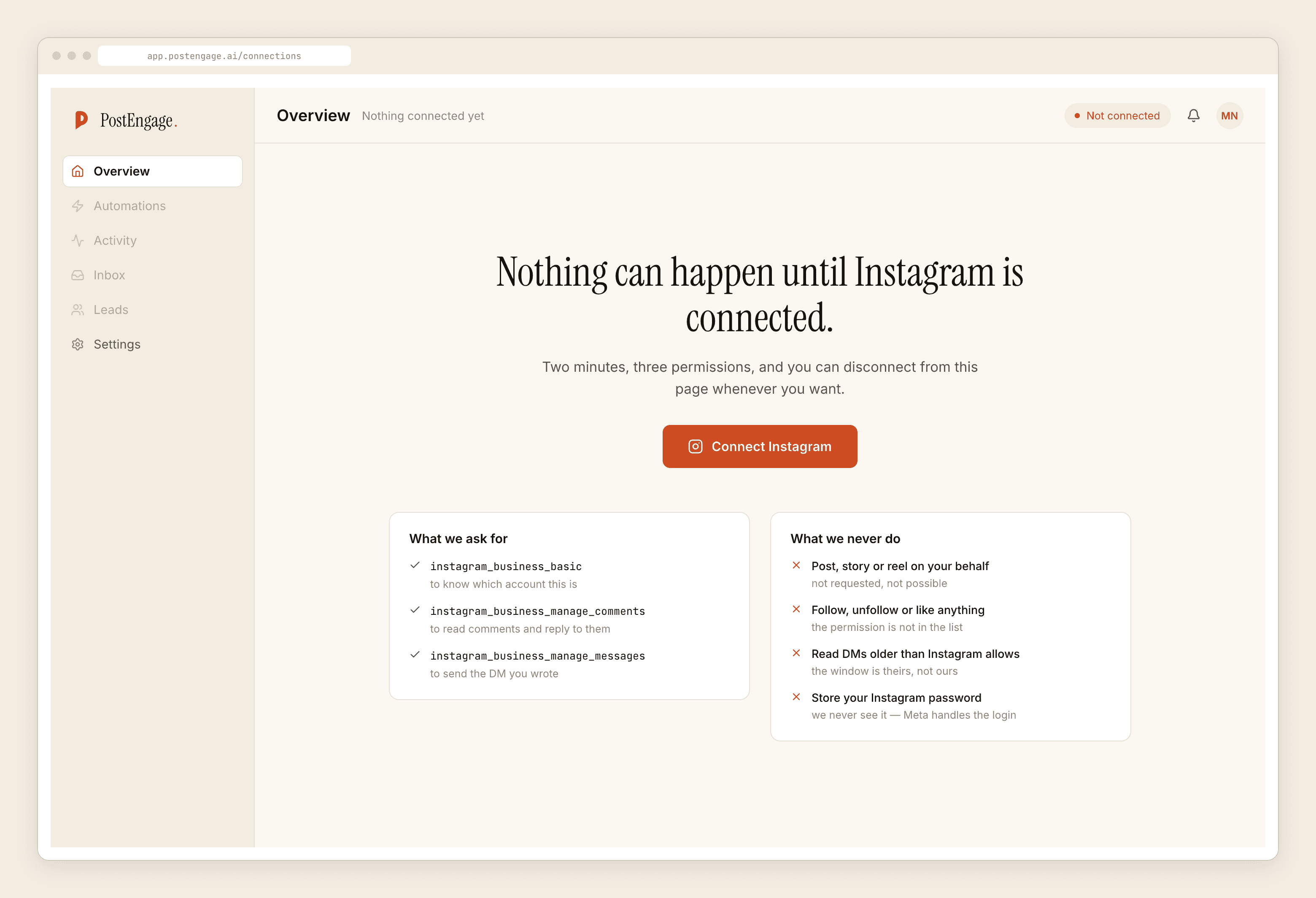
The account connection is made through the official Graph API and it can go stale. The person who set it up left. The client changed their password. Nobody has been in the workspace since the last campaign. None of that pages anybody, and all of it surfaces at the worst possible hour.
- Check the connection the day before, not the day of. A live connection is the precondition for everything else and the only one with a lead time you cannot compress.
- Confirm who has a seat. Whoever is going to be awake needs access before the post goes up. Sorting out logins during a spike costs you the window.
- Build the automation while the post is still scheduled. Trigger word, negative keywords, the public receipt, the private answer. All of it exists before publish or it does not exist.
- Test on myself. The button runs the whole pipeline — trigger match, all ten checks, the reply, the send — to your own account. Read it on a phone, as a stranger who has never heard of this brand.
- Set quiet hours deliberately. A reel that breaks out overnight will otherwise have the client's account answering strangers at 4am in a register nobody reviewed.
Under a spike the checks are doing most of the work
Every reply passes a fixed set of checks before it sends: kill switch, connection, takeover, window, dedupe, cooldown, quiet hours, rate budget, credits, content safety. On a normal day you never see them. On a spike they are the system.
Dedupe stops one person's three comments becoming three DMs. Cooldown stops an enthusiastic commenter being messaged repeatedly. Rate budget paces sending rather than firing eleven hundred replies into a platform in one minute. Content safety and your negative keyword list handle the part of a spike nobody warns you about: reach beyond the follower base brings people with no context and some of them are hostile, and sarcasm contains your trigger word perfectly.
Every blocked reply is recorded with its reason in Activity. After a spike that list is long, and reading it as failure is the wrong reading. Most of it is the system doing exactly what a spike needs.
Templates are free, and a spike is the day that matters
Templated replies are free and unlimited, at any volume. A credit is spent only when the AI writes a new reply — one credit, one reply.
Which makes the arming decision a cost decision too. If the client's spike answers are templates you wrote, a very large day costs nothing. If the AI is composing each reply, a very large day is metered, and a client on the free tier of 100 credits with no card will find that out mid-spike. Packs start at ₹499, so it is not ruinous, but the correct move is to have written the answers rather than to have bought your way through them.
The debrief is the client conversation
Do it within a day, while the window is still relevant, and do it from two screens.
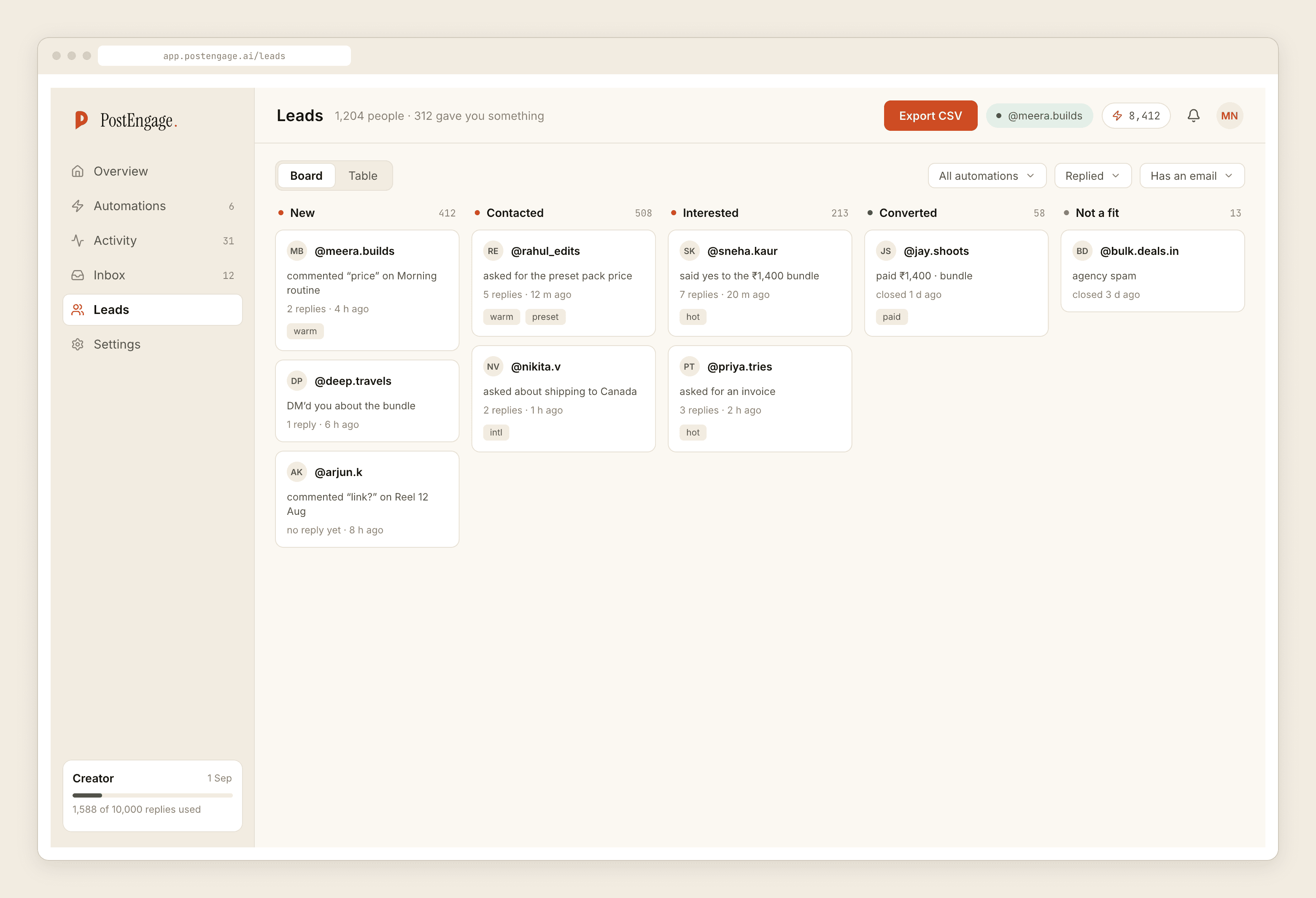
Activity, for what did not send and why — that is where you learn whether the trigger was too broad or the negative list too thin. And Leads, where every captured person sits with the post they came from and what they asked. Export the CSV and hand it over, because there is no CRM sync, no integrations, and no other way for those people to reach the client's sales process.
What we are not, so the pitch stays honest
There is no white-label. The client sees our name and our login screen. No agency dashboard showing every account on one page, no multi-client billing, no reseller tier, no partner discount. What exists is workspaces and team seats.
We also make nothing. No scheduling, no publishing, no captions, no hashtags, no performance prediction, no analytics. You keep producing the work wherever you produce it.
Takeover means that the moment anyone from the client's team replies by hand, the automation stands down in that thread permanently — which is the behaviour that lets a client's own staff jump into the good conversations during a spike without stepping on anything.
For the operational side across a roster, what breaks at ten clients and who checks it on Tuesday are the two to read next.