Product · 5 min read
Booking Confirmations: We Have No Diary to Confirm From
In every tool that genuinely sends booking confirmations, the confirmation is a consequence. Something happened in a database — a row was written, a slot moved from free to held, an identifier was minted — and the message exists to tell a human about that state change. The message is the receipt. The record is the thing.
We have no record. There is no calendar integration, no booking system, no slot, no diary, no reservation object of any kind. Nothing in this product can create, hold, move or cancel an appointment.
So a "booking confirmation" sent from here would be a receipt for a transaction that never occurred, which is not a confirmation. It is a sentence that looks like one.
The dangerous version is the one that reads correctly
Nobody sets out to fake a booking. It happens because a template was written in the natural register of the moment.
Somebody DMs "can I come at 4 on Thursday". The automation fires. The template says, warmly and grammatically, "You are all booked in — see you Thursday!"
That is now a promise. The customer stops looking at other options, tells someone else they are busy at four, and turns up. Your desk has never heard of them. The argument that follows is not with the software.
A confirmation your system cannot verify is not a booking. It is a receipt printed by something that was not in the room.
The trap is that this wording is more natural than the honest version. Left to write freely, a generated reply will produce it, because acknowledging a request enthusiastically is what polite service language does. The honest version has to be written deliberately, once, by you.
What a reply can honestly be
It can be an acknowledgement. That is a real and useful category and it should be unmistakable in the wording.
Sounds like a confirmation
Is an acknowledgement
The right-hand column does four things. It repeats the request back, so the customer knows they were understood. It states plainly that nothing is held. It names the thing that actually does the confirming. And it gives the hours, so silence between now and then is not read as being ignored.
That is slower and less satisfying than a fake yes, and it is the only version that survives contact with a Thursday afternoon.
People will ask for a reference number
This is the follow-up that catches teams out, and it is specific to pretending you have a booking system.
Once a message reads like a confirmation, the next question is "what is my booking ID" or "can you send the confirmation again". There is no ID. A captured lead is a row in a leads list — a note that somebody asked about something on a date — and it is not a reservation, cannot be looked up by a customer, and means nothing to your desk unless a human has already acted on it.
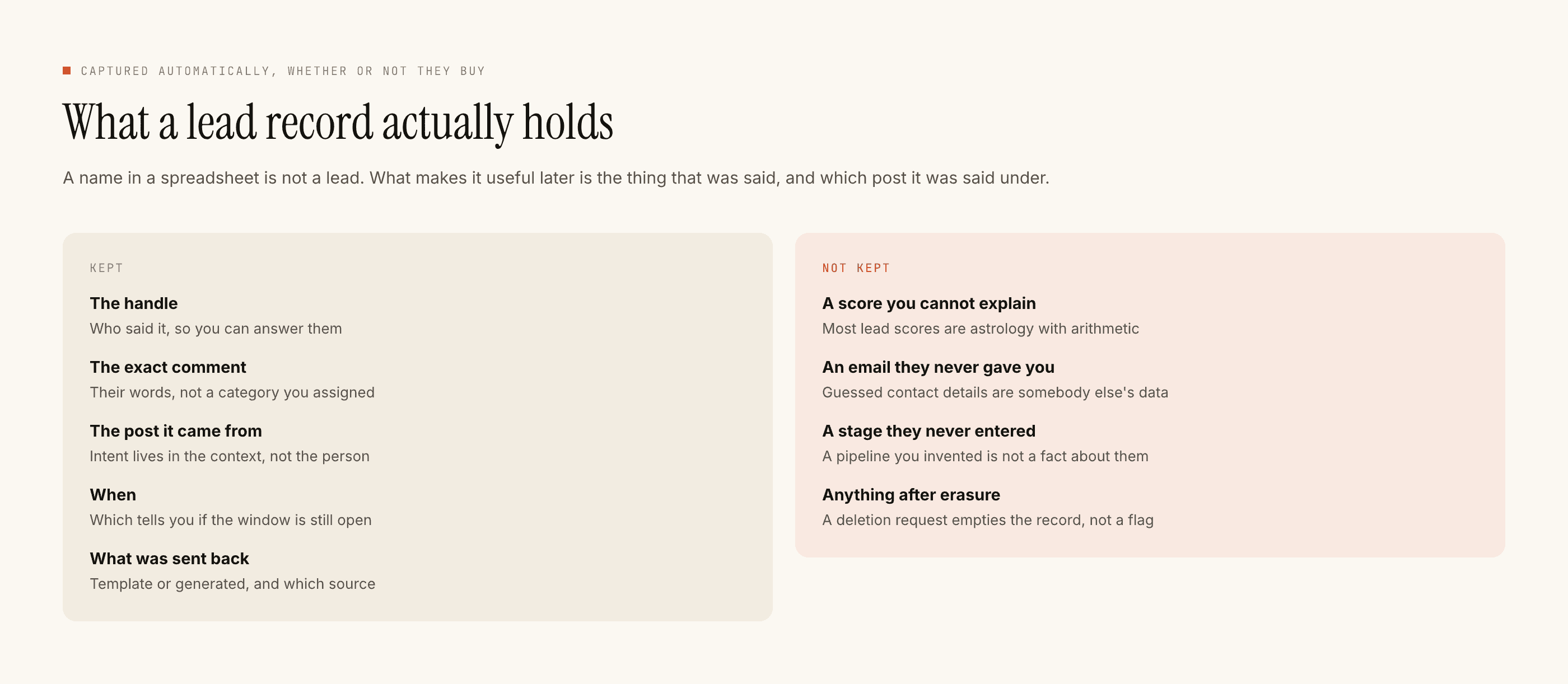
Do not invent one. A template that issues "reference #4471" is manufacturing an identifier that resolves to nothing, and the first time somebody reads it out on the phone your desk will discover that.
Where the confirmation should actually come from
One destination, named, and staffed. Either a booking link that writes to your real diary, or a number that reaches whoever holds it, with the hours somebody answers. Not both — two routes split attention at the exact moment somebody was about to act.
Whichever you choose, the confirmation is emitted by that system or that person. The Instagram reply's job is to get the customer there with everything already collected: what service, first visit or returning, roughly when, and anything that changes the length of the appointment. The desk then makes one call instead of five.
One timing constraint that shapes the wording
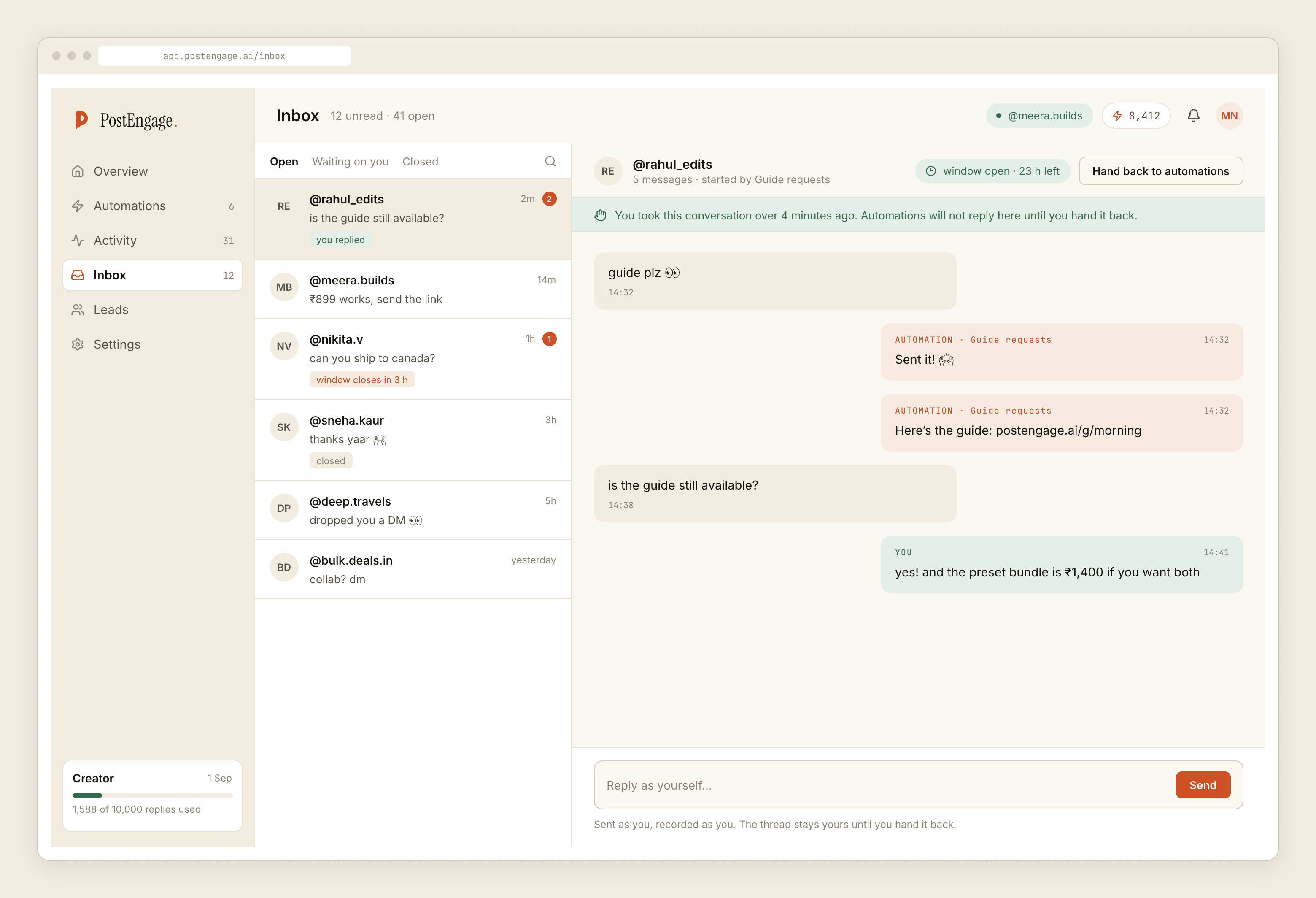
A DM thread stays open to you for twenty-four hours, and that clock restarts only when the customer writes to you. So an acknowledgement must not promise a follow-up message you may not be able to send: "we will message you with times" is a plan that expires overnight and frequently cannot be honoured on Monday morning.
If a human genuinely works the inbox every evening and will reply inside the window, say that and mean it. Otherwise the acknowledgement has to be self-sufficient — everything the customer needs in the message they already have. The separate and even harder case of messaging somebody before an appointment is covered in the reminders post, and the short answer there is that it cannot be done at all.
What this costs and what it will not do
Templated replies are free and unlimited; a credit is spent only when the AI writes a new reply. An acknowledgement is fixed text, so it costs nothing however much traffic a post gets. The free tier is 100 credits with no card and packs start at ₹499.
Takeover matters unusually much here. The moment somebody at the desk replies by hand — often with a real confirmation, because they have looked at the diary — automation stands down in that thread for good, so no template lands underneath a genuine yes.
And the boundaries, in one place: no calendar or booking integration, no slots, no holds, no cancellations, no reminders, no scheduled sends, no deposits or payments, no CRM sync, no WhatsApp, and no messaging anybody who has not messaged you first. Leads leave as a CSV.
If you want the version of this written around an actual appointment business, the salon booking handoff covers designing that first message in detail, and the clinic post covers the same problem where the stakes are higher.