Playbooks · 5 min read
The Analytics Guide for a Product With No Analytics Screen

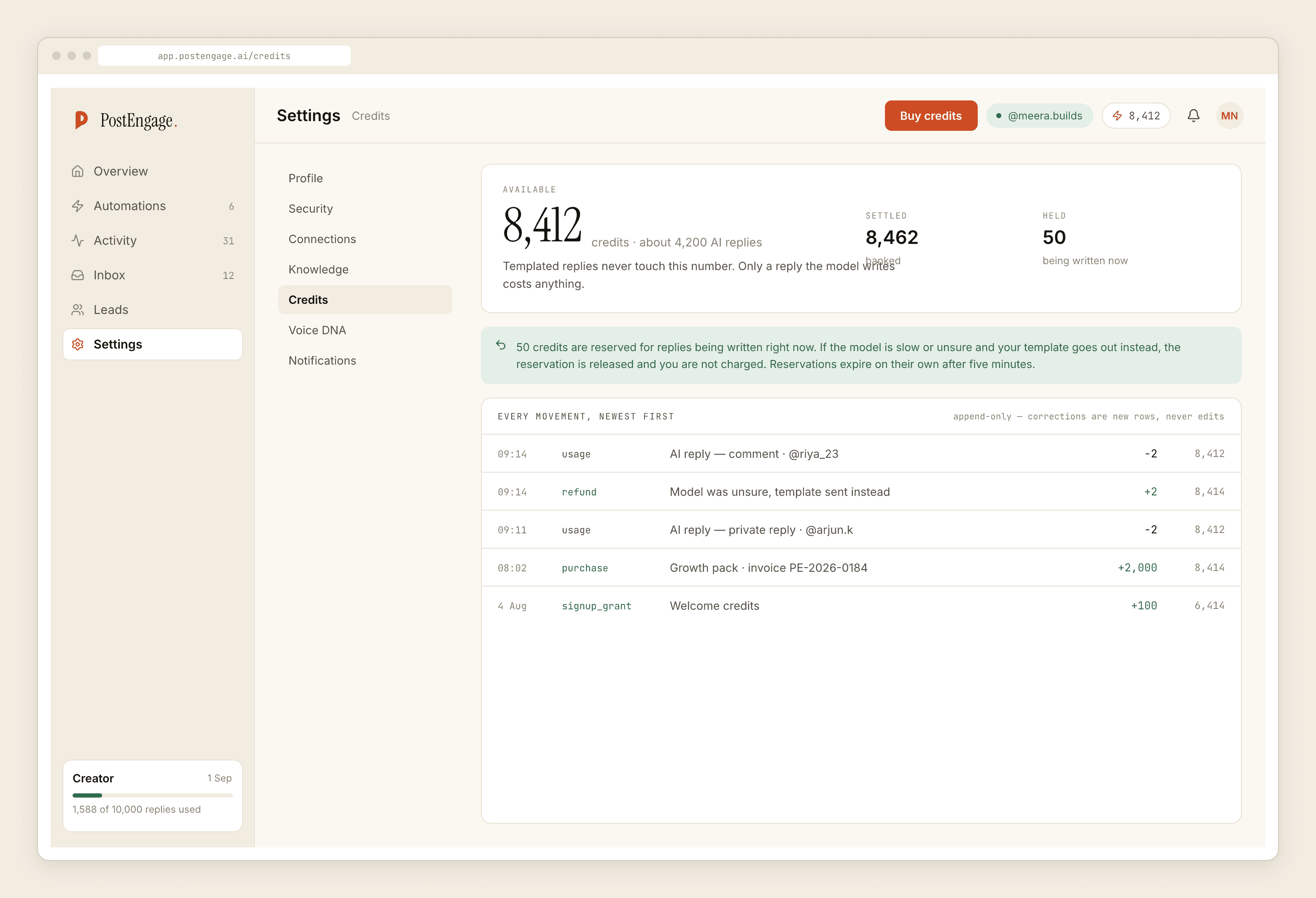
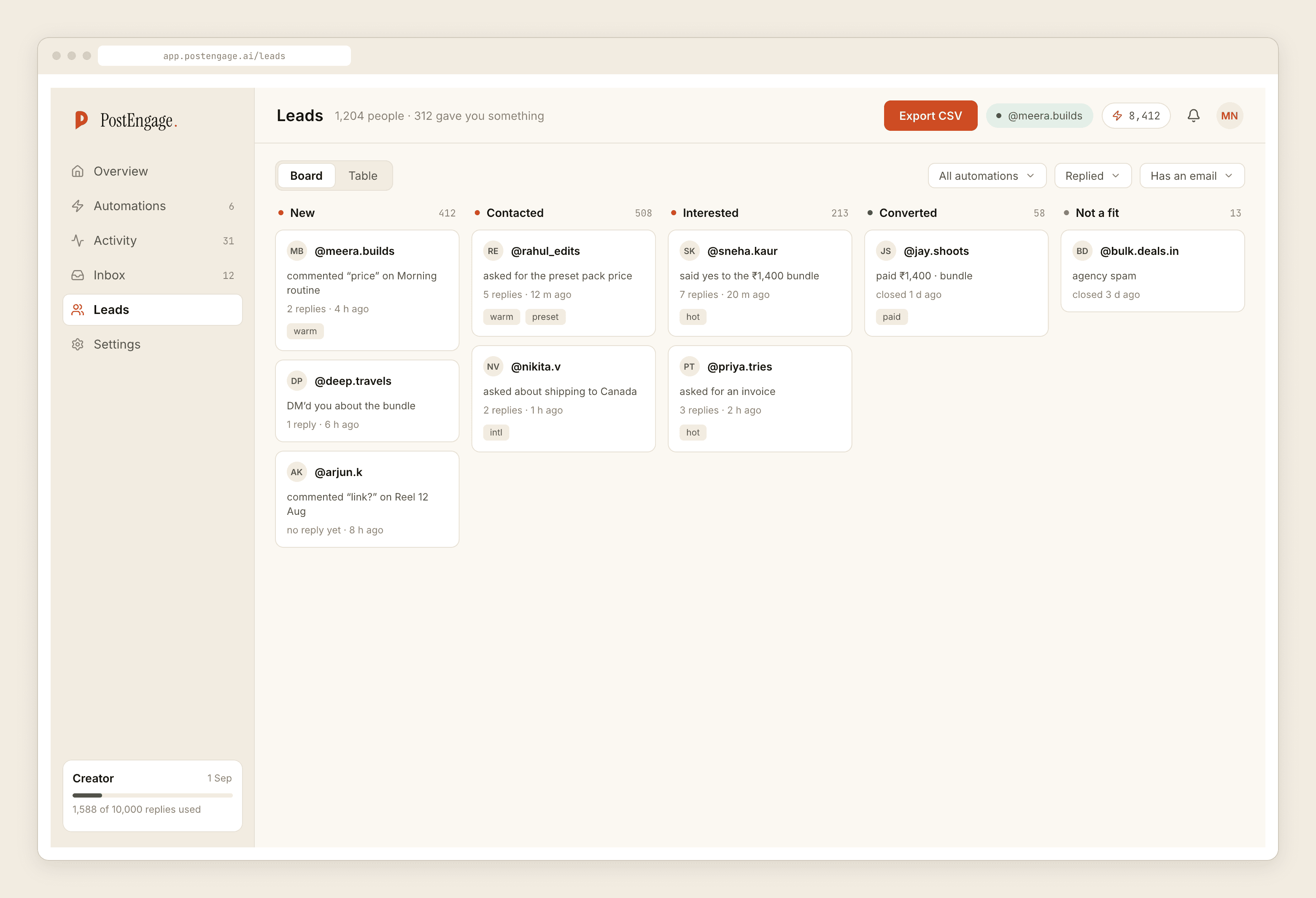
There is no analytics product here. No dashboard, no conversion funnel, no per-template performance chart, no trend lines, no export of a report. Three stores exist and you read them yourself: Activity, Leads, and the credit ledger.
So this is not a guide to a screen. It is a guide to the questions people bring to one, sorted into three piles — the ones that have an exact answer, the ones that have an answer only if you read rather than count, and the ones that have no answer here at all. The third pile is the largest and it is the useful part of the exercise, because knowing a question is unanswerable saves you from believing a number somebody assembled for you.
Pile one: exact answers
These come straight out of the stores and you can put them in front of anybody.
How many replies went out, and to whom. Activity, one row per decision.
How many were refused, and by which check. Ten checks run in fixed order — kill_switch, connection, takeover, window, dedupe, cooldown, quiet_hours, rate_budget, credits, content_safety — and the first one to object is recorded. This is the most interesting number in any report and the one nobody expects.
How many people were captured, what they said, and which post caught them.
What it cost, to the rupee. One credit, one generated reply. Templated replies are free and unlimited and never appear in the ledger, which is why a well-templated account has a very short one. Free tier is 100 credits with no card; packs start at ₹499.
Pile two: answerable, but only by reading
No count produces these. A person has to look at actual text, and this is the pile most teams skip because it does not fit in a slide.
Are the replies any good? Open twenty sent replies on a phone and read them as the recipient. Nothing in the product can tell you this. It can tell you a reply was refused; it cannot tell you a reply that passed all ten checks landed badly.
What is your coverage? Take the last few dozen comments on your own posts and ask how many your keyword list would have caught. This is usually the largest available improvement in an account and there is no screen for it, because the product only knows about the comments it matched. The ones it missed left no trace anywhere.
Which questions repeat? The credit ledger answers this sideways. Every generated reply is a question your templates did not cover. A recurring theme in that ledger is a template waiting to be written.
Is a lead worth interrupting your day for? Read the Leads list looking for sentences that do not sound like everyone else's. A person who typed a paragraph is not the same as a person who typed one word, and no scoring column captures the difference as well as reading it does.
Pile three: not answerable here
Each of these is a question we get asked, and for each one the reason is structural rather than a missing feature.
Conversion rate. Requires a definition of conversion and an event that fires when it happens. There is no conversion event coming back from Instagram and no tracked link going out, so any rate would need a denominator somebody invented.
Revenue attributed to a DM. Requires a join between a person in your inbox and a payment in your bank. Nothing here holds both.
Open rates. Not exposed to an integration on the official API. If a tool shows you one, ask where it came from.
Best time to post, or reach impact. We do not touch publishing at all. No scheduling, no calendar, no post analytics.
Sentiment trends over time. No sentiment history is kept and no chart exists over it.
First response time as a series. There is no timestamped conversation object to build it from, and the definition would have to decide whether a template counts as a response the same way a human sentence does.
A question with no data behind it does not become answerable because a tool draws it as a chart.
The routine that replaces a dashboard
Fifteen minutes, on a fixed day, in this order. It is not sophisticated and it beats most dashboards because you actually look at the underlying rows.
- Connection, then send volume. A quiet Activity screen on a live automation is a fault until proven otherwise. An expired token still shows your account name, so it looks fine at a glance.
- Refusals by reason, not by total. A steady base of
windowrows is normal — comments on posts older than seven days cannot be answered by anyone. A cluster ofquiet_hoursin your working day means the timezone is wrong. - Twenty sent replies, on a phone. The only quality measure available.
- The credit ledger, as a to-do list. Write the missing templates. They are free forever once written.
- The Leads list, for the ones worth a personal reply. Then reply by hand, which stands the automation down on that thread permanently.
If you need it in a spreadsheet
Leads export as a CSV. There is no integration, no push, no sync, and that is the whole export story. Once it is in a spreadsheet you can group by post, by week, by trigger — which is a perfectly good analytics layer and is the one most people should build rather than wait for.
What one row in each of the three stores actually contains, and the joins between them that do not exist, is documented in the deep dive. And when the output has to be a monthly report for somebody else, the honest shape of one is worth copying, particularly the part about labelling an estimate as an estimate.