Compliance · 7 min read
Does Instagram Label AI Posts, and Does It Hurt Your Reach?
You made a product shot with an AI image tool, or a short clip for a reel, and now you are about to post it. Two questions come up right away. Do I have to tell Instagram it is AI? And if I do, will fewer people see it?
Short answers first. You are only required to label one narrow kind of content: photorealistic video and realistic-sounding audio. Instagram may label other things on its own, because it reads markers that many AI tools write into the file. And nobody at Meta has said that a label lowers reach. The details below were read on 19 November 2026, and platform rules change, so check Meta's pages if you are reading this much later.
What does Meta actually require?
The rule comes from Meta's newsroom post on labeling AI content, first published 6 February 2024 and updated 1 April 2025. Here is the sentence that matters, word for word:
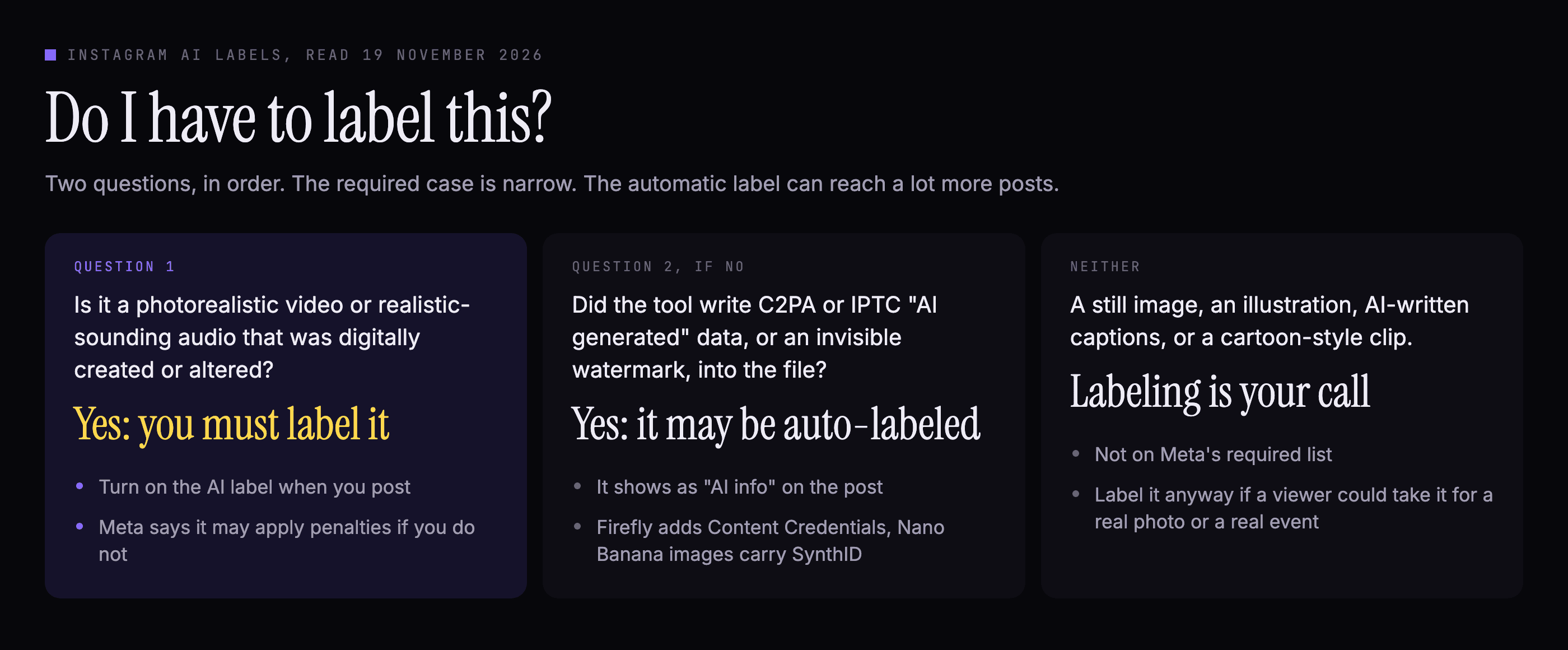
"We'll require people to use this disclosure and label tool when they post organic content with a photorealistic video or realistic-sounding audio that was digitally created or altered, and we may apply penalties if they fail to do so."
Meta newsroom
Read it slowly, because it is narrower than most people assume. It covers video and audio, and only when they look or sound real. A cartoon-style animation is not photorealistic. A voiceover that sounds like a real person speaking is realistic-sounding audio. A still image is not named at all.
"Organic content" means your normal posts and reels. The rule is written for organic posts, and this post does not cover ads. "Digitally created or altered" is broad on purpose. It covers a clip made from scratch by a video model and a real clip where AI swapped a face or changed what someone says.
When does Instagram add the label by itself?
This is the part that surprises people. You can skip the label tool and still end up with "AI info" on your post, because Meta looks for evidence in the file.
Meta says it detects "the 'AI generated' information in the C2PA and IPTC technical standards" and invisible watermarks, and labels the content it detects. In plain terms:
- C2PA is a standard for Content Credentials, a signed record attached to a file that says how it was made. Adobe Firefly adds Content Credentials showing AI was used.
- IPTC is an older metadata standard that photo tools use, and it has a field for "AI generated".
- Invisible watermarks are patterns hidden in the pixels. Google says all images from its Nano Banana 2.1 model include a SynthID watermark.
So a Firefly image may well get labeled automatically, since the credentials are built in. A Nano Banana image carries SynthID, and Meta says it reads invisible watermarks, so that image may be labeled too. Treat it as possible, not certain. If you are still choosing a tool, our guide to AI image generators for Instagram compares them on price and output size.
Is labeling optional for everything else?
Under the written rule, yes. A still image you made with AI, an illustrated carousel, a caption a chatbot helped you write: none of those are on the required list.
Optional does not mean you should never do it. Our rule of thumb: if a reasonable follower could look at the post and believe it shows a real product, a real place, or a real event, label it. A styled flat-lay of a candle that does not exist yet is exactly the kind of image that ends in an awkward DM ("is this what I'll get?"). An obviously illustrated quote card needs no label.
Captions are the easy case. Nobody labels a caption because a tool suggested a better first line, and the rule does not ask you to.
What about AI video and voice in reels?
This is where the requirement actually bites. Many current video models aim for realistic footage, and some add generated sound by default (Seedance 2.5 on fal, for one, has audio switched on unless you turn it off). A realistic clip with a realistic voiceover hits both halves of the rule at once.
If you are making reels this way, treat the label as part of the posting step, like adding a cover. Our breakdown of AI video models for Reels covers what each one costs per second and which aspect ratios they output. Whatever model you use, the label question is the same: does it look real, does it sound real?
Stylized animation is the gray edge. A clearly cartoon clip is not photorealistic, so the requirement does not apply on its face. But if the audio is a realistic human voice, the audio half still does.
What are the penalties?
Meta's wording is "we may apply penalties if they fail to do so." It does not list what those penalties are, how they are applied, or whether a first miss is treated differently from a pattern.
We are not going to guess at specifics Meta has not published. The practical reading is simple: the label costs you one tap, and the downside of skipping it is unknown. That trade is not close.
Does an AI label hurt reach?
This is the question everyone actually wants answered, so here is what we found. We looked for any official statement from Meta, or from Instagram's leadership, saying that posts carrying an AI label are shown to fewer people. We did not find one. What exists is secondary commentary: creators comparing a couple of their own posts, and articles repeating each other.
That does not prove labels have zero effect. It means nobody with access to the ranking system has said they do, and the anecdotes do not control for anything. A labeled reel that flopped might have flopped because of its first two seconds.
What you can control is the rest of the post:
- The first second. A reel lives or dies on whether the opening frame stops the scroll.
- The cover and the first caption line. These decide whether people tap at all.
- Whether the content is useful or interesting. AI or not, a generic image with a generic caption performs like one.
- What happens after people engage. If a post gets comments, answering them quickly keeps the conversation going, which is where a lot of small accounts win or lose.
If you want a longer read on what actually gets accounts in trouble (as opposed to what people fear), see whether Instagram bans accounts for automation. The pattern is the same: the scary rumor is usually not the real risk.
A quick check before you post
Checklist
Where this leaves a small account
The rule is narrower than the panic around it. Label realistic video and audio, accept that some AI images will be labeled for you, and do not build your plan around a reach penalty nobody has confirmed. If honesty with your followers matters to you (it should, since they are the ones buying), label generously.
This post explains Meta's published rules as we read them on 19 November 2026. It is not legal advice.
We are building AI post creation into PostEngage; it is not out yet. Whatever tool you end up using, the labeling step is yours to take.
Questions people ask
Do I have to label AI images on Instagram?
Meta's written rule requires a label for photorealistic video and realistic-sounding audio that was digitally created or altered. Still images are not on that required list. Instagram may still add an "AI info" label to an image on its own if the file carries AI metadata or an invisible watermark it can read.
Does an AI label reduce reach on Instagram?
We could not find any official statement from Meta saying labeled posts get less reach. What exists is commentary from people guessing. If a post underperforms, the usual suspects (a weak first second, a cover that does not stop the scroll, posting at a dead hour) are things you can check and fix.
Why did Instagram label my post AI when I only edited it?
Some editing and generation tools write "AI generated" information into the file using the C2PA or IPTC standards, and Meta reads that data. If you used a generative feature anywhere in the process, the file may carry that marker even if most of the image is your own photo.
What happens if I do not label AI video on Instagram?
Meta's newsroom says it "may apply penalties" if people fail to use the disclosure tool for photorealistic video or realistic-sounding audio. It does not spell out what those penalties are, so the cheap move is to label anything that falls in that category.