Compliance · 6 min read
Will Instagram Ban You for Automating? What Actually Happens

Ask this in any creator group and you get two answers, both useless. "Automation is fine, everyone does it." "My cousin's account got nuked, don't risk it." Both are true stories. Neither tells you what changes your odds.
The mechanism question — official API versus a tool that signs into your account — is settled, and we wrote it up separately in is Instagram DM automation safe. This post starts one step later. You have already picked a compliant tool. The risk left over after that decision is almost entirely risk you bring yourself.
Bans are rare. Restrictions are not.
The word "ban" makes people picture a deleted account. That outcome exists and it is uncommon for a business account with real posts and real followers. What is common is the graded stuff underneath it, and the graded stuff is what actually costs money.
It usually arrives in this order, and the early steps are quiet enough that most people miss them.
- Reduced delivery. Your replies still send. They land in the recipient's message requests rather than the primary inbox, so response rates fall and nothing on your end says why.
- An action block. "Action blocked. Try again later" when you send a DM or leave a comment, by hand or otherwise. Usually a day or two. It comes back faster the second time.
- A feature block. Messaging is disabled while the rest of the account works normally. This is the one that hurts, because comments keep arriving on posts you can no longer answer.
- Restriction of the account itself. Rare. Not rare enough to build a business on top of a coin flip.
What actually trips one
None of the following says "you used a tool". Every one of them describes a pattern that a person doing the same thing by hand would also get restricted for.
Sameness at volume. The same words to many people in a short window is the signature. Not the automation — the sameness. Two hundred replies that vary get treated differently to two hundred that are byte-identical.
Reports. The loudest signal on the platform is other people saying you are a nuisance. One person tapping report on a DM that felt unsolicited carries more weight than a thousand quiet, welcome sends.
Messaging people who never messaged you. Auto-DMing new followers is the closest thing to cold outreach that stays inside the rules, and it collects reports faster than anything else you can legitimately do.
A sudden change in shape. An account that sent five DMs a day for a year and then sends nine hundred on a Tuesday looks like a compromised account, because that is what compromised accounts look like.
Link behaviour. The same shortened link pasted into every message, or a destination other accounts have been reported for, is evaluated separately from your account's own history.
The account's past. Earlier strikes, a recently changed handle, a personal account converted into a shop last month, followers that were bought. These do not cause a restriction on their own. They lower the threshold for everything above.
Instagram does not know your intent. It knows your pattern.
Telling a platform throttle from your own tool refusing
This confuses people for weeks, and the difference is easy once you know where to look. A reply that never appeared has exactly two explanations, and they live in different places.
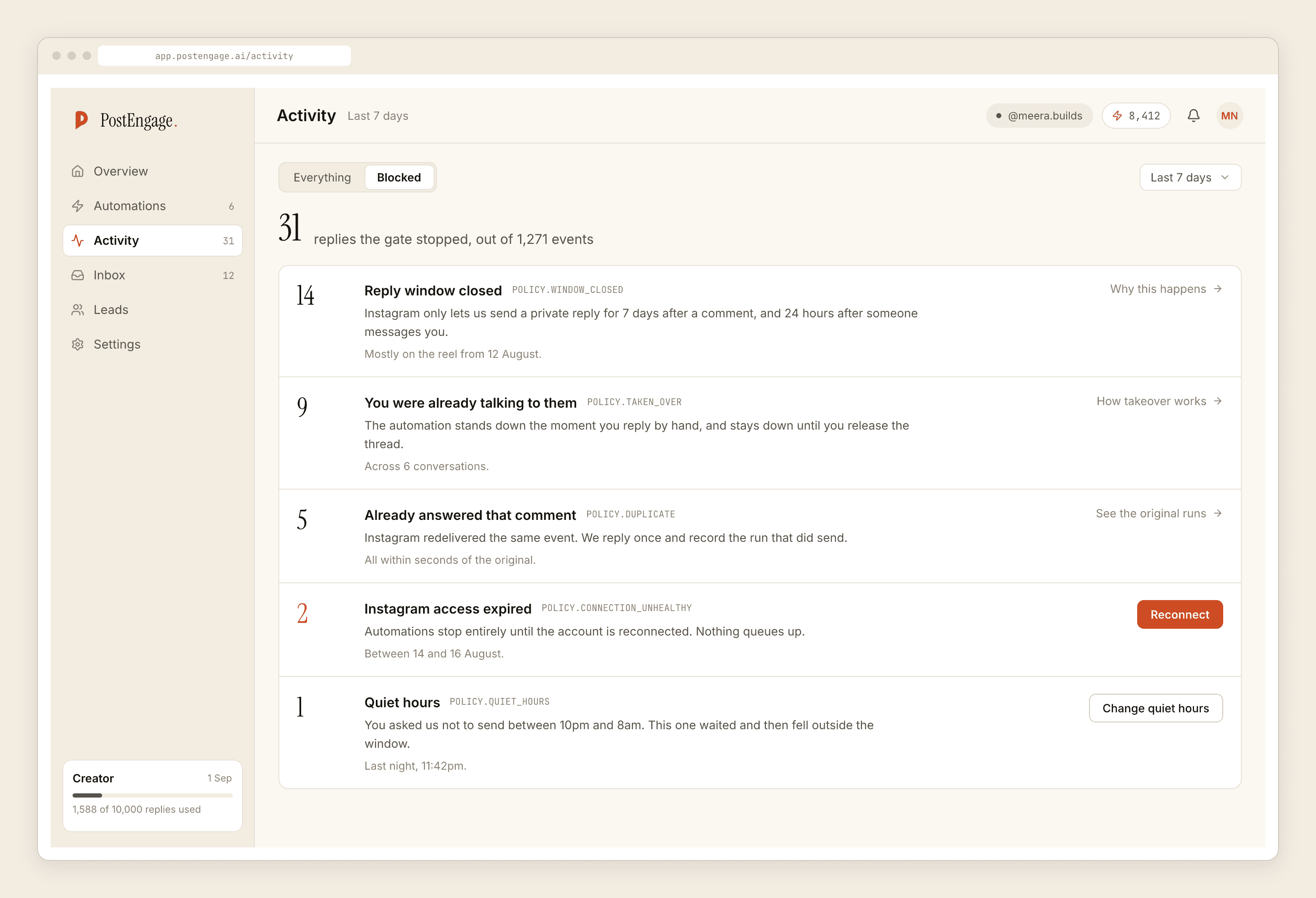
If your tool logged the reply as blocked and named the reason — outside the window, already replied to this person, quiet hours, a human took over — that is your side, behaving. Change a setting or leave it alone, but do not read it as enforcement.
If your tool says the reply was sent and the recipient has nothing, that is delivery. That is the platform, and no setting in any dashboard changes it.
Recovery is mostly waiting, and mostly doing less
There is no button. For most messaging throttles there is no appeal form either — the form you find covers content takedowns, not delivery. What is left is time, and behaviour that shortens it rather than extends it.
- Turn automation off entirely. Not down. Off. A kill switch that takes one click is worth having before the day you need it.
- Stop retrying. Repeatedly hitting send during an action block is read as exactly what it looks like. It lengthens the block.
- Keep the account otherwise normal. Post, reply by hand, answer stories. An account that goes silent the moment its automation stops looks like an account that was only ever automation.
- Wait out a full cycle before turning anything back on. A day or two past the point where manual sends work again, not the same afternoon.
- Come back at a fraction of the volume. Narrower keyword, one post, quiet hours on, hourly cap low. Then widen over a fortnight.
Weeks, not hours. The instinct to fix it by doing something is the instinct that keeps the block alive.
The behaviours that are yours, not your tool's
These are the ones we see cause trouble on completely compliant setups.
- The giveaway that begs for comments, followed by a DM with a link in it. Hundreds of people who commented for a prize get a sales message. That gap between what was promised and what arrived is where reports come from.
- Follow-ups to people who did not answer the first message. One unanswered message is a non-answer. Three is a complaint waiting to be filed.
- The identical public reply under every comment. Your DMs may be lovely. Your comment section reads like a bot to everyone scrolling past, and that is the part strangers judge.
- Running several accounts off one setup with the same message. Cross-posted identical DMs from linked accounts is a pattern, and patterns are the whole game.
- Automating to an audience you bought. Engagement collapses against follower count and the automation looks like the cause.
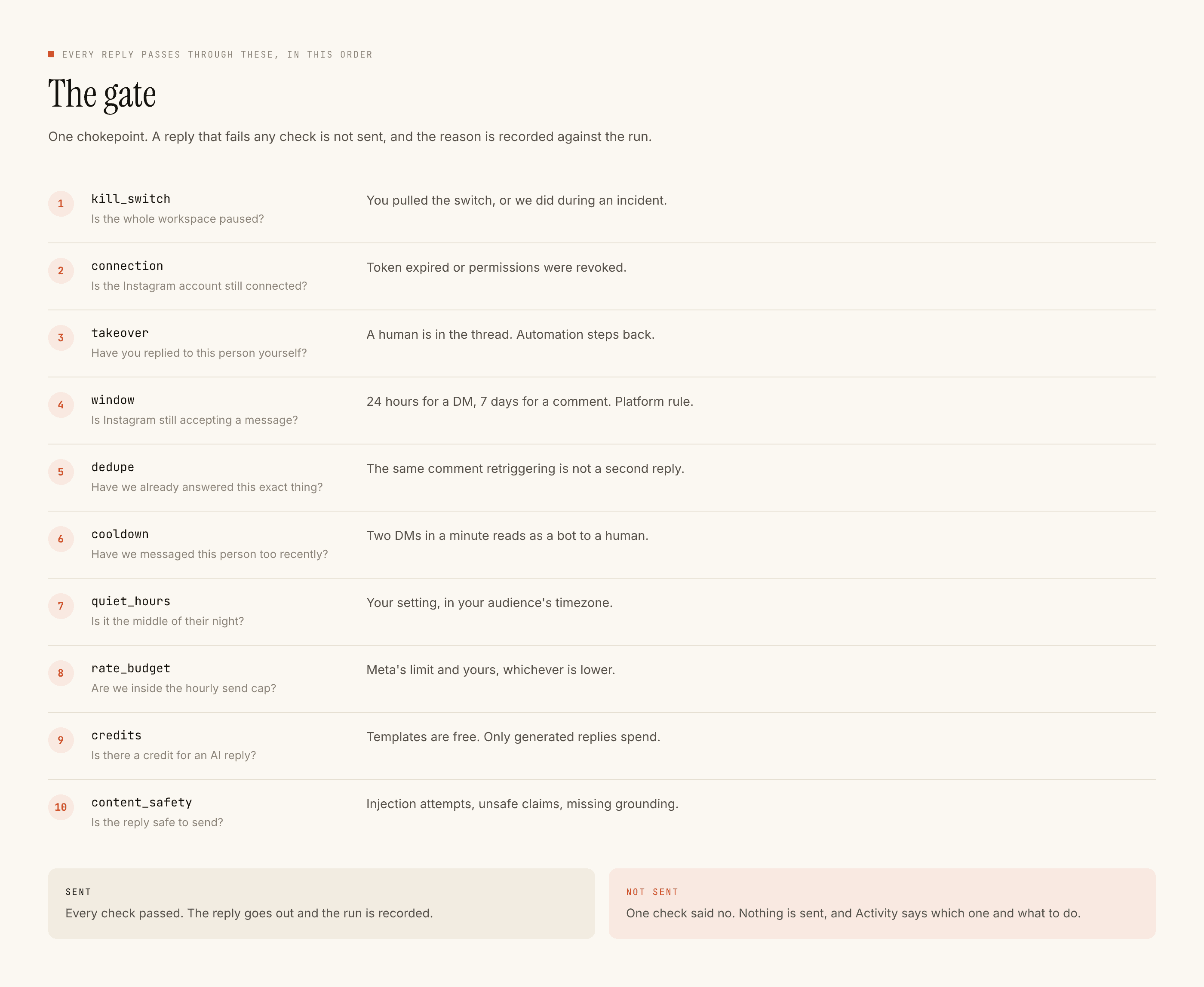
The test to run before you turn anything on
Read the reply you are about to send. Now imagine you are the tenth person that hour to receive it, that you were not expecting it, and that you are slightly annoyed already. Would you tap report?
If the honest answer is maybe, the settings will not save you. Change the message.
If you are still choosing a tool, the fifteen-minute vendor audit covers what to check before you connect an account. If you have already picked one and want the narrow, safe first automation, the three-minute setup is deliberately built to be too small to cause any of this.