
Start with the constraint, because it decides everything else: on the official Instagram API you cannot message someone who has not messaged you. There is no tier, no application, no clever configuration that adds it. Every DM in your inbox is one a person decided to send.
That makes "get more DMs" a content problem rather than a software problem, and it is worth saying plainly before a post about automation goes any further. What automation does is make the DMs you already get worth having, and stop the ones you earn from going unanswered. It does not manufacture them.
Nothing here creates demand. It removes the reasons a person who nearly messaged you did not.
Ask for the thing you actually want
The single largest change most accounts can make is to stop implying and start asking. "Link in bio" asks somebody to leave the app, find your profile, tap through, and land on a page. "Comment GUIDE and I'll send it" asks for one word.
The gap between those two is not persuasion, it is friction, and friction is the thing you can actually move.
- Name a specific word.
GUIDE,PRICE,LINK. A word, not a phrase, because the phrase gets typed four different ways. - Say what arrives. "and I'll send the list" is a promise a reader can evaluate. "DM me" is not.
- Put it where it is read. The caption's first line and, for a Reel, on screen — a lot of people watch with sound off.
- Repeat it. One post asking is a test. The word only becomes a habit if it appears more than once.
Understand which surface you are asking on
A comment and a story reply behave differently, and asking for the wrong one wastes the ask.
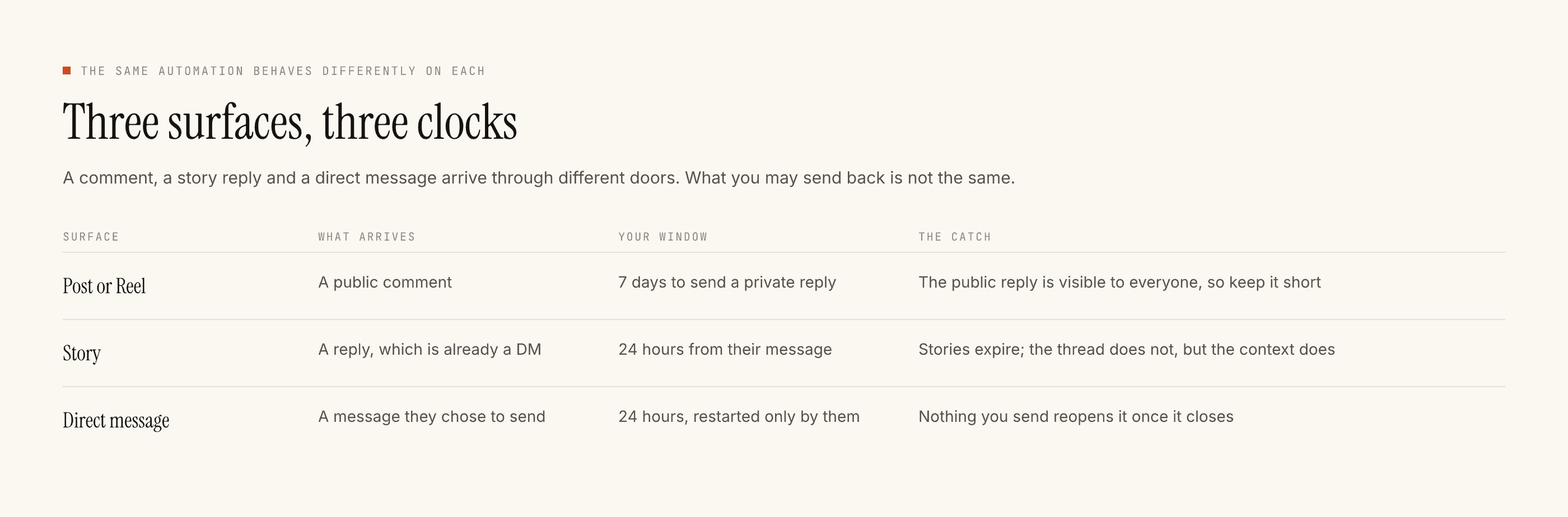
A comment on a post or Reel is public, which is why it compounds — other people see forty comments and read the post as worth engaging with. A story reply is private and arrives already in your inbox, which makes it lower friction and completely invisible to everybody else.
Use the first when you want the volume and the social proof. Use the second when you want a conversation without an audience, which is most service businesses.
Make the public reply do a job
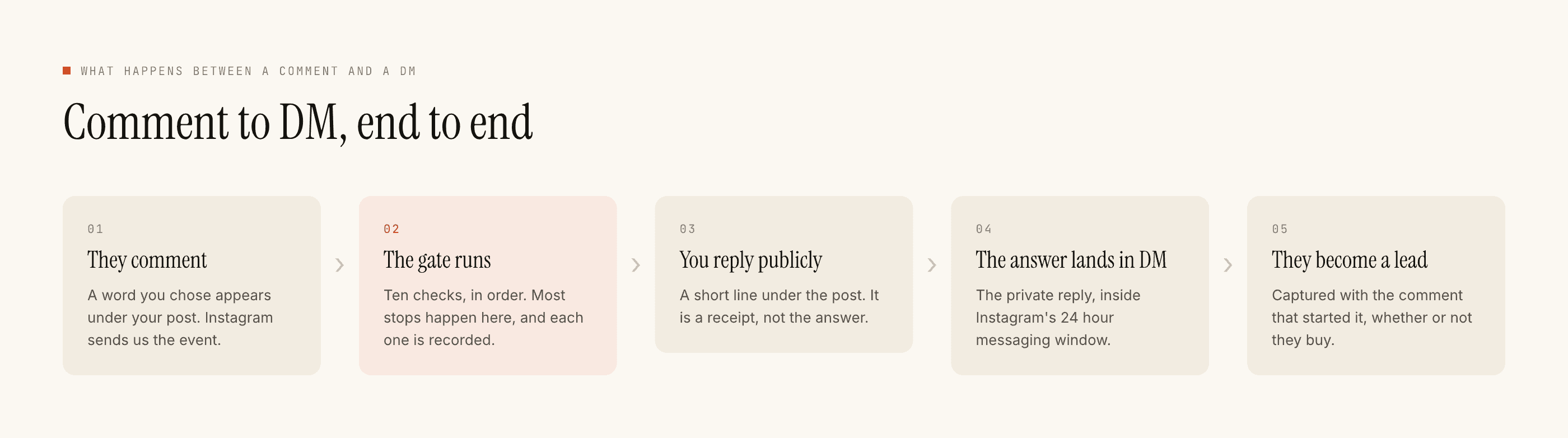
When somebody comments, the reply everyone sees is not the answer. It is a receipt, and it has two audiences.
The person who commented needs to know something arrived. Everyone else reading the comments needs to see that commenting produces a response. "Sent it" does both in two words, and it is far more effective at producing the next comment than a paragraph would be.
Answer fast enough to matter
Speed is not a vanity metric here, it is a hard mechanic. You may reply to a direct message for twenty-four hours after their last message, and only another message from them restarts that clock. Somebody who wrote at 11pm and got nothing by the next evening is not a slow reply, they are an expired one.
This is where automation earns its place. The four questions that repeat get answered immediately, in your words, at 2am, and the rest of the inbox is small enough that you can reach it before the clock does.
The things that quietly stop people
Worth auditing, because each is invisible until you look for it.
Reduces DMs
Increases them
The first item on the left is the one people underestimate. A comment section where the last four questions went unanswered tells every future reader exactly what to expect.
Capture them, because the conversation ends
Whoever writes to you is worth keeping even when nothing comes of it that day. Leads capture automatically with the comment that started them and the post it came from, which is the part that makes them useful later — the intent lives in the context, not in the name.
They export as CSV. There is no CRM sync and no one-click integration here, so the handoff to whatever you use is manual and honest about being manual.
What none of this does
It does not grow your following. There is no follow-for-follow, no engagement pods, no discovery feature, and the approaches that promise those things generally work by signing into your account, which breaks Meta's terms and puts the account at risk.
More DMs come from asking clearly, on content people already see, and from having a visible record of answering. That is the whole mechanism.
If you want the setup, the guide walks through it. If your inbox is already fuller than you can face, start with triage instead.