Lead generation · 4 min read
Keeping Leads Warm When You Cannot Send Them Anything

Nurturing, everywhere else, means touching the same person several times over several weeks until they are ready. Every tool in the category is built around that assumption, and the assumption does not hold here.
You cannot start a conversation on Instagram. Not with a lead who went quiet, not with somebody who messaged you in March, not on a higher plan. The messaging window reopens when they write to you and by no other means, so the sending half of nurturing has no mechanism behind it.
To be complete about what that rules out on our side: no drip, no broadcast, no re-engagement campaign, no retargeting, no scheduled follow-up, no win-back send. None of it exists and none of it is on its way.
So what is actually still happening to a cold lead
Something, and it is worth naming precisely, because most people write these contacts off entirely.
A lead who stopped replying in March is, in most cases, still following you. They still see posts. They still scroll past a Reel occasionally. The touch you wanted is happening — several times a week, for free — it simply is not addressed to them personally.
That is the whole reframe. When you cannot send to an individual, your nurture sequence is your posting schedule. It goes to everybody at once, it has no personalisation, and it is the only recurring contact you have with a person who is not currently in an open window.
You have no send button. You have a feed, and the person decides which post is the one they answer.
Which makes re-entry the thing to design
If the only way back into a conversation is them writing to you, then the design question stops being "what do I send on day four" and becomes "what would make somebody who went quiet type something again".
Three things do it, and none of them are settings.
- A post that asks a specific question rather than announcing. "New stock" is an announcement and nobody answers announcements. "Blue is back in M and L — comment SIZE if you want it held" is a door, and a cold lead walks through doors more readily than they reply to messages.
- A reason that is new. Somebody who did not buy in March did not buy for a reason. A restock, a price change, a delivery area, a date — something that was not true last time is the only honest reason to expect a different answer.
- A comment section that looks answered. Somebody deciding whether to re-engage reads the last few replies first. The comment section is a public document and a cold lead reads it more carefully than a new one.
The part that is genuinely automated
When they do come back, the automation treats it as a new event and answers it. It does not know this person went quiet in March, there is no stage machine tracking them, and there is nothing to configure about it. That is fine. From their side the experience is that they asked and got an answer, which is the only thing they were checking.
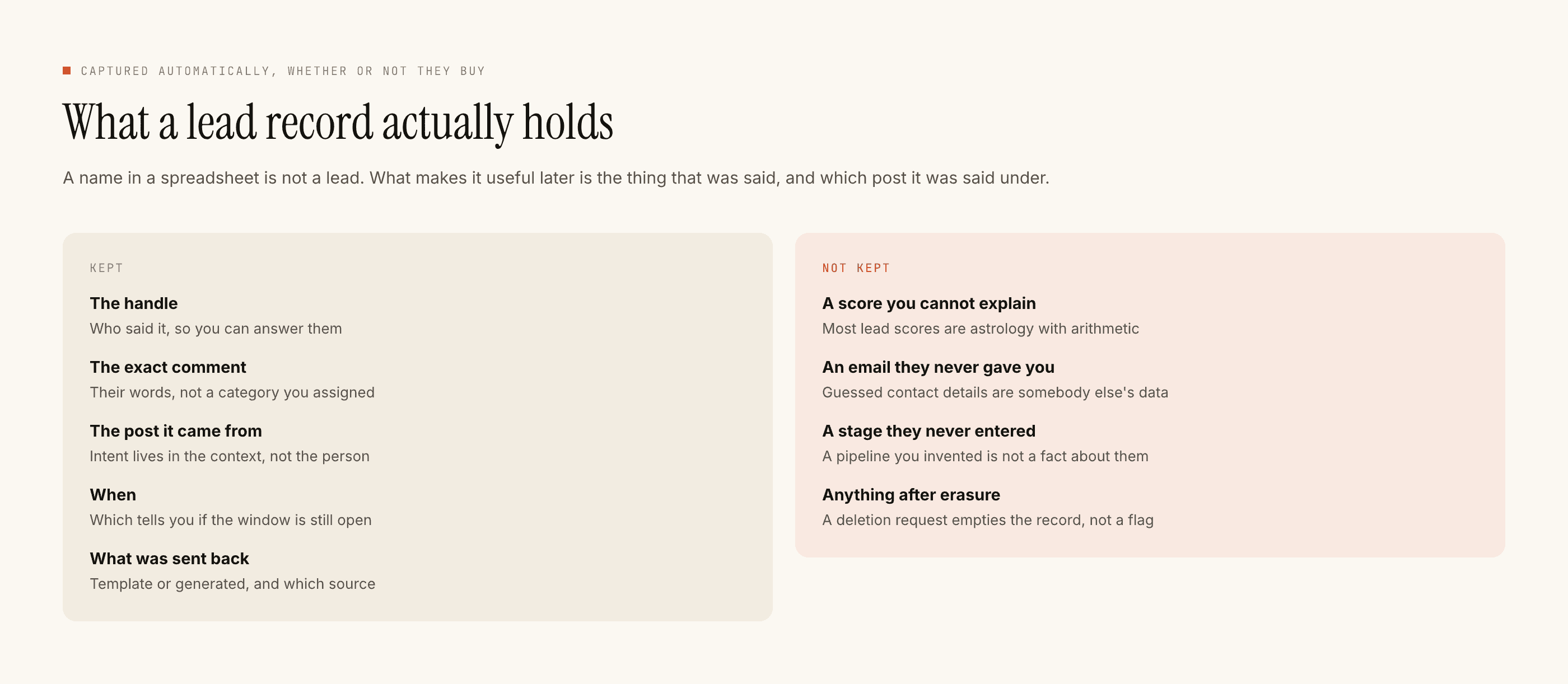
The record is what survives between conversations, and it is more useful than it looks: it means the second conversation can start from what the first one established rather than from nothing. What nurturing becomes when it is a record rather than a send goes into that properly.
If you genuinely need to initiate, change channel while the window is open
This is the honest answer for anybody whose sales cycle actually requires follow-up.
The moment to collect an email address or a phone number is during the conversation, when they are engaged and the window is open — not later, because later does not exist. Ask after you have answered their question, never before it. Then the follow-up happens in a channel where sending is permitted, and this product's role is to hand you the list rather than to work it.
Why the address is worth having at all covers the ownership argument, and the mechanics of capture are in the email post. Leads leave as a CSV. There is no sync, no Zapier, no webhook, no CRM integration — the file is the whole handoff.
What to stop doing
Stop building a lead list you intend to message later, because you will not be able to. A list of handles with no address and no open window is a research artefact, not a pipeline.
Sort it instead. The leads worth anything are the ones who typed something specific — a size, a city, a date, a budget. Those you can act on by hand, one at a time, the way a person would. The rest are a count.
And keep posting, because in this channel that is what nurturing is.