Playbooks · 5 min read
Fitness Studio DMs: The Timetable Is Not a Booking System
On this page

A studio is not a coach. The coaching inbox is its own thing — personal, often heavy, and that post owns it.
A studio inbox is operational. Somebody wants to know when the 7am spin class is, whether there is space in it, what a month costs, whether they can freeze their membership while they are travelling, and whether the Sunday yoga is on this week. Four of those five sound identical and they have four completely different answers about what a machine is allowed to say.
The timetable is the most template-shaped thing in this blog, and it will still betray you
Class schedules are exactly what automation is for. Fixed, repetitive, asked constantly, and asked most often at nine at night when the desk has gone home.
The problem is that a timetable is fixed until it is not. An instructor leaves. The Tuesday evening class moves by half an hour. A studio closes for a festival week. Somebody covers the Saturday class for a month. Every one of those changes makes a template wrong, and a wrong template does not announce itself — it keeps sending, confidently, for as long as nobody notices.
The rule that survives is to automate the shape of the week and not the grid.
Ages badly
Survives a rota change
The right-hand version is less impressive and stays true. It also gives you one place to maintain rather than four, which is the actual reason schedules go stale.
Capacity is the studio version of the diary problem
"Is there space in the 7am tomorrow?"
There is no calendar integration, no class booking system connection, no attendance feed. The automation cannot see how many people are signed up for anything. A salon automation cannot see the diary; a studio automation cannot see the roster, and a class that seats fourteen fills in a way a salon chair does not.
So it should never say there is space, and it should never say a class is full either. Both are guesses and the second one costs you an attendance.
What it can do is remove every step before the check: confirm the class exists, say what it is, say what to bring, say whether first-timers should arrive early, and hand over the one place that does know — your booking app, or the number that reaches the desk, with the hours somebody answers.
Memberships are a contract, which changes what a template may say
Published pricing is safe. If the monthly and quarterly rates are already on your website and your board, sending the same numbers in a DM adds no risk at all.
Everything around the pricing is where it goes wrong, because those are contract questions dressed as pricing questions.
Freezing while travelling. Transferring a membership to a friend. What happens to the unused months if somebody moves cities. Prorating a mid-month join. Refunds. Whether the joining fee applies to a returning member. Whether last quarter's offer still stands for somebody who saw the old post.
Each of those depends on the specific agreement that specific member signed, and a generated reply will produce a plausible, generous, wrong answer. Worse, the member now has it in writing from your account.
A template that answers a freeze question has just amended somebody's contract, in a chat window, on behalf of a business that never agreed to it.
Negative-keyword the lot: freeze, hold, pause, transfer, refund, cancel, cancellation, prorate, shift, notice period, renewal, offer, discount. These reach a human. There is no version of this where the volume justifies the exposure.
The same applies to anything mentioning an injury, a condition, or a medication. That is the coaching post's territory and the rule is identical: it never gets an automated answer, however much it looks like a question about a class.
The trial class is the automation actually worth building
One flow, on your most-commented class reel. Public reply of five words. Private reply carrying the four things a first-timer needs and cannot find: what the class actually involves for somebody who has never done it, what to bring, how early to arrive, and where to book. Capture on.
That is the whole thing. It converts curiosity into a booking attempt at the moment the curiosity exists, which for a studio is usually late on a Sunday.
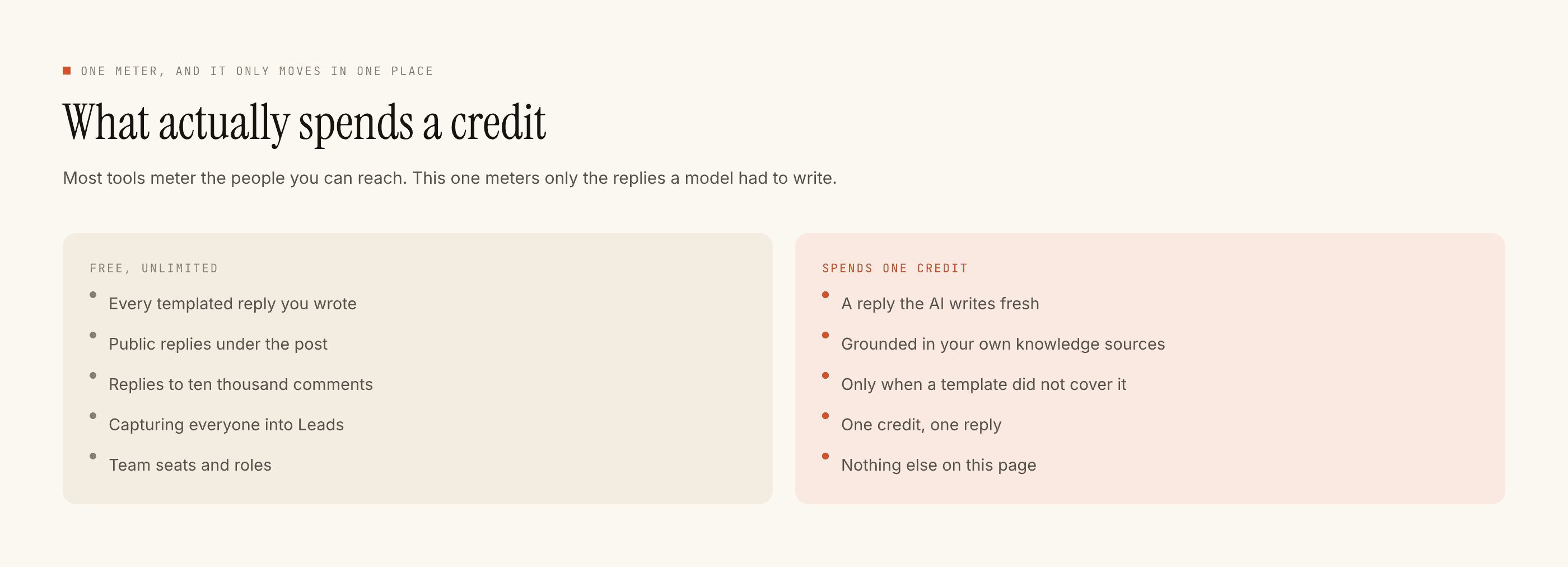
Templated replies are free and unlimited; a credit is spent only when the AI writes a new reply. Free tier is 100 credits with no card, packs from ₹499. A single-location studio running six good templates may not need a pack at all.
The edges, stated plainly
No calendar or class-booking integration. Nothing books, holds, cancels or checks capacity. No payments, no membership management, no attendance data, no CRM sync, no WhatsApp. No reminders and no scheduled sends of any kind, so an automation cannot nudge somebody about tomorrow's class — the message has to carry everything on the day it goes out.
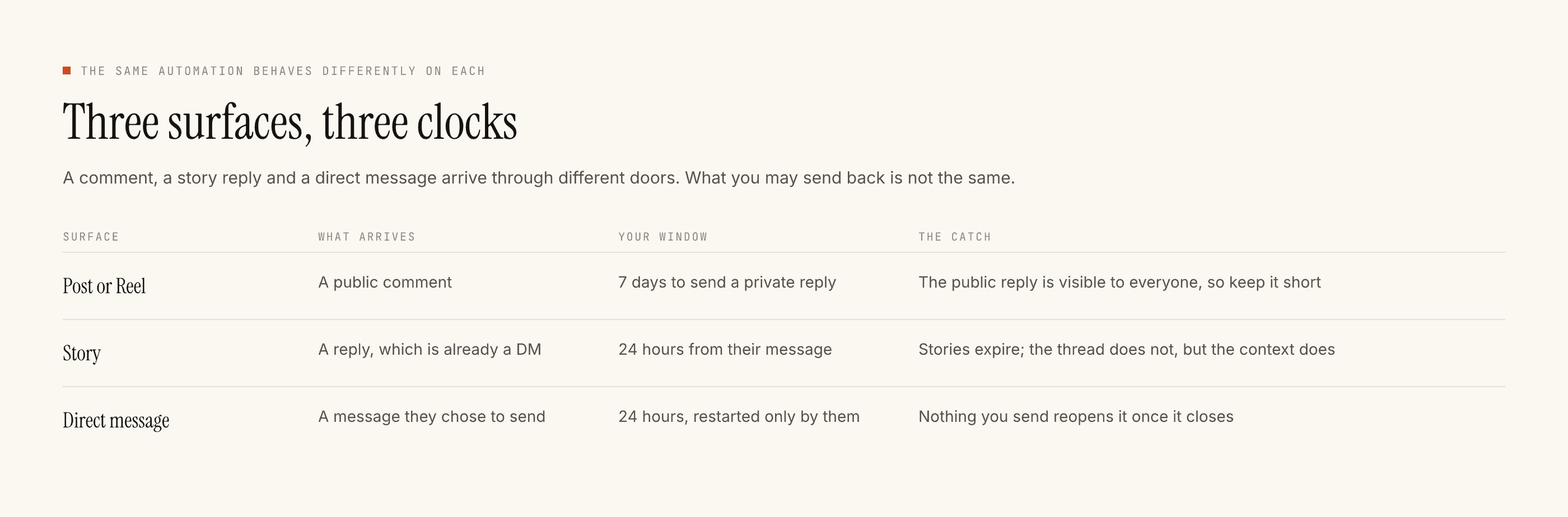
Takeover stands the automation down the moment anyone at the desk replies by hand. Comments stay answerable for seven days and DM threads for twenty-four hours, restarted only when the member writes again. Leads export as a CSV that the desk works like a callback list.
Start with the trial-class flow, add the timetable shape, then the contract refusals. If members leaving is the problem rather than members arriving, the churn post is closer to it, and since most of your traffic will come through stories, story reply automation is worth reading before you build.