Comparison · 5 min read
Instagram Automation vs Hiring a VA: What Each One Is Good At
This gets framed as a cost comparison and it is not one. A virtual assistant and an automation are not two ways to do the same job. They are good at opposite halves of the same inbox, and picking the wrong half for either is where the money goes.
We sell the automation. That should colour how you read the next thousand words. It also means we have watched a lot of accounts try to automate the part a person should have handled.
They fail in opposite directions
An automation fails predictably. Given the same comment twice it does the same thing twice, at 3am, at scale, whether or not that thing was right. When it is wrong it is wrong nine hundred times.
A person fails unpredictably. They are excellent on Tuesday, slower on Friday, and on holiday in December. They notice that a comment is actually a complaint dressed as a question. They also mistype the shipping charge occasionally, and they do not exist between 11pm and 8am.
A VA is good at
An automation is good at
Almost every account we see has both kinds of message. The mistake is not choosing wrong. It is choosing one for everything.
The real cost of a VA is not the salary
Rates vary enormously by market, hours and experience, so we will not pretend to quote a figure that fits your situation. What is more consistent is the shape of the total.
| What you pay for | Notes |
|---|---|
| Hours | The visible number, and the smallest surprise on this list |
| Training | The first two to four weeks are you writing down things you never wrote down before |
| Review | Somebody reads a sample of replies, forever, not just in month one |
| Coverage gaps | Nights, weekends, leave, notice periods |
| Handover | Every time the person changes, you pay the training cost again |
Training is the underrated line. Explaining what your voice sounds like, what the shipping policy actually is, and when to escalate takes real hours out of the person who is already too busy, which was the reason for hiring in the first place.
The upside is that this buys something an automation cannot: someone who improves. A good VA in month six knows things about your customers that no configuration screen has a field for.
The real cost of automation is not the subscription
It is the setup, and it is smaller than training a person but it is not zero.
You still have to write the answers. You still have to decide what happens at midnight, what happens when someone comments twice, and what happens when a post travels. The difference is you write it down once and it holds. A person needs the same instruction repeated occasionally. A ruleset does not.
The other cost is the tail. Whatever share of messages needs judgement, an automation will not supply it, and set loose on those anyway it produces replies that are technically responsive and obviously wrong. That share never reaches zero.
Automation buys you time. It does not buy you judgement, and pretending otherwise is how accounts embarrass themselves at scale.
The split that actually works
Sort your inbox by whether the correct reply is knowable in advance.
- 01
Read two weeks of messages and bucket them
Group by what was being asked, not by who asked. Most accounts find four or five buckets covering the large majority: price, shipping, availability, the link, booking.
- 02
Automate the buckets
These are answers you have already written a hundred times. Templated replies with us are unlimited and free, so this half costs nothing to run.
- 03
Route the rest to a person
Anything outside the buckets. Complaints, negotiations, anything with a name and a history attached.
- 04
Make the handoff automatic
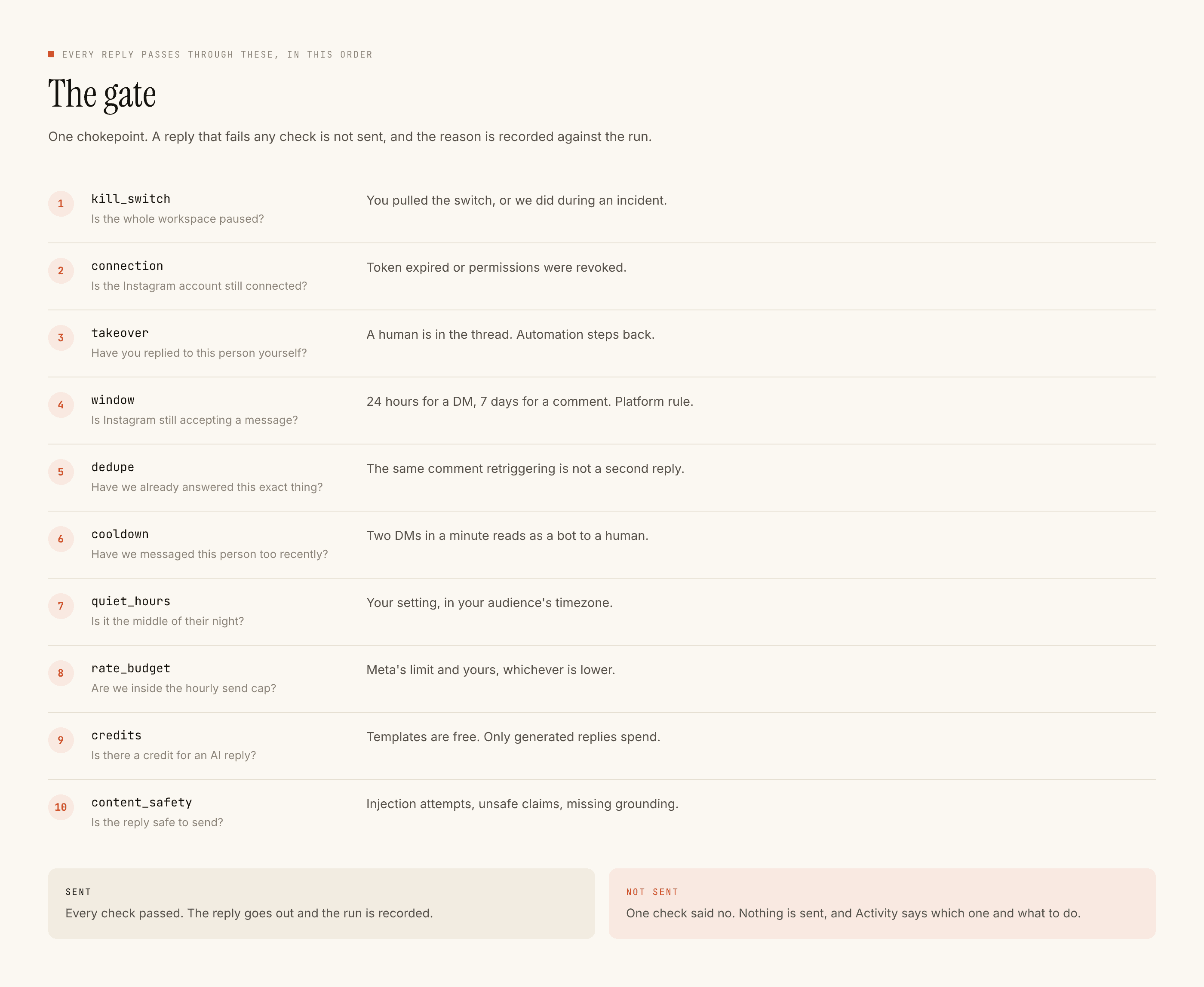
The moment a human replies in a thread, the automation should stop touching it. Ours checks takeover before anything else that involves the conversation, and once a person is in, the bot is out.
- 05
Re-bucket every quarter
New product, new questions. The bucket list is not a one-time exercise.
Done this way, the VA hours go down without the VA going away, and the hours that remain are spent on the messages where a person is worth paying for.
Voice is where the comparison gets interesting
The usual argument for a person is that a person sounds human. That is true of a good VA on a good day and less true than people think in general. A new assistant working from a bullet-point brief sounds like a new assistant working from a bullet-point brief.
Our approach to the same problem is to build a voice profile from replies you wrote yourself, then draft against it. When the model produces something that is not grounded in your own words, or is unsure, or is slow, your own template goes instead of the draft. The floor is a sentence you actually wrote.
That is not better than a person who knows your business. It is more consistent than a person who does not yet, and it is available at 2am.
Practical notes on running both
Give the person the kill switch. Whoever is watching the inbox should be able to stop the automation in one click without asking anyone. Ours checks that first, before anything else, for exactly this reason.
And measure the right thing. Not replies sent. Read twenty replies the automation produced and ask whether you would have sent them. If yes, widen the buckets. If no, shrink them. That question is the whole management loop.
If you are weighing the reply quality side of this, AI versus manual DMs goes deeper on where generated replies hold up and where they do not. If you are still choosing a tool, the best tools survey covers the field.