Playbooks · 5 min read
Running a Creator Inbox Alone: Two Automations, One Pass

The awkward fact about a micro-influencer business is that the inbox does not care what you are doing.
Tuesday you are shooting. Wednesday you are editing until 2am. Thursday you have a client call and a shoot that overruns. The DMs arrive across all three days at the same rate, and every one of them decays — a brand that gets no answer for four days has already briefed somebody else, and a follower asking where the jacket is from has stopped caring by Friday.
What is actually in that inbox and what deserves your own words is a separate post and it is the one to read first. This is the operations question that comes after it: what runs while you are not there, and what you do on the one day a week you look properly.
Build two automations. Resist building eight.
The instinct after a good week is to build an automation for every pattern you notice. Do not. Every automation is a thing that can be wrong on a day you are not watching, and one person cannot maintain eight of anything.
The brand reply. Fires on the posts a brand is likely to find you through — your pinned work, your portfolio reel, your collab posts. It sends what you make, roughly what it costs, what you need in order to quote properly, and what you do not do.
The audience reply. Fires on content posts where you asked people to comment a word. Where the link is, which shade, kaunsa brand hai, which gym. The answer is stable and you have typed it two hundred times.
That is the whole system. Two automations, each scoped under Advanced to specific posts so that neither one wanders onto content it was not written for.
One person can maintain two automations honestly. Nobody maintains eight, they just stop reading what the other six are sending.
The rate template has a review date, and that is the actual work
Writing the rate reply once is the advice everybody gives. Nobody mentions the part that bites: your rates change, your deliverables change, the list of things you do not do gets longer every time you regret something, and the template does not know about any of it.
So it needs a date on it, in your own calendar, and a rule for the day you raise your rates: change the template before you tell anybody. Not after. The gap between announcing a new rate and updating the automation is exactly the window in which a brand receives your old number in writing and holds you to it.
- Put the shape in the template, not the whole contract. What you make, the starting figure, what you need from them, what you will not do. Four lines, in the register you actually type in.
- Give the detail a link. Anything long or likely to change — usage rights, turnaround, the full menu — goes on a page you can edit in thirty seconds. The template points at it.
- Set a review date the day you write it. Twice a year, minimum. Immediately after any rate change.
- Reread it as a brand would, once. Writing a template feels like writing a document, so people go formal, and a brand gets a bank letter from a creator whose entire appeal is that she does not sound like a bank.
The two settings that matter when you are one person
Quiet hours. You are in one timezone and brands are not. Without quiet hours, an automated reply goes out at 4am, and a brand that gets an instant 4am response either thinks you are a bot or thinks you never sleep. Neither helps you negotiate.
First-time senders only. Restricts the automation to people who have not messaged you before. It is the cleanest way to keep templates away from the brands you are already mid-conversation with, and away from friends.
And the negative keyword list, which on a creator account has a job that is easy to get backwards. It is not only there to block bad messages. It is there to protect the good ones — your own name, the phrase you say at the end of every reel, the title of a specific post. A brand that names your actual work should reach you, not a rate card.
The weekly pass
Twenty minutes, on a fixed day, and it is the only maintenance this system needs.
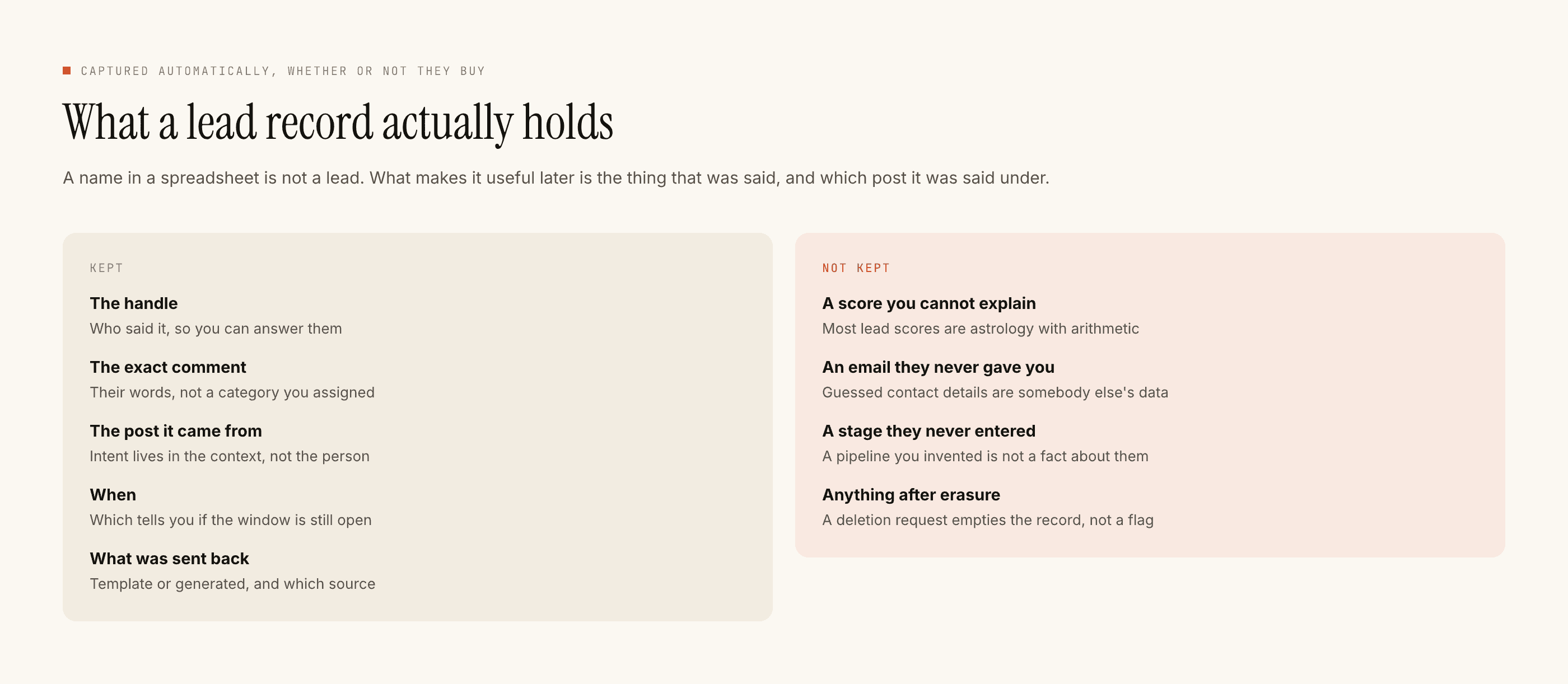
Open Activity and read the replies that were not sent, each with the reason: takeover, window, dedupe, cooldown, quiet hours, rate budget, credits, content safety. You are looking for two things — a trigger that is firing too widely, and blocked replies piling up because the connection went stale while you were travelling. Nothing pages you when that happens.
Then open Leads, export the CSV, and put the real enquiries wherever you track work. There is no CRM sync, no calendar, no invoicing.
What makes it safe to leave running
Takeover. The moment you reply by hand in a thread, the automation stands down in it permanently — no cheerful follow-up landing under your considered answer, no second message contradicting the number you just gave.
That is why you can leave it on during a shoot. It is not a commitment to a bot conversation. It is a first line that holds until you get to your phone, and every conversation you actually care about you will get to first.
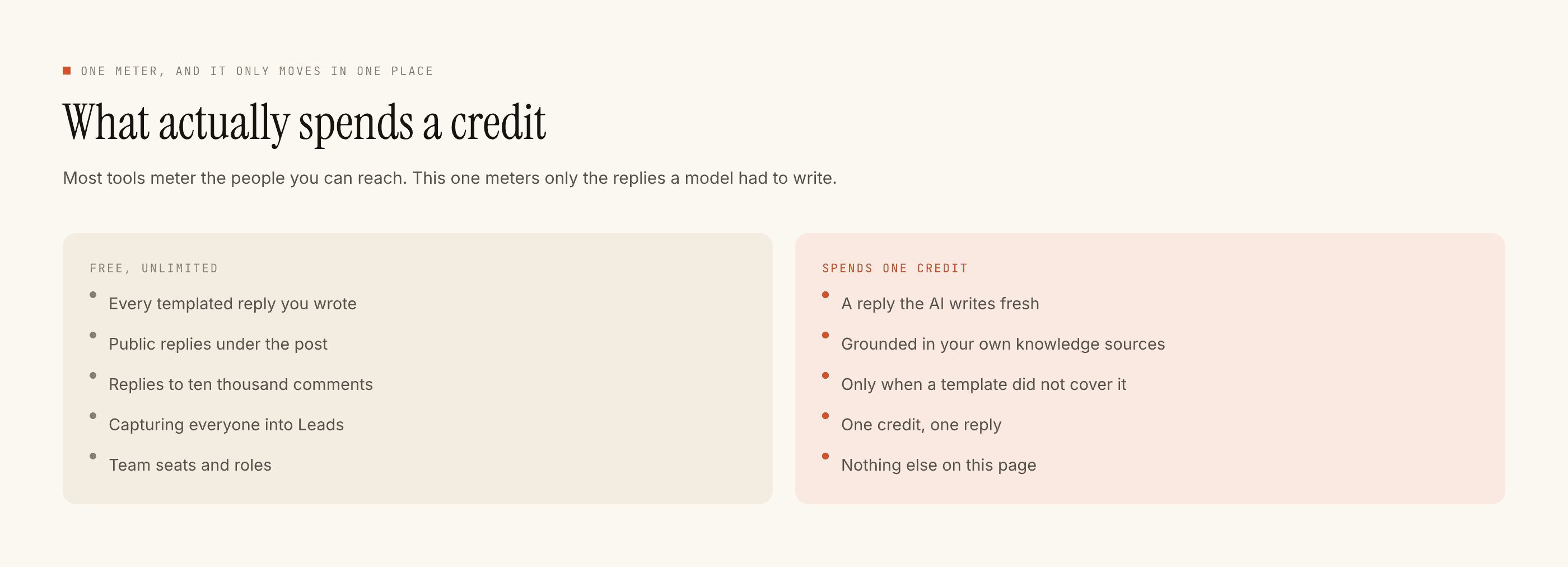
Templated replies are free and unlimited; a credit is spent only when the AI writes a new reply. Free tier is 100 credits with no card, packs start at ₹499.
Nothing here finds brands for you, tracks affiliate links, builds a media kit, benchmarks rates, schedules posts or reports analytics. No WhatsApp, no broadcasts, no sequences. Official Graph API only: seven days per comment, twenty-four hours in a DM thread, restarted only by their message.
What changes as the account gets bigger is a different post, and it changes earlier than the follower count suggests.