Playbooks · 6 min read
What Does an AI-Made Instagram Post Actually Cost in 2026?
You have seen the headline prices. Five cents an image, around ten cents a second for video, four cents for a song. What you want to know is what a real month of posting costs once you add it all up.
Here is the short answer, using list prices read from vendor pages on 19 November 2026. A month of three carousels and four short reels costs about $8 if you keep the first output every time. Nobody does. At two or three tries per keeper, the same month costs $16 to $24. Video is most of that bill, and retries are the part people forget. Prices move, so treat every number here as a dated snapshot.
What goes into one AI-made post?
A post made with AI is a few separate purchases, each priced in its own unit.
Carousel images, priced per image. Google's Nano Banana 2.1 costs $0.0504 for a 2K image, FLUX 3 Klein $0.014, and Nano Banana Pro $0.134. A six-slide carousel on Nano Banana 2.1 is about 30 cents. Our AI image generator comparison covers which model suits which slide.
Reel video, priced per second of output. On fal, Kling 3.0 Pro is $0.112 a second without audio and $0.168 with it. Kling 3.0 Standard is $0.084 and $0.126. Veo 3.1 Fast image-to-video is $0.10 and $0.15, full Veo 3.1 is $0.20 and $0.40, and Seedance 2.5 at 720p is $0.473 a second. Google's Gemini Omni 1.2 Flash is priced in tokens, which by our own conversion comes to roughly $0.07 a second at 720p. The AI video model comparison goes through each one.
Voiceover, priced per 1,000 characters. ElevenLabs' API lists its eleven_v3, eleven_v4 and eleven_multilingual_v2 models at $0.08 per 1,000 characters, with its faster Flash and Turbo models at about $0.04. A common rule of thumb is about 150 spoken words a minute, so a 15-second voiceover is roughly 37 words, or around 225 characters. That is less than two cents.
Music, priced per song. Google's Lyria 3 clip model makes a 30-second track for $0.04, and a full song on Lyria 3.5 is $0.08. Google says Lyria 3.5 songs now run up to three minutes.
Captions, priced in fractions of a cent. Text models cost a fraction of a cent for a caption-length piece of text. It is the one line you can safely ignore in the budget.
A worked month
Here is a realistic plan for a small shop: three carousels of six slides, and four reels of 15 seconds each, with a voiceover and a music bed on every reel.
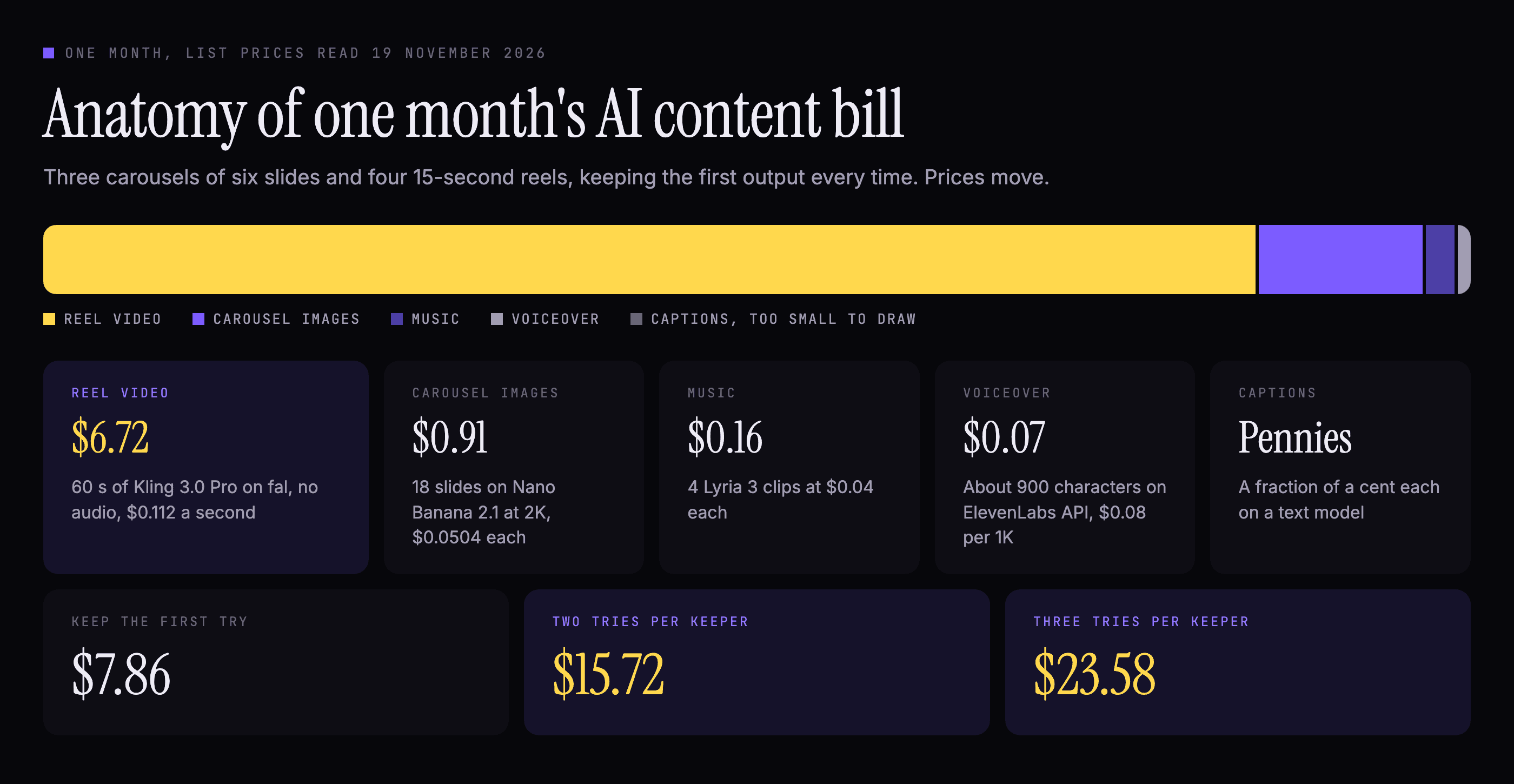
The arithmetic, line by line:
- 18 slides on Nano Banana 2.1 at 2K: 18 × $0.0504 = $0.91.
- 60 seconds of video on Kling 3.0 Pro without audio: 60 × $0.112 = $6.72. Kling makes clips of 3 to 15 seconds, so each reel fits in one clip.
- About 900 characters of voiceover on ElevenLabs' API: $0.07.
- Four 30-second music clips on Lyria 3: $0.16.
- Seven captions: pennies.
That is $7.86 if every first output is a keeper. We chose video without audio on purpose. If you are adding your own voice and music, paying Kling's audio rate as well means paying for sound twice: the same 60 seconds with audio would be $10.08.
The hidden multiplier: retries
Every vendor bills each generation, including the ones you throw away. The slide text has a typo, or the camera drifts the wrong way, so you make another one.
So the honest formula is list price × units × tries. At two tries per keeper, the month above is $15.72. At three, it is $23.58. Notice where the extra money lands. Two more tries on the carousel slides add under $2. Two more tries on the reels add over $13.
A few habits keep the tries down where they cost the most:
- Start reels from an image you already like. Kling 3.0 takes a start image, and an optional end image, so you are not gambling on the whole scene.
- Test on the cheap model first. Work out the prompt on FLUX 3 Klein at a cent or so per image, then make the final on the better model.
- Keep clips short. You pay per second, so a 15-second reel that could be 10 seconds costs half again what a 10-second one would.
- Don't retry what is cheap to fix by hand. A wrong word on a slide is a minute in an editor, not another generation.
Price your own month
Move the sliders to match your plan. The tries slider starts at two, which is the figure we would budget with.
One month of AI content
At 2 tries per keeper, the month comes to
$15.72
- Carousel slides, Nano Banana 2.1 at 2K$1.81
- Reel video, Kling 3.0 Pro, no audio$13.44
- Voiceover, ElevenLabs API$0.144
- Music bed, Lyria 3 clip$0.32
List prices read from vendor pages on 19 November 2026; they move. Captions are left out because they cost a fraction of a cent each.
If you post a reel every day, drag the video slider to 450 seconds (30 reels of 15 seconds). At two tries, video alone is about $100 a month on Kling 3.0 Pro. That is the number to plan around.
Where the bill can surprise you
Choosing a pricier video model. Seedance 2.5 at 720p is $0.473 a second, so the same 60 seconds costs $28.38 before retries. It may be worth it for a particular look, but know what you are buying.
Free plans you cannot use for business. ElevenLabs' terms say free users "may only use the Services for non-commercial purposes", and paid plans start at $6 a month. Suno's help center says free-plan songs cannot be used commercially, and subscribing later does not license them. For music, also check what your own account shows in Instagram's audio library, since business accounts often see a limited catalog.
Models that disappear. OpenAI shut down its Sora video API on 24 September 2026, and Google retired its Veo 3.1 preview model IDs from the Gemini API on 22 October 2026. Rebuilding a workflow on a new model costs time and test generations.
Your own time. None of this counts the hour you spend picking, editing and scheduling. For many small businesses that hour is the real cost, which is why the tools you already use matter as much as the model. Our guide to AI Instagram tools for small business is a good place to start.
The short version
A month of AI-made Instagram content is cheap in raw model fees: under $10 at first-try prices for a modest plan, and $16 to $24 once you count realistic retries. Video drives the bill, so cut tries and seconds there first. Read the commercial terms on any free voice or music plan before you post for a business.
If you then want those reels to bring in leads, the reels to DM funnel shows how to turn comments into conversations. As for making the content itself, we are building this into PostEngage; it is not out yet.
Questions people ask
How much does it cost to make an Instagram post with AI?
A carousel of six AI images costs about 30 cents on Nano Banana 2.1 at list prices read on 19 November 2026. A 15-second reel clip on Kling 3.0 Pro costs $1.68 without audio. Count on paying for two or three attempts for every one you keep.
What is the most expensive part of AI content for Instagram?
Video, by a wide margin. In our example month of three carousels and four short reels, the reel clips were $6.72 of a $7.86 bill before retries. Images, voice, music and captions together were just over a dollar.
Can I use free AI voice and music tools for business posts?
Read the terms first. ElevenLabs says free users may only use the service for non-commercial purposes, and Suno says songs made on its free plan cannot be used commercially, even if you subscribe later.
Why does my AI bill come out higher than the price list suggests?
Because you pay for every attempt, not just the one you post. If you make three clips to get one you like, your video cost is three times the list price. The retries are the multiplier most budgets forget.