Playbooks · 5 min read
What AI Actually Does for a SaaS Instagram Account

Search for AI and Instagram growth and you get content advice: generate captions, pick hashtags, plan a calendar, predict which reel will perform. We do none of that. There is no caption generator here, no hashtag tool, no scheduler, no analytics, no follower growth feature, and none of those are planned.
So this post could be two sentences long. It is not, because there is one genuinely useful thing a model does for a SaaS account on Instagram, the economics of the product point straight at it, and most people set it up backwards.
The useful thing is this: writing the reply that nobody wrote a template for, in a register that matches the ones you did.
Why the pricing tells you where AI belongs
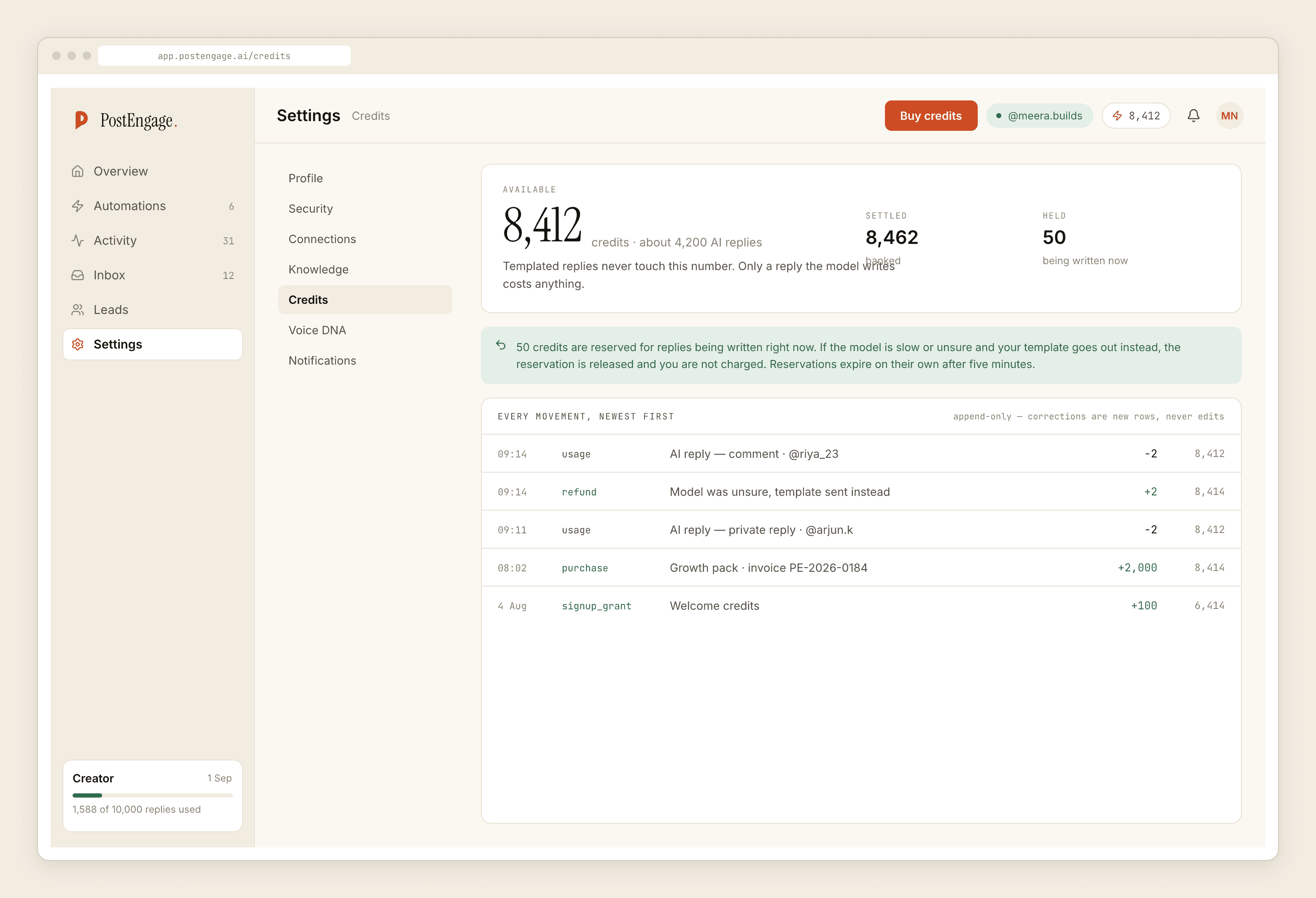
Templated replies are free and unlimited. A credit moves only when the model writes a new reply. One credit, one reply.
That is not a marketing structure, it is a description of where the value is. If a template can answer the question, a template should, and it costs nothing. The model earns its credit only on the questions your templates do not cover.
Which means the correct first exercise is not configuring AI. It is finding out how much of your inbox is repetitive.
- Export or scroll two weeks of replies you actually sent. Not this month's. Two ordinary weeks.
- Sort them into groups by what was being asked, not by who asked.
- Count how many groups cover the bulk of the pile. For most SaaS accounts with a live product it is a small number: pricing, does it do X, is it down, how do I get back in.
- Look at what is left over. That tail is the entire case for AI on your account, and its size is the honest input to whether you should pay for any of this.
The register problem, which is the real one
Here is what actually goes wrong when a SaaS team turns on generated replies. Not hallucination. Tone.
The templates were written by whoever writes the docs. They are careful, complete and slightly formal. Then the model handles the long tail, and it writes in a different voice — usually more enthusiastic, always more generic — and a person reading three of your messages in a row can tell that two different entities are behind the account. That inconsistency reads as a bot even when every individual message is fine.
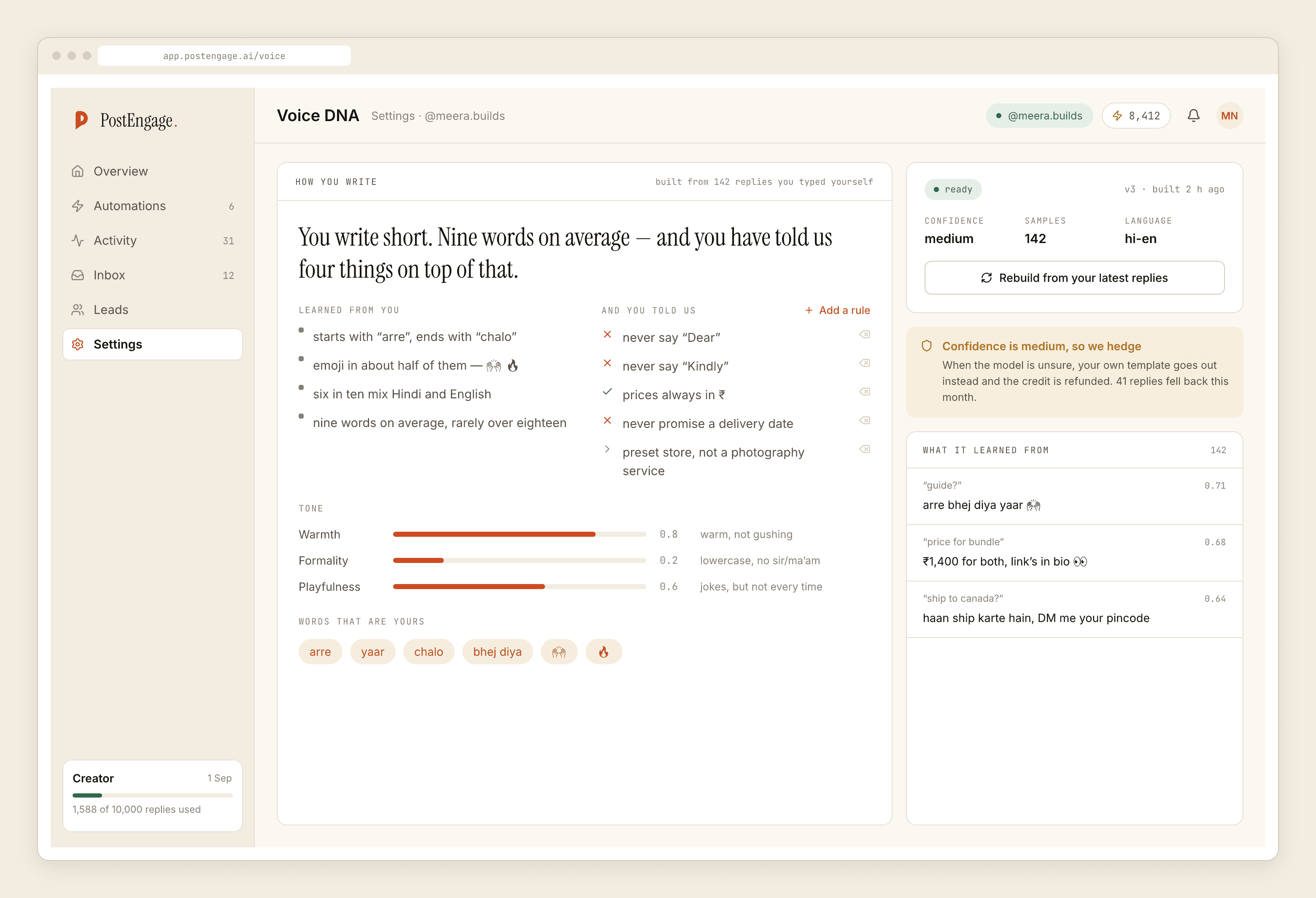
The profile is built from replies you actually sent, which is why it has a cold start. A new account has nothing to learn from and the first drafts read flat. For a SaaS team the fix is easier than for most businesses: you have a support tool full of your own writing. Paste in a body of it. That is manual work and there is no importer.
Grounding, and the thing grounding does not do
A generated reply must be grounded in a source you supplied. If it is not, or the model is unsure, or it is slow, your template goes out instead. Some replies go to a review queue rather than to the customer.
That is a real protection against invented answers and it is the reason this is usable on a support-shaped inbox at all. How grounding decides what gets sent is worth reading in full if you are pointing this at documentation.
It is also worth being clear about the limit. Grounding checks that a reply is supported by your source. It cannot check whether your source is true. Point it at a changelog entry describing a feature you shipped and then rolled back, and it will faithfully describe a feature that does not exist. For a SaaS product where the docs drift behind the build, that is not a hypothetical.
Grounding protects you from a model that makes things up. It does not protect you from documentation that is nine months old.
What a credit does not buy you
It does not buy reach. Nobody on the official API can message a stranger, so no amount of model quality expands who you can talk to. The people you can reply to are the people who commented or messaged first, inside a seven-day comment window and a twenty-four hour DM window.
It does not buy follow-up. There are no sequences, no broadcasts and no scheduled messages.
And it does not buy content. If the growth problem is that nobody sees your posts, nothing in this product touches that, and a tool that claims to solve both reply quality and distribution is usually doing one of them badly.
A sane configuration
Templates for the head of the distribution, written by a person, in the voice the account actually uses. Generated replies for the tail, grounded in docs you have re-read this quarter. Review queue on. Takeover doing what it does, which is standing the automation down the instant someone answers by hand.
Then watch one number, and it is not sent replies. Watch credit usage per week against the number of posts you published. If credits climb while posting stays flat, a question has become common enough to deserve a template, and writing it converts a recurring cost into a free one. That is the entire optimisation loop, and it is closer to inbox hygiene than to growth hacking.
The free tier is a hundred credits, no card, and packs start at ₹499 — enough to run the two-week experiment above and find out which half of this applies to you. What the free plan covers is written out plainly, and the deeper version of how the voice profile is built is the one to read before you paste anything in.