Playbooks · 5 min read
We Cannot Boost Your Engagement Rate. What Replying Does

We do not boost engagement rate. There is no feature in this product that raises it, no setting that influences ranking, and no mechanism by which an automation reaches into Instagram and changes how far a post travels. Nobody outside Meta has that lever, and every tool that implies it does is describing a wish.
It is also worth being precise about the metric, because the imprecision is where the selling happens. Engagement rate is a ratio: interactions divided by reach or by followers. We do not supply interactions — the people who comment do that. We do not supply reach at all. We hold neither the numerator nor the denominator, and we cannot see either of them, since we have no analytics product and Instagram Insights is where those numbers live.
What we do is answer people. Comments within seven days of the post, DMs within twenty-four hours of the person's last message, through the official Graph API. That is the entire mechanism.
The effect that is real, and the size of it
Here is the honest version of the connection, and it is smaller than the headline suggests.
A person who asks a question in your comments and gets a real answer is more likely to comment on you again. Not because a ranking system rewarded it. Because they are a person, they were acknowledged, and being acknowledged in public is pleasant. The next time they have a question, they already know they will get an answer, so they ask rather than scrolling on.
That is reciprocity. It is a human effect operating on individual humans, one at a time, and it accumulates slowly across the handful of people who actually interact with you.
An account that answers its comments has a different comment section six months later. That is a habit forming in your audience, not a metric responding to a feature.
It is also not what "engagement rate boost" means to whoever typed that into a search box. They meant a number going up next week. This does not do that, and saying so is the only useful thing this post can do in its first half.
Where automation genuinely helps and where it makes things worse
The help is coverage. A comment section with forty questions and one founder gets three answers and thirty-seven silences, and the silences are the ones people remember. An automation answers the ones that match a known question, which is most of them, and leaves the interesting ones for you.
The harm is uniformity, and it is easy to cause.
A single public reply string stamped under every comment is worse than not replying. Readers scroll a comment section. They see the repetition immediately, they conclude the account is automated, and the reciprocity effect inverts — now commenting feels like talking to a machine, so they stop.
- Vary the public reply, or keep it very short. "Sent!" repeated forty times is honest and unremarkable. A cheerful three-line paragraph repeated forty times is a billboard advertising your bot.
- Answer in public where the answer is public. If somebody asks the price and the price is not a secret, saying it in the comment is more useful to the next forty readers than "check DMs" is.
- Use negative keywords so complaints do not get sunshine. The failure everybody eventually has: an unhappy customer writes something with your trigger word in it and receives an enthusiastic sales reply. One negative keyword prevents it permanently.
- Leave the good comments alone. A thoughtful comment deserves a hand-typed answer. Scope your automation to the specific posts and words where a template is genuinely the right response.
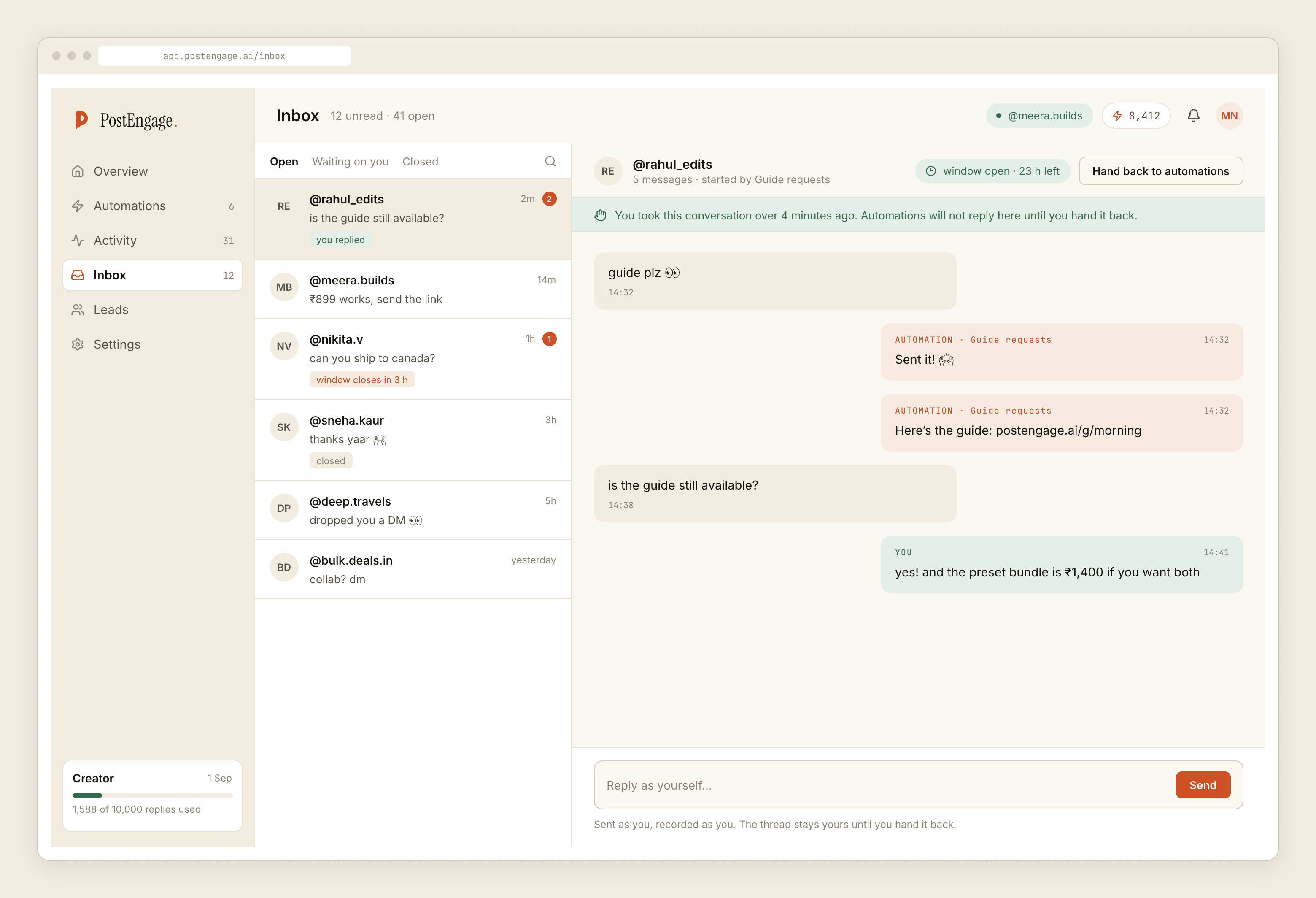
- Let takeover do its job. The moment you reply by hand in a thread, the automation stands down. That is the design, and it means answering the interesting ones yourself costs you nothing in conflicts.
Count conversations instead
If you want a number to watch that is not a lie, watch how many threads got a reply back from the other person. That is a count you can take from your own inbox, it does not need a denominator you cannot see, and it moves for reasons you control.
It is also closer to what you actually wanted. Nobody's business improves because a ratio improved. It improves because more people had a conversation with you and some of them bought something.
The things that move that count are unglamorous: answering quickly, answering the literal question, and asking one easy question back. The anatomy of a reply that gets answered is the whole of it, and none of it involves the algorithm.
What to do with the comment section itself
Two things, both of which are content decisions rather than automation decisions.
Ask for a word, not a reaction. "Comment PRICE" produces a comment that carries intent and can be answered. "Double tap if you agree" produces a number. The first grows an inbox, the second grows a ratio.
Reply to the second comment, not just the first. The people who come back are the ones worth the minute. They are also the only ones for whom the reciprocity effect above is real, because it takes more than one exchange to become a habit.
That is the honest ceiling of what a reply tool contributes to engagement: it makes it possible to answer everyone, which changes how your audience behaves towards you over months. It does not change the ratio next Tuesday, and if a comparison table told you it would, that table was written by someone selling something. How to auto-reply to comments without sounding automated is the practical follow-on, and the mistakes list covers the ways this goes wrong in public.