Playbooks · 5 min read
Automation Mistakes, and What Activity Shows Afterwards
On this page
- Scoping to every post
- Writing sentences where the keywords go
- Leaving the negative keywords empty
- Quiet hours set against the wrong clock
- Reading a closed window as a bug
- Treating duplicates as double-sending
- Going live without testing on yourself
- Fighting the takeover
- Misreading a credits block
- An unhealthy connection
- The mistake underneath all of them

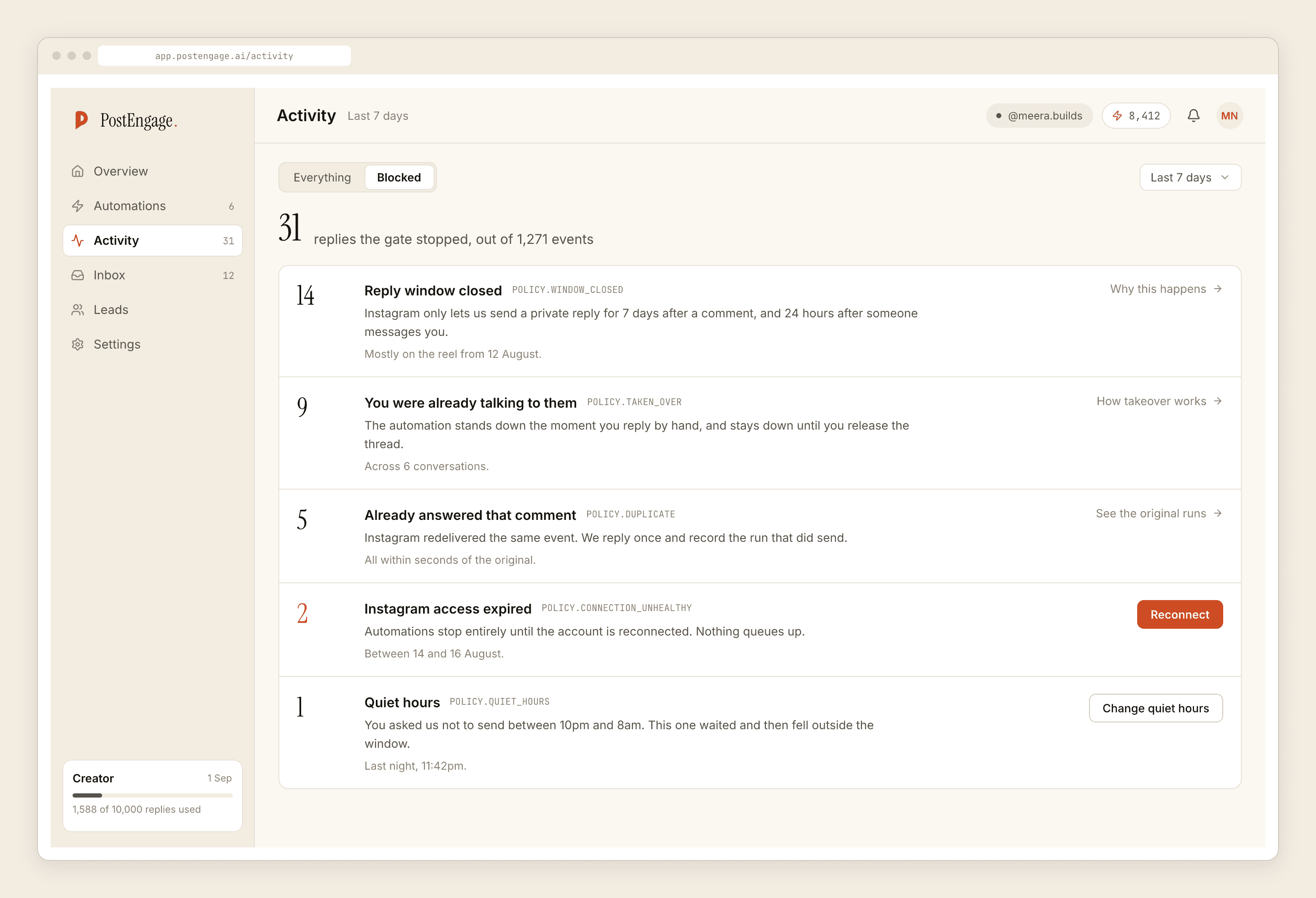
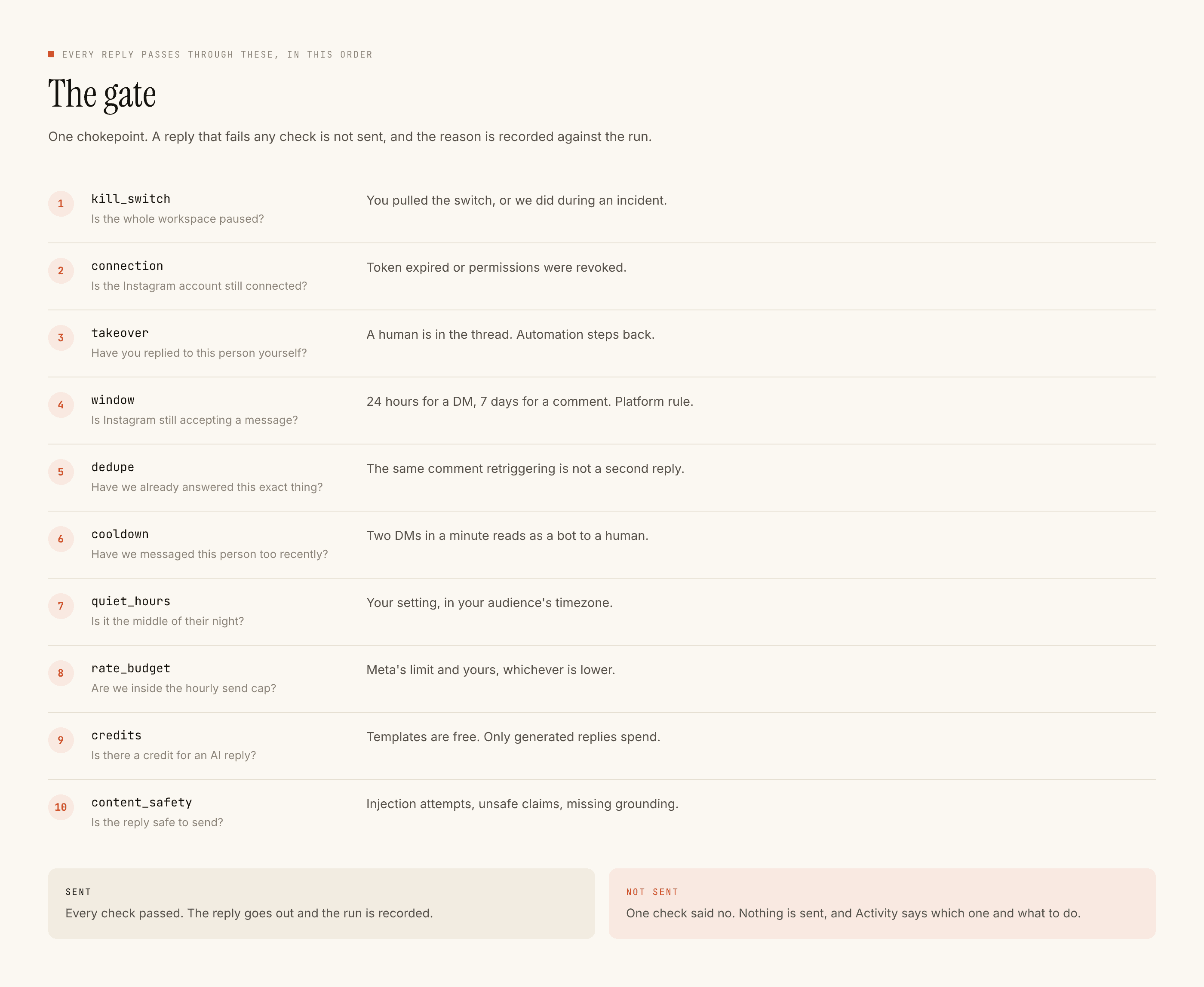
The useful thing about a gate that records why it refused is that mistakes stop being mysterious. Almost every way an automation goes wrong leaves a distinctive pattern in the blocked list, and once you can read those patterns, diagnosis takes about ninety seconds.
So this is a list of the failures people actually make, each one paired with what it looks like afterwards.
Scoping to every post
The most common mistake and the only one on this list that produces no blocked rows at all, because nothing was blocked. It sent. That is the problem.
A trigger scoped to any post with the keyword link will answer link? under the reel it was built for and also under the reel about something else entirely, with the same link, confidently.
Signature: successful sends, and a slow trickle of confused replies from people you answered wrongly.
Fix: scope to specific posts. A one-word comment is only unambiguous when the post makes it so.
Writing sentences where the keywords go
Somebody sits down and enumerates phrasings — "how much does this cost", "what is the price of this" — and a real comment says kitna and nothing happens.
Signature: silence. Not blocked rows, not errors. An empty Activity screen and an automation that is technically live and has never fired.
This is the most expensive misconfiguration precisely because it generates no evidence. If your automation has been on for a week and Activity is bare, it is not that nobody commented. It is that your list does not contain the words they used. The keyword post covers how to build one properly.
Leaving the negative keywords empty
Every account needs not interested. Most also need one or two specific to them: price drop, job, internship, collab, sale.
Signature: successful sends that read badly in context — the price template landing under a comment complaining about the price, which is a worse outcome than not replying.
Quiet hours set against the wrong clock
Quiet hours run in the timezone you configured, and people configure it once, quickly, at setup.
Signature: a dense cluster of quiet-hours blocks at times of day you consider working hours. This one is genuinely satisfying to diagnose, because the blocked list tells you the exact offset — the rows will be shifted by however many hours the wrong zone is out.
Fix: set it in your customers' timezone, and while you are there, ask whether the evening deserves to be inside it. For a lot of accounts the evening is the inbox.
Reading a closed window as a bug
POLICY.WINDOW_CLOSED is the single most common row in a healthy account's blocked list, and a lot of people treat it as a defect to be configured away.
It is not. On the official API you have seven days to reply to a comment and twenty-four hours inside a DM thread, and the DM clock is restarted only by their message. A comment from three weeks ago cannot be answered by anybody, through any tool, at any price.
Signature: a stack of window rows, heaviest on your older posts.
Fix: nothing in the settings. If the stack is large, it means your back catalogue is still generating comments, which is good news about your content and an argument for having the automation on those posts too — going forward.
Treating duplicates as double-sending
Instagram redelivers the same event sometimes. Dedupe catches it.
Signature: POLICY.DUPLICATE rows. They mean the safety net worked, not that something tried to spam anybody.
Going live without testing on yourself
Test on myself runs the whole pipeline — match, checks, reply, send — and delivers to your own account. Nothing is faked. Skipping it is how a typo, a wrong link or a reply in the wrong register reaches a few hundred people before anybody notices.
Signature: you find out from a customer.
Fighting the takeover
Takeover stands the automation down the moment a human replies by hand in that thread. It is not optional and it should not be.
Signature: a large number of takeover blocks.
That pattern means you are answering faster than the automation, which usually means one of two things: the automation is too broad and is trying to handle conversations you were always going to take personally, or you have not yet decided to trust it. Both are fixed by narrowing what it covers, not by widening it.
Misreading a credits block
Templated replies are free and unlimited. A credit is spent only when the AI writes a new reply.
Signature: credits rows on an account you believed was running on templates.
That combination means an automation is set to generate rather than to send fixed text. Sometimes that is what you wanted. Often it is a template you left half-written. The free tier is 100 credits with no card, and packs start at ₹499, but the first question to ask is not whether to buy — it is whether that reply needed writing at all.
An unhealthy connection
A token that has expired still shows the account name, so the connections screen looks fine at a glance.
Signature: everything stops. No sends, no blocks, nothing. Distinguishable from the empty-keyword-list failure only by looking at the connection itself, which is why it is worth checking first when Activity goes quiet.
The mistake underneath all of them
Never opening Activity.
The builder tells you what you asked for. Activity tells you what happened, and for the first week those are different documents. Ten minutes reading the blocked list on day one will teach you more about your own configuration than any amount of planning beforehand.
The ten checks are documented individually here, and the first-week guide is paced so that most of the failures above never get the chance to happen.