Playbooks · 5 min read
AI-First Is the Wrong Order for an Instagram Inbox

AI-first usually describes an order of operations: the model does the work, a person supervises the output, and the human effort moves from producing to checking. It is a coherent strategy in plenty of places.
In this particular inbox it is not merely a bad idea, it is impossible, and for a specific reason. The voice a generated reply uses is built from replies the account owner actually wrote. Before you have written any, there is nothing to build from. An account that starts AI-first starts with a model imitating nobody, which produces exactly the fluent, characterless message everyone recognises.
So the AI cannot be first. It has to be roughly fifth. Here is what one through four look like.
The order that works
- Read your own inbox. Not to automate it yet. To find the question you have answered by hand more times than you can stand. Shipping timelines, whether it suits oily skin, whether you take clients in Pune, what the syllabus actually covers. The evidence for what to build is already sitting in your DMs.
- Write the answer yourself, once, properly. In your register, not your marketing register. This message will go out several hundred times, which makes it the highest-leverage paragraph you will write this quarter.
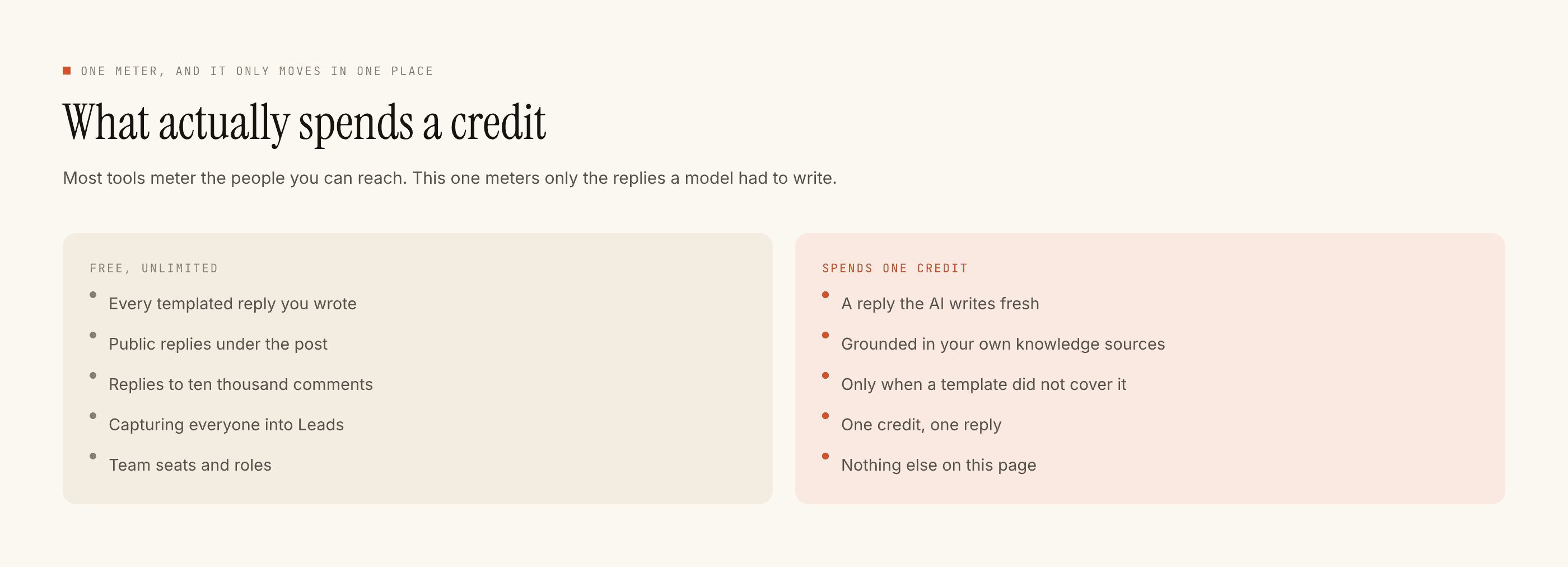
- Make it a template with a trigger. Templated replies are free and unlimited. A template is deterministic: it says what you wrote, every time, with no chance of inventing a policy you do not have.
- Test it on yourself, go live on one post, read what got blocked. The blocked list is where you learn whether your setup is sane, and it is the step people skip because nothing appears to be wrong.
- Only now, name what templates cannot handle. Go back through the messages your automation did not answer well. That set — not your ambition, that set — is the job for a model.
What the fifth step actually contains
The messages a template genuinely cannot handle have a shape once you go looking.
Two questions at once, where one of them is unusual. "Do you ship to Guwahati and can I pay half now" is not a keyword, it is a person with a specific situation. A follow-up that references something earlier in the thread. A question phrased so obliquely that no keyword catches it. A complaint that is really a question. A message half in Hindi and half in English with a spelling nobody would have listed.
That is a real category and it is a genuinely hard writing job at scale. It is also, in most inboxes, a small fraction of the total. Which is the point: the AI is for the tail, not the trunk.
If your credit ledger is long, the honest reading is not that you are AI-first. It is that a template is missing.
What AI-first must not mean here
Worth being blunt, because the phrase is used to sell a lot of things this product does not do.
There is no caption generator. No content calendar. No hashtag tool. No scheduling or publishing of any kind. No reel performance prediction, no follower growth feature, no analytics product. We reply to people. We do not create posts.
An AI-first content strategy — a model writing your captions and choosing your posting times — is a different product category, and if that is what you were looking for, nothing here provides it. The strategy in this post is about the inbox only.
Grounding, and the thing grounding does not fix
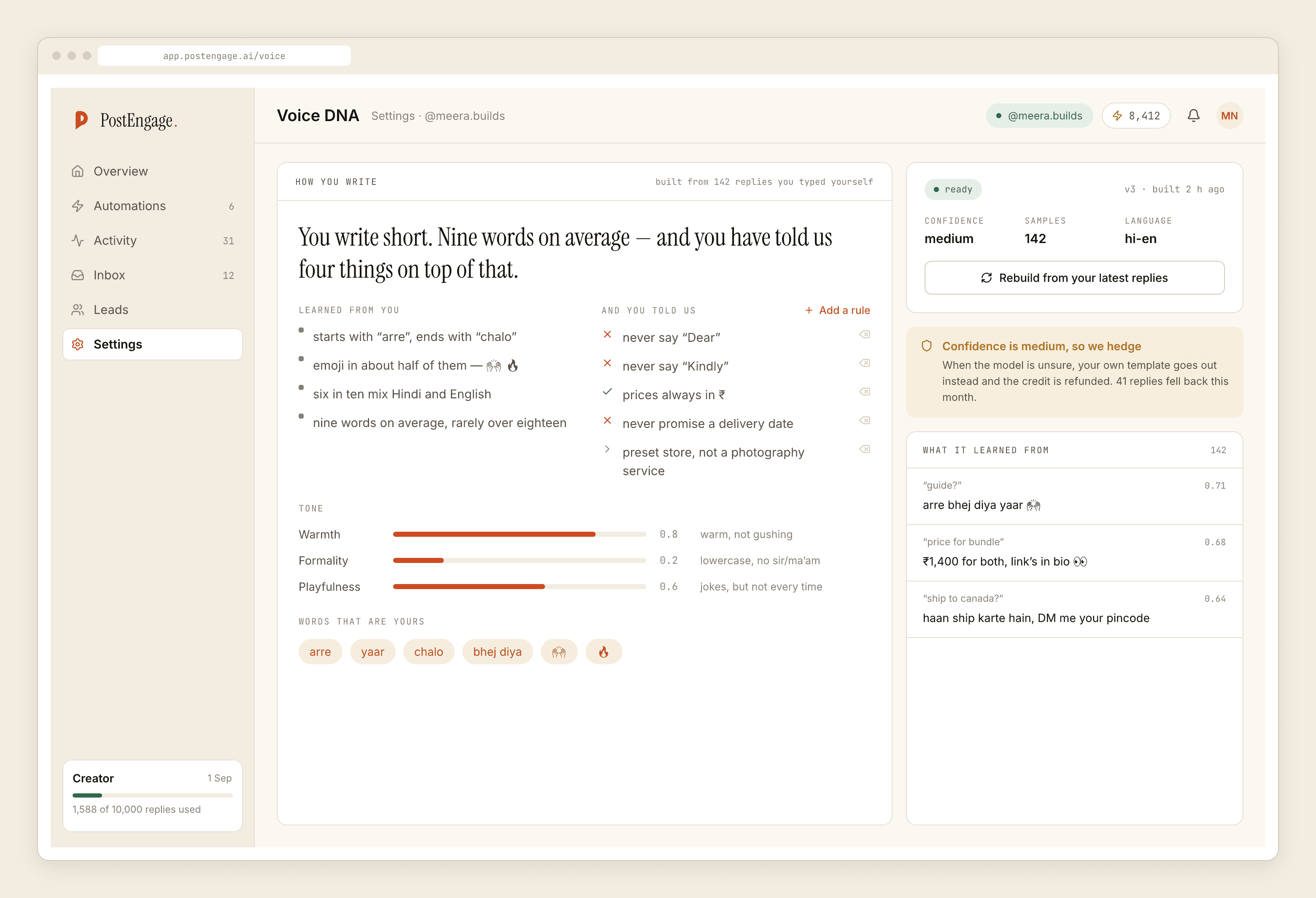
A generated reply is grounded in sources you supply — your own material, your own prior replies. That constrains what it can say and it is the reason generation is usable at all.
It does not make the model correct about things you never wrote down. If your price list is not in the sources, the model does not know your price; it knows how you write sentences about prices, which is a completely different and much more dangerous kind of knowledge. If it is slow, unsure, or writing something it cannot ground, your template goes out instead. That fallback is the actual safety mechanism, and it is worth designing your templates as though it will fire, because sometimes it will.
The steady state, six months in
A healthy setup looks lopsided and should. Most of the inbox is handled by a small number of templates that you wrote and occasionally rewrite. A minority is generated, reviewed at first and trusted later. A slice — the money conversations, the complaints, the referrals, the negotiations — is routed away from automation entirely by negative keywords and answered by a person.
The proportions are not something to optimise toward some ideal. They are a readout. A growing generated share usually means your audience is asking something new that you have not written an answer for yet, which is useful information about your business rather than a reason to buy more credits.
Where to go from here
If you are setting up from scratch, the week-long paced version of steps one to four walks the whole thing with screenshots. If you want the argument about why the pricing model itself tells you where AI belongs, it is made at length for SaaS accounts and applies well beyond them. And the mechanics of the voice — what it is built from, what it can and cannot imitate — are covered properly here.