Playbooks · 5 min read
Instagram Community Management: The Parts Software Can Take

Nobody's job description says "community manager" and means one activity. Open the calendar of anyone who does it full time and you find eight or nine unrelated tasks wearing one title, and they have almost nothing in common except that they all happen inside the same app.
That matters here because "automate your community management" is a sentence that only makes sense if you have not written the list down. So write it down first. Here is the list from most accounts we see, roughly in order of how much of the week it eats.
The actual list
Comment triage under a new post. The first two hours after publishing, when the same four questions arrive from different people and none of them have read the caption.
The recurring question. Price, availability, shipping, timings, where the link is. It is the same answer every time, and it will be the same answer next month.
The person who is upset. An order went wrong, or a reply took four days, or they read the caption as something you did not mean.
The regular. Someone who has commented on eleven posts and whose name you now recognise. They are the reason the account is worth running.
The one that is actually a sales conversation. Buried between the other two hundred.
Moderation. Spam, bots selling followers, and the comment that has to come down.
Deciding what any of it means. Which is not a task at all, which is why it never gets done.
Which of those a tool can take
One of them. The recurring question, when the answer is stable enough to be written down in advance.
That is not a small win. On a busy account the recurring question is the majority of the volume, and every instance is trivial while the total is not. A templated reply goes out in the words you chose, in seconds, and you never see that message again unless the person writes back with something new. Templated replies are free and unlimited, so the cost of taking that load off is nothing except the twenty minutes it takes to write the templates properly.
Everything else on the list needs judgement about a specific person, and a keyword match does not have any. The upset customer, the regular, the sales conversation — those are not slow because you type slowly. They are slow because deciding what to say is the work.
Automation does not reduce how many people want something from you. It removes the obligation to compose the same sentence again.
The two clocks that shape the whole practice
Community management on Instagram runs against two windows, and they are not the same length.
A comment can be replied to for seven days after it is posted. A DM thread stays open for twenty-four hours, and that clock restarts only when they send you something — not when you send them something. There is no way to reopen it from your side, on any tool, because the platform does not offer one.
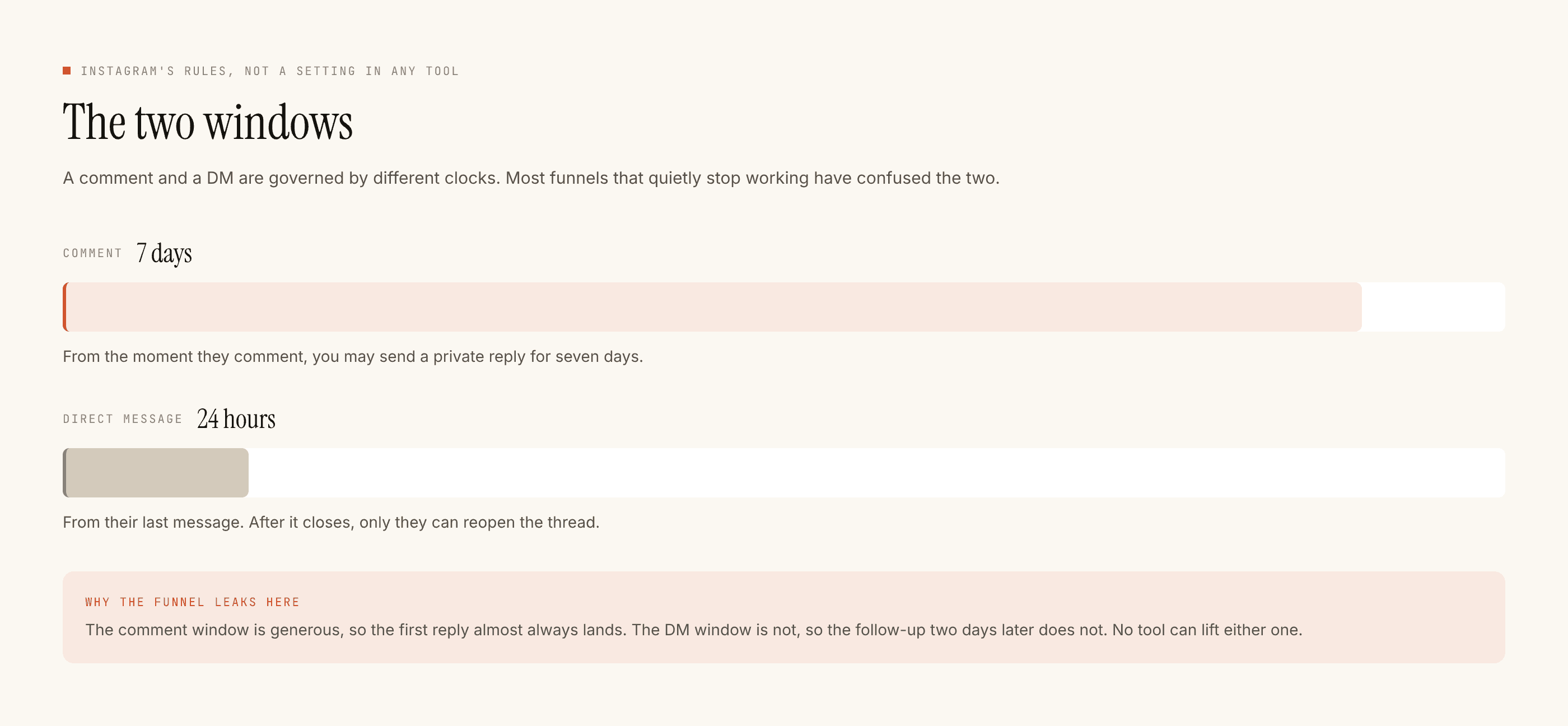
Practically: a comment-to-DM flow works because the comment is fresh and the person is on their phone right now. A "let me get back to you tomorrow" does not work, and it is worth knowing that before you design around it rather than after.
The negative keyword list is the real artefact
The trigger list is the part everyone spends time on. The negative keyword list is the part that decides whether this makes your community better or worse.
Two categories belong on it, and the second is the one people miss.
Obvious
not interested, already ordered, stop, complaint, refund. Anything where a cheerful template is the wrong register.The one people miss
Put the second list in as negative keywords and read those yourself, late, whenever you get to them. Slow is fine there. Slow is arguably correct.
Takeover, and why it makes this reversible
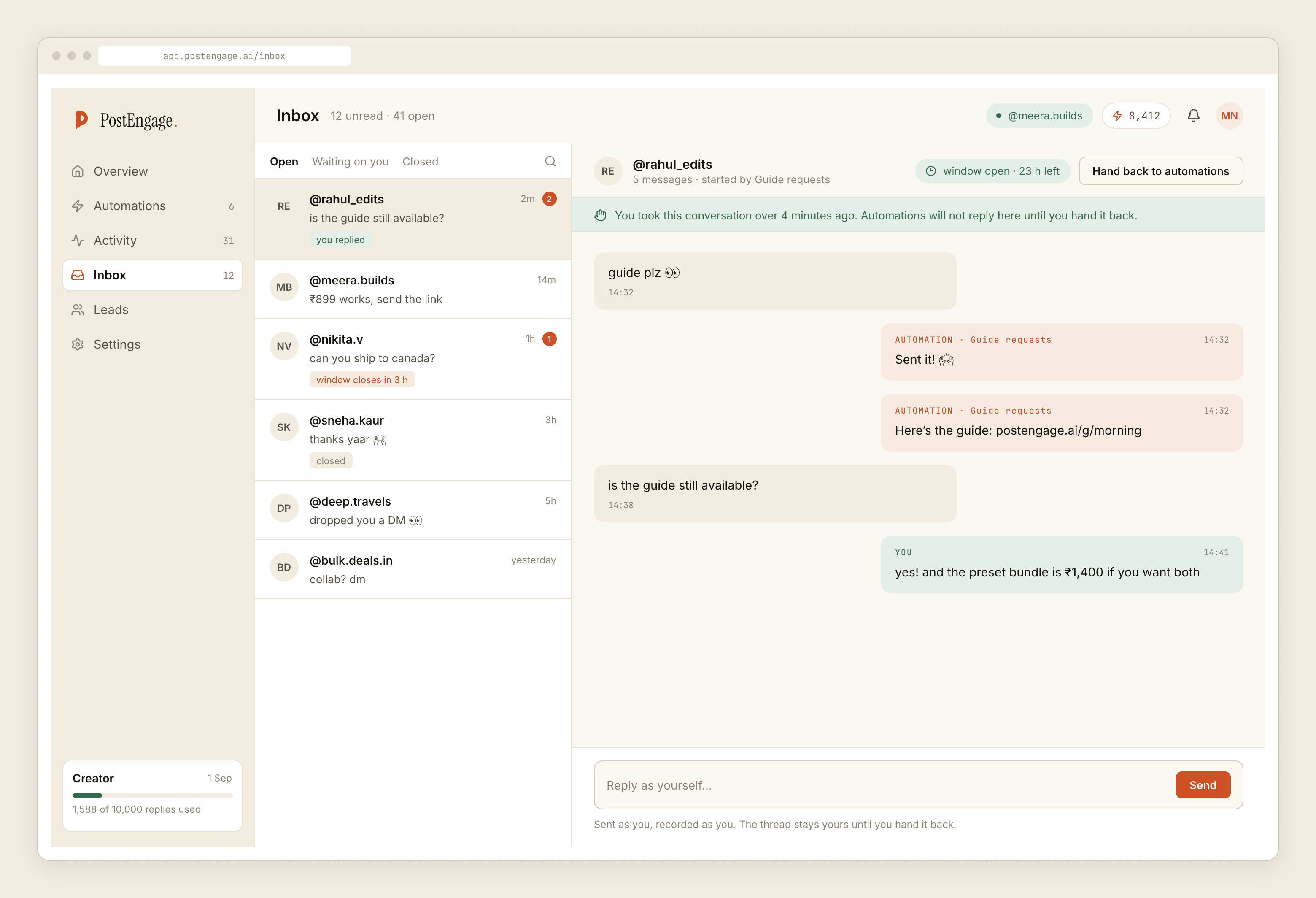
The moment a human replies by hand in a thread, automation stands down in that thread. You do not switch anything off, and nothing lands on top of a conversation you have taken over.
That is the property that makes it safe to try. Nothing you build is a commitment to let it run. If a template is answering someone who deserved a person, you type, and the template stops.
What this does not do, plainly
There is no analytics product here, no sentiment dashboard, no social listening, no follower-growth feature, no competitor tracking. It does not tell you what your community thinks — it replies to what your community typed.
It does not create anything either: no scheduling, no publishing, no caption tool, no content calendar. We reply to people. We do not make posts.
There is no CRM sync and no one-click integration; leads leave as a CSV you download. There is no broadcast, no multi-step nurture sequence, and no WhatsApp. Official Instagram Graph API only, which is also why the two windows above are non-negotiable.
Where to start if you are going to
Pick the single most repetitive comment on your account. Build one automation for it, scoped to one post. Test it on yourself before it reaches anybody. Then open Activity and read what got blocked, because that screen tells you whether your setup is sane in a way the builder cannot.
The paced setup guide walks that over a week, deliberately slowly. If the question underneath yours is really about the job rather than the task — whether this changes what a community manager is for — that is a different post, and the answer is less dramatic than the headlines suggest. And if what you want is the comment-to-DM mechanic specifically, the funnel version is here.