Playbooks · 5 min read
What Automation Actually Does to a Social Media Manager Job

Look at an actual week for somebody who runs social for a business. Planning, shooting, editing, writing captions, scheduling, chasing approvals, arguing about the brief, pulling numbers for a monthly deck, and somewhere in there, answering the inbox.
Automation of the kind this product does touches one item on that list. Not the biggest one. It is worth starting there, because the phrase "AI social media manager" implies software doing a role, and what actually happens is narrower and more interesting: one task shrinks, a different task appears, and the balance of the job shifts.
What is not in scope, so the rest is honest
We do not create posts. No caption generator, no hashtag tool, no content calendar, no scheduling or publishing, no Reel prediction, no analytics product, no reporting deck. There is no WhatsApp, Messenger or Telegram. Leads leave as CSV because there are no integrations.
So most of that week is untouched. Anybody telling a manager that AI now handles their job has not itemised the job.
The hour that leaves
The task that genuinely compresses is the repetitive half of the inbox. In most accounts a small number of questions make up most of the volume: price, availability, shipping, where to buy. Those are the ones where a person is typing an answer they have typed two hundred times, usually at an hour they would rather not be working.
Templated replies are free and unlimited, so those four questions cost nothing forever once you have written them. A credit is spent only when the AI writes a new reply — one credit, one reply — and the free tier is 100 credits with no card, packs from ₹499. The economics push you towards exactly the right habit: type your common answers yourself, in your own register, and save generation for the tail.
The work that leaves is the work you were doing badly anyway, because nobody types their two hundredth reply carefully.
The different hour that arrives
This is the part nobody puts in the brochure. Running an automation is a job, and it is a job of a kind most social managers have not done before, because it is closer to operations than to marketing.
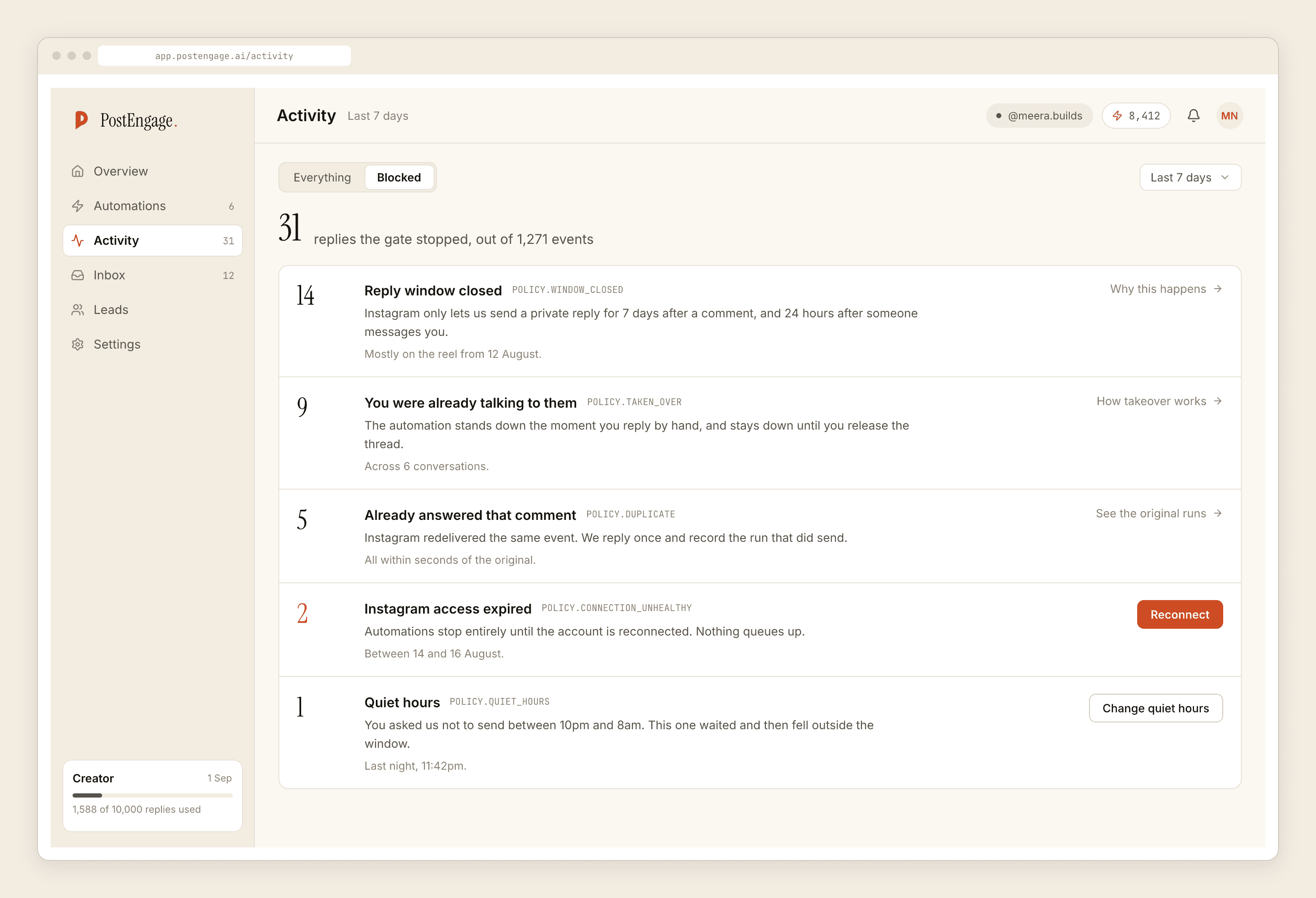
- Reading Activity, particularly what got blocked. Ten checks run before every send, in a fixed order, and a refusal is recorded with its reason. A stack of
POLICY.WINDOW_CLOSEDis normal. A connection that has gone unhealthy means nothing is sending at all, and nobody will tell you but that screen. - Maintaining keyword lists. People invent new phrasings constantly.
kitna,kitne,kitniare three strings. Matching folds case, punctuation and Latin accents, but it does not fold Indic vowel signs, soदामandदमstay separate words and both have to be listed if you receive both. - Writing and re-writing templates. Prices change, stock changes, the Diwali line is wrong in February. A stale template is worse than no template, because it is confidently wrong at scale.
- Clearing the review queue. Replies the system is not confident about go there instead of to the customer, and somebody has to look.
- Deciding what should never be automated. Refunds, complaints, anything involving a person's health or money. That list is a judgement and it is nobody's but yours.
Net, the hours may not even go down much in month one. What changes is that the hours are spent on decisions rather than on typing, and decisions compound in a way typing does not.
The parts that do not move, ever
Judgement about who deserves more. A manager decides in the moment that this enquiry is worth a phone call and that one is worth a line. That decision is invisible in the finished text, which means no record of your replies contains it and no model can learn it.
The first angry message of a bad week. A voice profile is built from replies you actually wrote. If you have never written to a furious customer, there is nothing in the record about how you handle one, and it will produce something in your usual cheerful register, which is precisely wrong. Negative keywords keep automation out of those threads; you handle them.
Taste. Whether the public reply under a post sounds like your brand or like a call centre is a thing only a person can judge, and only by reading it as a stranger would.
Everything upstream. What to post. Whether the idea is any good. Whether the campaign should run at all.
Takeover is the seam, and it is one-way
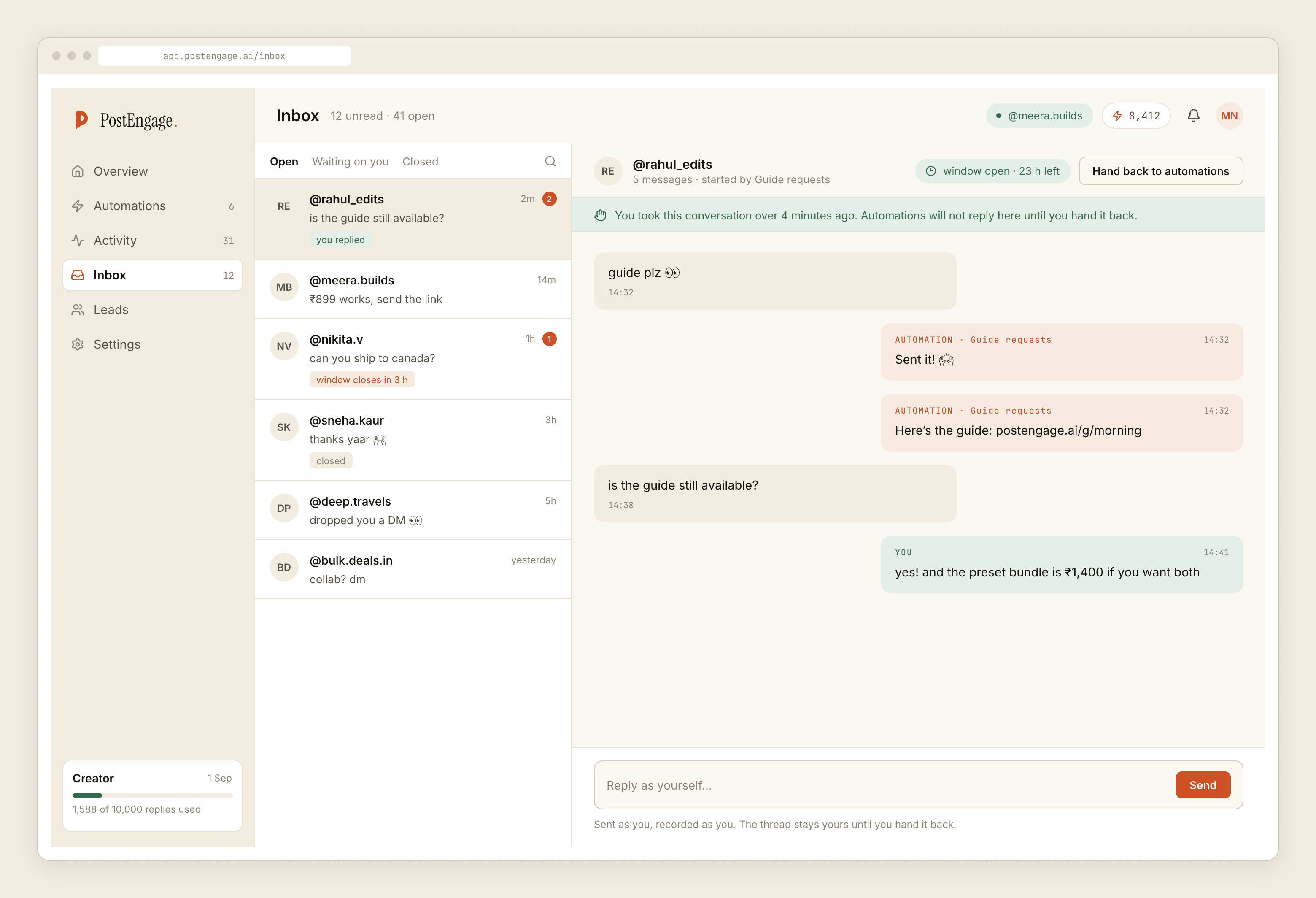
The mechanic that makes the split workable is simple: automation stands down the moment a human replies by hand in a thread. No handoff to configure, no escalation rule, no state machine.
Which means the manager's instinct — see something odd, jump in — is also the correct operational move. You do not have to pause anything. You reply, and the automation is out of that conversation.
What the title should probably say
Not "AI social media manager". The software does not manage anything. It answers a defined class of message, refuses the rest, and keeps a record of both.
What has actually changed about the role is that a manager is now accountable for a system's behaviour as well as their own writing — and that the system is only ever as good as the replies the manager wrote to train it and the lists they maintain. The community-manager version of this argument takes the same split from the community side, and the comparison with hiring a VA is the practical one if the decision is a budget decision.