Lead generation · 5 min read
Comments as a Lead Source: The Word Is the Qualification

Every other lead source makes you find out what the person wants. A form asks. A quiz infers. A scoring model guesses from behaviour and is wrong often enough that somebody has to review it.
A comment does not need any of that. The person typed a word, and the word is the answer. Somebody who commented price wants a price. Somebody who commented size is choosing between two of them. You know before you write anything, and you did not have to ask.
That is the property that makes comments worth building a lead process around, and most setups treat it as a matching convenience rather than as the qualification it actually is.
Your keyword sets are a segmentation scheme
Once you see it that way, the design changes. You are not writing one list of every word that means "interested". You are deciding which buckets you want people sorted into, and the trigger sets are the buckets.
- Price intent.
price,pric,rate,kitna,kitne ka,daam,कीमत. These people want a number and nothing else will do. - Availability intent.
available,stock,size,in stock,hai kya. Different question, different answer, and often a different product. - Access intent.
link,guide,pdf,book,slot. They want the thing, not information about the thing. - Not-a-lead.
not interested,nahi chahiye, plus the complaint vocabulary —refund,cancel,not received,payment failed. Negative keywords, and they veto a reply regardless of what else matched.
Three buckets and a veto list is more segmentation than most small accounts ever get from a CRM, and it happened before you spent a minute on it.
You did not qualify the lead. They qualified themselves in one word, in public, for free.
The clock that makes a comment section a workable backlog
Seven days to respond to a comment, counted per comment rather than per post. That combination is unusual and it has a practical consequence people miss.
It means the comment section of an old post is live inventory. A comment arriving today on something you posted in March is fully answerable today — publicly, and in a DM. Accounts that only run automations on this week's content are leaving a working lead source switched off, and turning it on is a matter of scoping an automation to two or three old posts under Advanced.
What a comment gives you, and what it does not
It gives you a handle, a sentence, and the post it appeared under. That is the lead record, and it is enough to answer, enough to follow up by hand, and enough to know which content produced which kind of question.
It does not give you an email address or a phone number. Those only exist if the person types them to you in the DM afterwards, and they are captured from that message rather than looked up anywhere. Nothing is read from a profile or a bio. If they did not send it, it does not exist and no export will contain it.
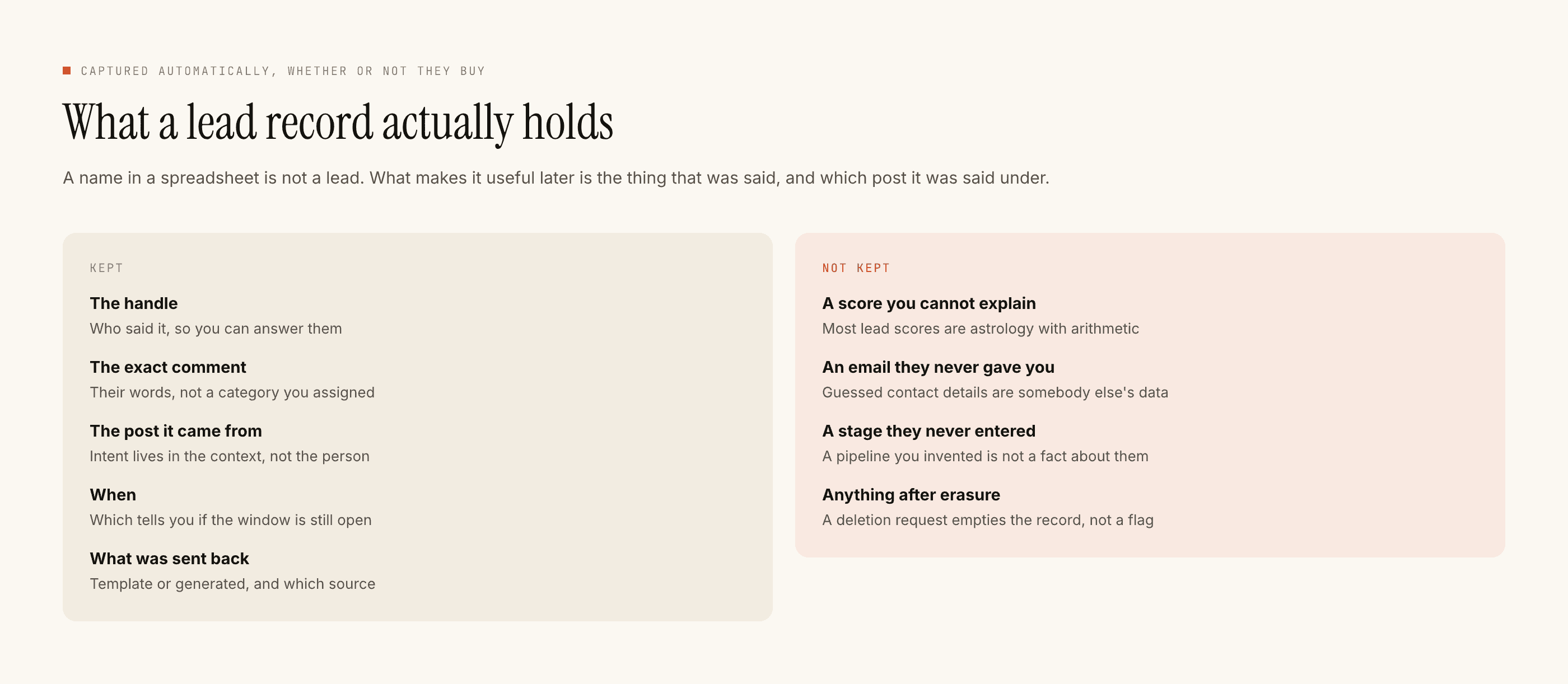
It also does not give you the people who did not comment. You cannot see who saved the post, who screenshotted it, or who read all forty comments and left. Those are not leads by any definition available here, and any tool offering them is not reading them from the official API.
Where the AI is, and where it is not
Worth being precise, because "AI-powered comments" is a phrase that hides the boundary.
Matching is not AI. It is a string comparison — whole word, case and punctuation folded, no translation, no intent model. It runs before anything else, so a comment that matches nothing never reaches a model at all. Which means improving the reply text does nothing for coverage. Coverage is the keyword list and only the keyword list.
Generation is AI, and it is metered. One credit, one reply, and only when the model writes something new. Templated replies are free and unlimited, forever, which is why the first DM after a keyword comment should almost always be a template: the person typed one word, you know exactly what they want, and there is nothing to compose.
The model earns its credit on the second turn, when somebody replies with something specific that no template anticipated. It writes in a voice built from replies you actually wrote yourself, and if it is unsure or cannot ground what it would say, your template goes out instead.
The unglamorous part that decides all of it
Read fifty of your own comments as strings, once a month. Write down the exact words people used, misspellings included, and add them. Every spelling you do not have is somebody who asked and got nothing, and there is no clever feature that substitutes for the ten minutes.
Then watch replies rather than lead counts. A captured lead who never answered is a username with a timestamp; a lead who replied is a conversation. Where the comment-to-DM funnel leaks covers the six places that difference gets made, and choosing the word people will actually type is the decision upstream of all of it.