Playbooks · 5 min read
Referral Programmes on WhatsApp: Why the Mechanics Are the Easy Part

We do not ship WhatsApp, so this is not a walkthrough of a feature. It is about why referral programmes on messaging channels underperform in a specific and predictable way, and what the honest version looks like.
The premise is genuinely good. People already forward things to each other in this app, a recommendation from a friend outperforms any advertisement, and the sharing action costs nothing. Everything about the channel says this should work.
It usually does not, and the reason is not the tracking.
What actually goes wrong
Three things, in descending order of how much damage they do.
Nobody sends the message. The asked-for share is a small favour with a social cost — the sender is spending credibility with somebody they know. Most programmes assume the cost is zero and design accordingly.
The message you wrote does not sound like them. A pre-filled share text written in your brand voice, forwarded into a group chat, reads as an advertisement the sender is carrying. People feel this and quietly do not send it.
The reward is aimed at the wrong person. Most programmes reward the referrer. The friction is on the receiving end — the friend now owes a response.
A referral is not a marketing action. It is a small favour asked of somebody who has to face the other person tomorrow.
The mechanics, which really are easy
For completeness, because this is the part every vendor demonstrates.
- A unique link or code per customer. Trivial, and every tool does it.
- Attribution when the friend arrives. Also trivial, provided you accept the link is imperfect — people retype codes, screenshot them, and describe them out loud.
- A reward that fires. Bounded and mechanical.
- A message telling the referrer it worked. Genuinely valuable and usually forgotten, which is a shame, because it is the message that produces a second referral.
None of that is where programmes fail. All of it is what the demo shows.
Write the share message as the sender, not as the brand
The one change that moves this more than anything else.
If the pre-filled text says "Get 20% off your first order at [Brand]! Use my code", the sender is forwarding an advertisement. If it says "I use these for my morning coffee, they're good — this gets you a bit off the first one", the sender is making a recommendation.
The second one gets forwarded far more often, and it is not because it converts better. It is because it does not cost the sender anything to send.
Consent does not travel
The rule that catches programmes out, and it is worth stating plainly.
Somebody's friend has not opted in to hear from you. A referral programme that harvests a phone number from the referrer and messages it is not a growth loop; it is unsolicited contact with the extra insult of naming a mutual acquaintance. The friend arrives when they choose to, through the link.
The opt-in post covers what consent actually requires on this channel, and it applies here with no exceptions.
What is possible on the channel we do run
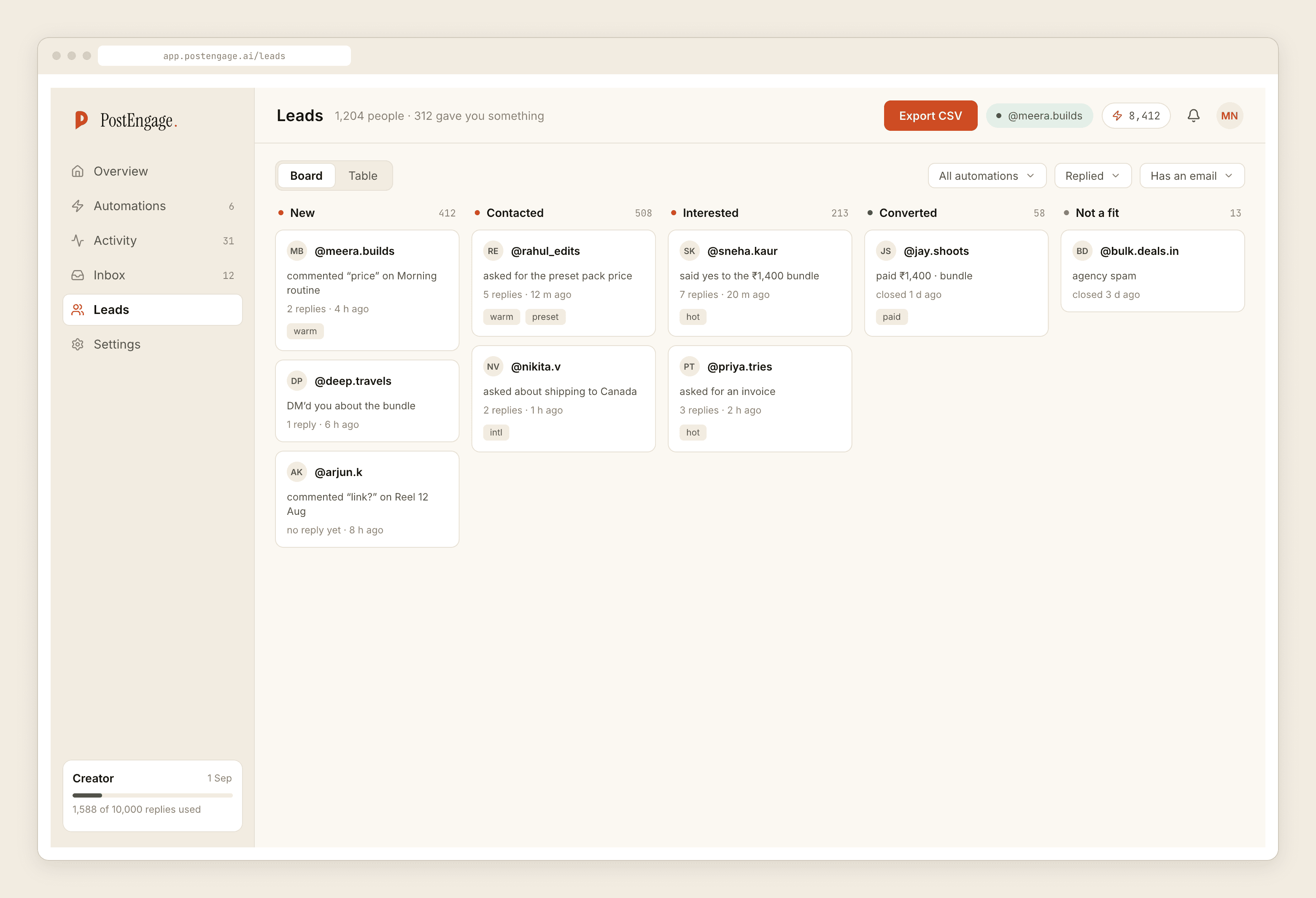
PostEngage answers Instagram comments and DMs. There is no referral feature in it — no codes, no attribution, no reward ledger. What exists is the part that happens before any of that: someone commenting something enthusiastic under a post, which is the moment a referral is actually available.
An automation can answer that comment and capture the person to Leads with their exact words and the post they were on. What you do next is manual, and for a programme this dependent on tone that is probably correct.
Rewards, and the one that backfires
Worth a paragraph because the choice is usually made carelessly.
A discount on the referrer's next purchase works when there will obviously be a next purchase — coffee, groceries, anything consumable. It works badly for things people buy once, where the reward is worth nothing to the person earning it and everybody can tell.
Cash-equivalent rewards work more broadly and change the character of the ask. Once money is involved, the sender is no longer recommending something; they are being paid to forward a message, and the friend can usually sense which of the two happened. For a business built on trust that trade is rarely worth it.
The reward that consistently does well is the one aimed at the friend rather than the referrer — something that makes the sender look generous instead of compensated. It reframes the ask from "do me a favour" to "here is something for you", which is a message people are happy to send.
The number that tells you whether it works
Not the number of codes issued. The share of issued codes that were used at least once.
Programmes with a high issue rate and a near-zero use rate are extremely common, and the diagnosis is always the same: people accepted a code because accepting was free, and never sent the message because sending was not.
Where to read more
For the Instagram version of this argument, there are two posts on it and an adjacent one. For the loyalty question, which fails for related reasons, that is here.