Playbooks · 5 min read
Referrals Arrive as Strangers Who Already Trust You

There is no referral system in this product. No codes, no unique links, no click attribution, no commission calculation, no payout, no leaderboard, no roster of who referred whom. Nothing in here knows that one person told another person about you.
That is worth stating before anything else, because "referral automation" as a category means tracking, and we do none of it. If you need to pay people accurately for referrals, you need a tool that measures them, and it is not this one.
What is left is the part that actually happens on Instagram anyway: a referral walks into your DMs as a stranger, and how you handle the next sixty seconds decides whether the trust your customer spent on you survives the trip.
The person who arrives is not like your other leads
Somebody who typed PRICE under a reel is curious. Somebody who writes "hi, my cousin got her mehendi done by you last month" has already been sold. They have a name, a story, a specific outcome in mind, and an expectation that you will treat them as connected rather than as traffic.
Sending that person your standard template is the single worst reply available. It is not offensive. It is worse than that — it is deflating, in a way they will describe to the person who referred them.
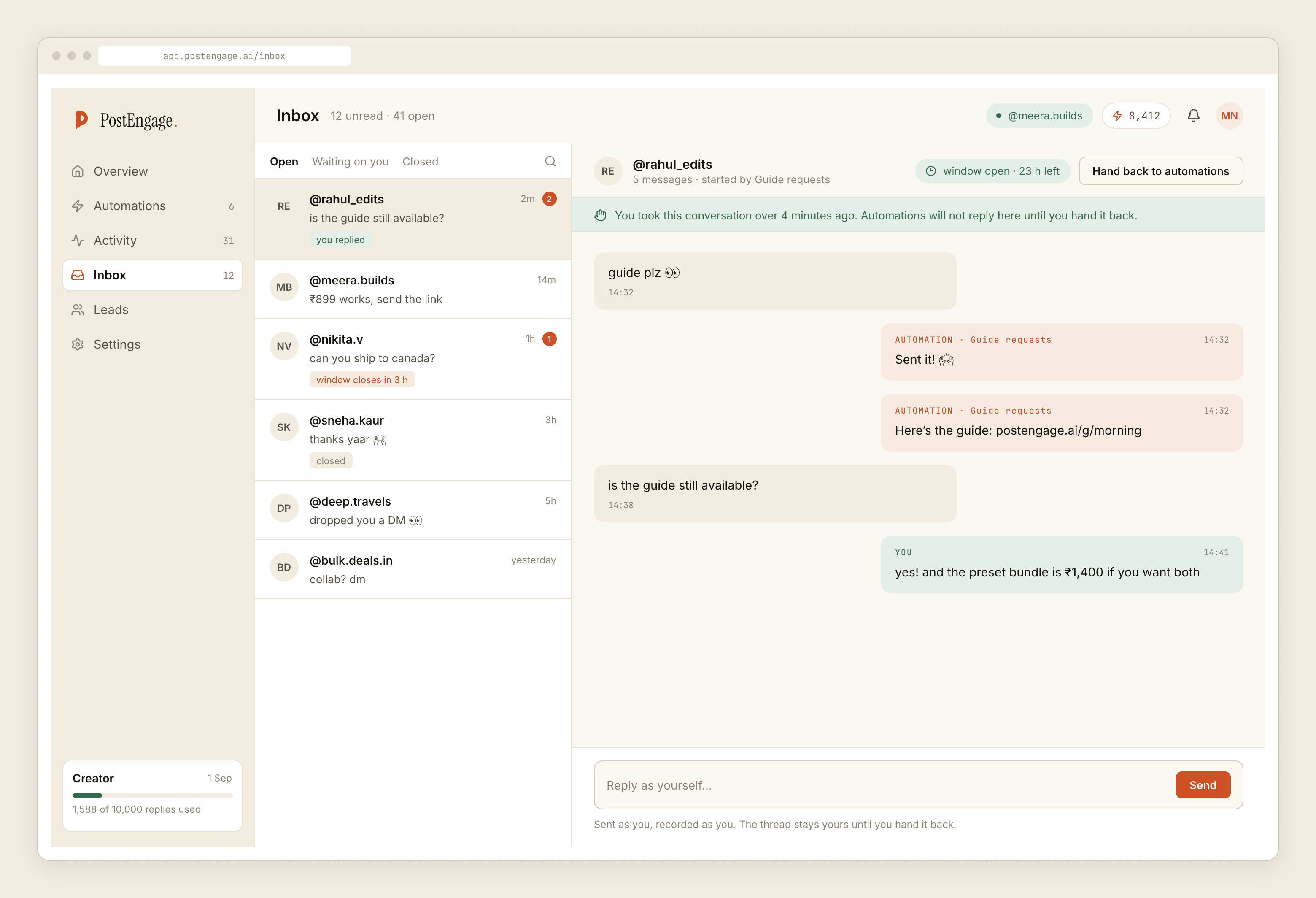
Use negative keywords to not automate
This is the mechanic that matters and it is backwards from how people think about the feature. Negative keywords are usually described as spam protection. Here they are a routing tool: phrases that mean a human should read this.
The list is easy to build because referrals announce themselves in a small number of ways:
- Names and relationships.
friend,cousin,didi,bhabhi,colleague,neighbour. People almost always say who sent them in the first line. - The telling verb.
recommended,referred,suggested,told me,bataya,bheja,sent me here. - Prior-work references.
saw your work at,did my sister,you did the,we met at. - Your own repeat customers. They open with
again,last time,phir se. Not a referral, but the same rule applies: nothing automated should go to them.
Any of those in a comment or a message and the automation sends nothing. The message sits in your inbox and you answer it as a person. Takeover handles the other direction: the moment you reply by hand, automation stands down for that conversation entirely.
The tracking you can actually keep
Since nothing records who sent whom, you record it. The lead record has tags and notes, and a referral is a tag plus one line.
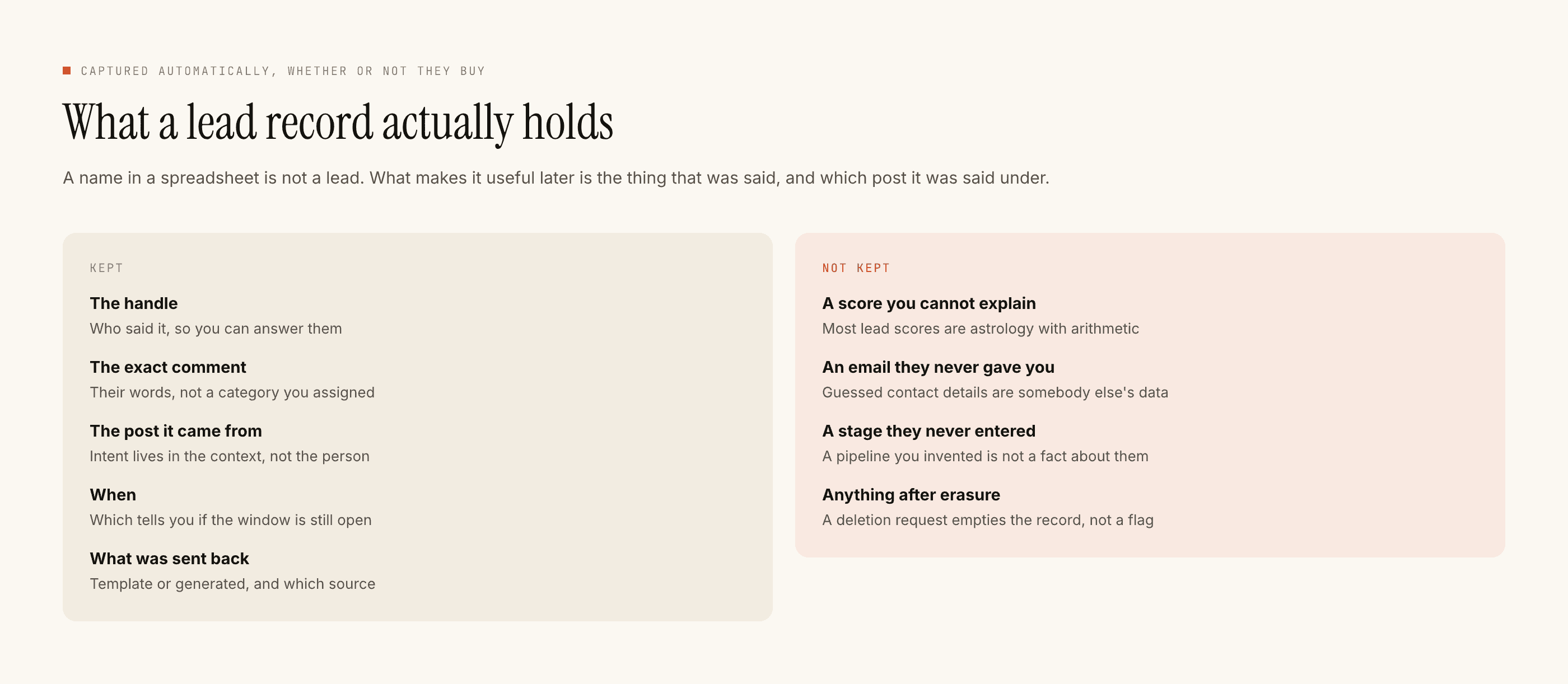
Do it consistently for three months and you can answer the only referral question that matters at small scale: which of your customers keep sending people. That is not attribution, it is a tally you kept by hand, and it will be roughly right in a way an untracked instinct is not.
Export is a CSV. Filter by the tag, count the names. Nobody needs a dashboard for this.
Ask, because you are already in a conversation
The tool cannot tell you the source. The person can, and you are mid-conversation with them.
"Can I ask who sent you?" costs one line and gets answered almost every time, because people are pleased to say. The answer gives you the referrer's name, a reason to thank them, and — more usefully — the specific thing that got said about you, which is your own marketing copy written by somebody with no incentive to flatter you.
That is a version of the same argument made at length about attribution generally: in a channel with no tracking, asking is not a fallback, it is the better instrument.
The ask, which is not automatable
The moment to ask for a referral is right after you have delivered something that went well, and it has to come from you. There is no scheduled post-purchase message here, no follow-up flow, no way to message a past customer who is not currently writing to you. If they are outside the twenty-four hour window, the conversation is closed and no setting opens it.
So the referral ask lives where it always did: in the delivery, in the packaging, in the last message of a conversation that ended well. "If someone asks, send them my way" typed by you at the right moment does more than any system, and this is one of the places where that is genuinely true rather than a consolation.
The referrer is doing outbound on your behalf. That is the only outbound available to you.
The honest list
No codes. No unique links. No click or conversion tracking. No commission rates, tiers or payouts. No dashboard showing who referred what. No automatic thank-you to the referrer. No WhatsApp, no email, no way to reach anybody who has not written to you.
If you are running something more structured than word of mouth — a set of creators posting on a schedule, a defined incentive — the ambassador version of this problem covers the timing and the volume spike that comes with it. And if money is changing hands for those links, the disclosure has to be inside the message itself, which is a compliance question rather than a tooling one.