Playbooks · 5 min read
Cafes and WhatsApp: Almost Nothing You Send Is Utility
Start with an uncomfortable audit. Write down every message a cafe would genuinely want to send to a customer who is not currently in the cafe.
Most lists come out like this. Today's special. We have a new cold brew. Live music on Friday. Monsoon offer. We are shut for Holi.
Now sort them by whether there is a transaction behind them. A transaction the customer entered into, with terms, that this message is about.
Almost none of them qualify.
Why that matters more than it sounds
The WhatsApp Business Platform sorts business-initiated messages into categories, and the useful split for a small business is utility versus marketing. Utility messages are about something the customer bought or booked. Marketing messages are everything else — announcements, offers, reminders that you exist.
Both need a pre-approved template if you are sending outside the twenty-four-hour window the customer's own message opened. But marketing additionally needs opt-in specifically for marketing, and it lands in a different place in the customer's head. A restaurant telling you your delivery is downstairs is useful. A cafe telling you about a cold brew is an ad.
A retailer with orders and deliveries gets a whole rail of legitimate utility traffic for free. A cafe does not have one. A flat white is bought and consumed in the same ten minutes. There is no shipment, no appointment, no account.
The cafe's problem is not that WhatsApp is expensive. It is that a cafe has very little it is entitled to say.
Where a cafe does have utility traffic
Three places, and they are worth naming because they are the honest case for the channel.
Catering and bulk orders. Fifty sandwiches for an office on Thursday. That is a real order with a real delivery time, and every message about it — confirmed, being prepared, on its way, delivered — is utility.
Table and event bookings. A private booking for a birthday, a table held for eight on Saturday. Confirmation and reminder are utility, in exactly the way a restaurant's are.
Festival pre-orders. Hampers, Christmas cakes, Diwali boxes. Someone paid an advance; everything about that order is fair game.
If your cafe does a lot of any of the three, the case for the Business Platform is real. If your cafe is fifty walk-in coffees a day, it is not, and no amount of tooling changes that.
The reply half is where the volume is
Everything a cafe actually gets asked is a reply, not an outreach.
What time do you close. Do you have wifi. Is the terrace open in the rain. Pet-friendly hai? Do you have plugs. Kitna wait hai right now. Do you do oat milk.
Every one of those arrives as a customer message, which opens a twenty-four-hour service window in which you can answer freely, in your own words, without templates and without approval. That is the part of WhatsApp that works for you, and it is the part that costs the least to set up.
The trap is that this is also the part where "today's special" gets smuggled in. Someone asks about your timings, you answer and add a line about the new croissant. Inside the window that is allowed. Done on every reply, it is how a service channel becomes a channel people mute.
Compared to the channel we actually run
PostEngage handles Instagram comments and DMs — that is the entire product today. The comparison is worth drawing because the clocks are the thing that differs most, and a cafe's inbound is bursty in a way that makes the clocks matter.
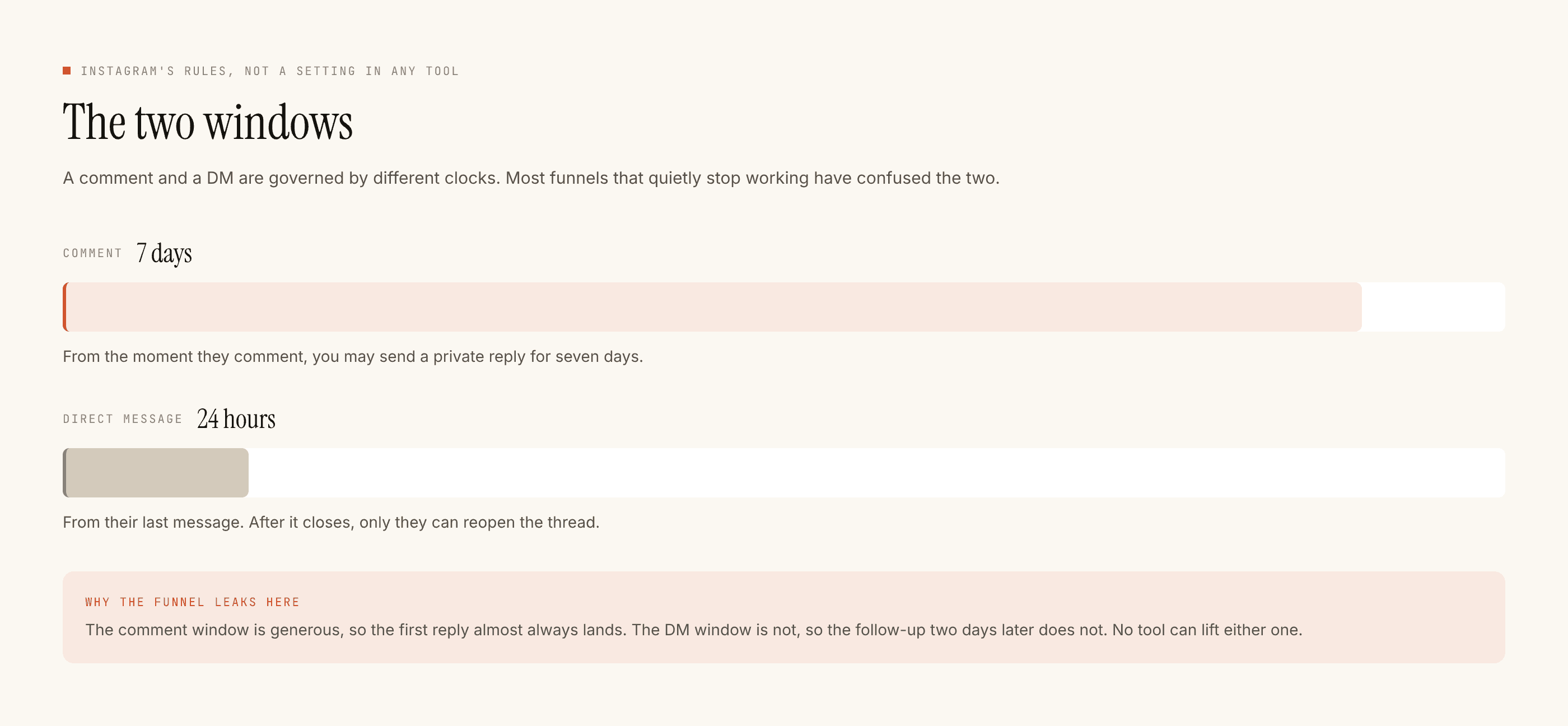
On Instagram a comment can be answered for seven days after it is posted, which is generous. A DM thread runs on twenty-four hours, restarted only when the person messages again. Templated replies are free and unlimited, and a credit is spent only when the AI writes a new reply. The free tier is 100 credits with no card and packs start at ₹499, which means the enormous repetitive tail — timings, wifi, parking, "open ho?" — costs nothing however many times it is asked.
That asymmetry is the practical point for a cafe. Your inbound is repetitive, high-volume and low-value per message. A channel where answering the same question a thousand times is free suits that shape better than one where you are thinking about per-conversation cost.
If you do build it
- Start with catering, not coffee. Build templates for the order rail you actually have, and leave the promotional side alone until the first one works.
- Separate the consents. Order updates and offers are two permissions. Collect them as two.
- Cap the promotional cadence before you send the first one. A cafe's offers are small and frequent, which is exactly the combination that produces mutes.
- Never let an automated reply answer an allergen question. Ingredients change with suppliers and cross-contamination is a property of your kitchen this morning. Route it to a person, always.
For the version of this that applies to a full-service kitchen, the restaurant post goes further on what a bot must refuse. Local business automation covers the timings-and-parking tail, and always-on support is the argument for answering at eleven at night.