Comparison · 7 min read
WhatsApp Automation Pricing 2026: Reading the Tiers Properly

Two vendors in this category will show you three plans each, and the plans will look comparable because pricing pages have converged on the same layout. They are usually not comparable at all, because each vendor has chosen a different thing to gate.
This post has no vendor prices in it. Not because we are being coy — because they change, we would quote them wrong, and a stale price attributed to somebody else's product is the kind of error that deserves to cost a reader their trust. What is durable is the structure, and the structure is what you actually need to read a pricing page properly.
First, two different things called tiers
They get confused constantly and they are unrelated.
Vendor plan tiers
Meta's messaging limits
Upgrading a plan does not change what Meta permits your number to do. The messaging limits post covers that side and it is worth reading before you conclude that a bigger plan solves a sending problem.
What a tier is actually gating
Every pricing page in this category is gating some subset of the following. Identifying which one a vendor chose tells you more about the product than the feature list does.
- Contacts. You pay for everybody you hold, forever, whether or not you message them. Cheap at launch, and it grows with your history rather than with your activity.
- Conversations or messages. A markup on top of Meta's own charge, or a bundled allowance with an overage rate. Read the overage rate; it is deliberately the smallest text on the page.
- Seats. You pay per person who logs in. Fine for a two-person shop, and the number that quietly decides whether your whole support team can use the tool or only two of them.
- Capability. The API access, the webhook, the automation builder, the export, the audit log. This is the gate to watch, because it is the one that can make a cheap plan unusable rather than merely limited.
- Support. Whether a human answers you, and how fast. On a channel where a broken number stops your order queries, this is not a soft benefit.
The gate a vendor picked reveals the customer they built for. A contact-metered product was designed around businesses with lists. A seat-metered one was designed around support teams. Neither is wrong; one of them is wrong for you.
You are not choosing a price. You are choosing which of your own growth curves the bill is attached to.
The meter underneath changed, and most pricing posts have not caught up
Before comparing any vendor, know what Meta itself now charges, because it sits under every plan on the market and it is no longer what most articles describe.
WhatsApp moved from conversation-based pricing to per-message pricing on 1 July 2025. You are billed per delivered template message, priced by category and by the recipient's country — not per 24-hour conversation window. Anyone budgeting in conversations is budgeting for a model Meta retired.
India rates, as published for 2026:
| Category | Meta rate | With 18% GST | Volume discount |
|---|---|---|---|
| Marketing | ₹0.8631 | ₹1.0185 | none — every message at full rate |
| Utility | ₹0.1150 | ₹0.1357 | tiered by monthly volume |
| Authentication | ₹0.1150 | ₹0.1357 | tiered by monthly volume |
| Service (inside the 24h window) | free today | — | changing — see below |
Three things follow from that table and they decide most bills.
Marketing is roughly seven times utility. A campaign blast and an order update are not the same product at all. The cheapest thing you can do to a WhatsApp bill is move messages out of the marketing category by making them genuinely transactional, and the second cheapest is to send fewer of them.
Service messages are free today and will not be. Meta has said that from 1 October 2026 it charges per service message at the same rate as utility and authentication templates. If your model assumes free replies inside the 24-hour window — and most current advice does — that assumption has an expiry date on it. Budget for it now.
GST is not a rounding error. Eighteen percent applies on Meta's per-message rate and again on your provider's platform fee. A ₹0.8631 marketing message is ₹1.0185 delivered, and an Indian business buying a USD-billed foreign tool usually cannot claim input credit without a proper GST invoice — which many international vendors do not issue.
How to normalise two plans
The only comparison that means anything is a total for one month of your own traffic, computed the same way for both vendors.
Write down a real month. Number of template messages you would send, split by category. Number of inbound threads. Number of people who need a login. Number of contacts you would hold. Send that same paragraph to both vendors and ask for a total, including whether Meta's own per-message charges are inside or outside it, and whether the quote includes GST.
Then do the identical exercise for a month with twice the volume, because the plan that wins at your current size frequently loses at the size you are planning for, and the switching cost is real — migration is its own project.
The four questions that are not on any pricing page
What happens at the ceiling? Does the tool stop sending, queue, or bill overage silently? All three exist in this category and only one of them is a surprise you can survive on a busy day.
Is the export gated? If getting your contacts, your conversation history and your consent records out is a feature of the higher plan, the lower plan is not cheaper. It is a lock.
What is annual-only? A discount for annual billing is normal. A capability that exists only on an annual contract is a different thing, and it is worth knowing before rather than after.
What did the price do last year? Ask directly. Most vendors will tell you, and the answer tells you what to budget for the year after next.
What we will not tell you
We will not rank the tools in this category, quote their prices, or suggest any of them is unsafe. They operate on the same platform under the same rules we would be under. A comparison table written by a vendor is a table scored on the axes where that vendor wins, and readers can spot one in about ten seconds — it should cost the vendor their credibility, including when the vendor is us.
What we can do is tell you what we charge, because it is the only price we can state correctly.
Where we actually stand
PostEngage does not ship WhatsApp. Nothing above describes a product you can buy from us for that channel today, and if your revenue arrives there, buy a tool that serves it — that is not a soft recommendation.
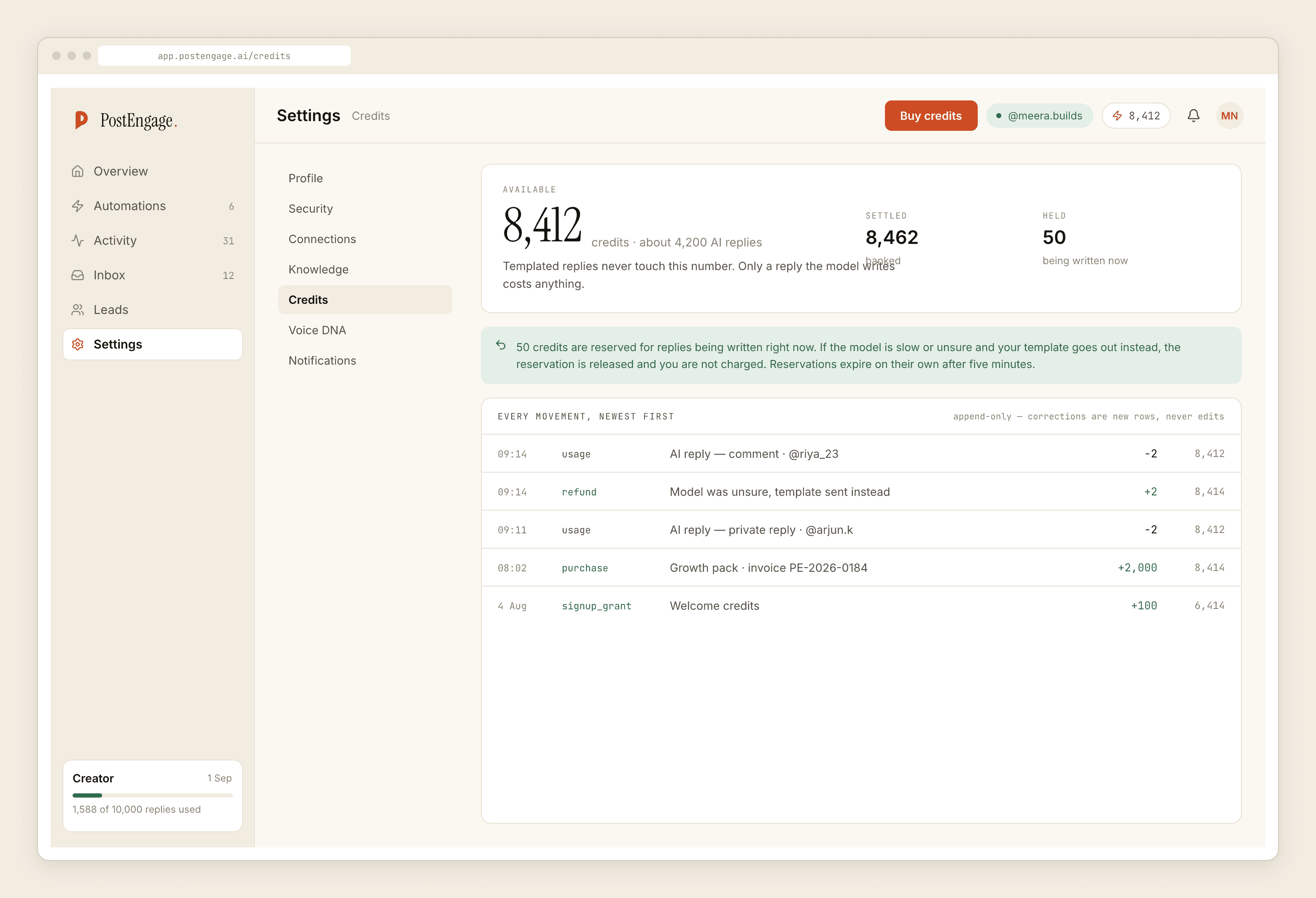
On Instagram, the meter is a credit. Templated replies are free and unlimited; a credit is spent only when the model writes a new reply, one credit per reply. The free tier is 100 credits and needs no card. Packs start at ₹499. There are no seats to buy and no contact ceiling, which is easy to offer when a product does one thing on one channel.
If you want the underlying model rather than the packaging, the pricing structure post is here. And if the real question is which tool suits your inbox rather than which is cheapest, that one refuses to rank anything either.
Questions people ask
How does WhatsApp Business pricing work in 2026?
Per delivered template message, priced by category and by the recipient country. Meta moved off conversation-based pricing on 1 July 2025, so any guide telling you to budget per 24-hour conversation window is describing a retired model.
What does a WhatsApp message cost in India?
As published for 2026: marketing about ₹0.8631, utility and authentication about ₹0.1150 each. Add 18% GST on Meta's rate and again on your provider's platform fee — a ₹0.8631 marketing message is about ₹1.0185 delivered. Verify against Meta's own pricing page before budgeting; these come from rate trackers.
Why is marketing so much more expensive than utility?
Meta prices the categories to discourage broadcast and encourage transactional messaging. Marketing is roughly seven times utility in India and carries no volume discount, while utility and authentication get cheaper as monthly volume rises. Moving a message from marketing to utility by making it genuinely transactional is the largest single saving available.
Are replies inside the 24-hour window free?
Today, yes. Meta has said that from 1 October 2026 it charges per service message at the same rate as utility and authentication templates. If your cost model assumes free replies, it has an expiry date on it.
Do I pay Meta and the tool separately?
Yes, and that is the number one reason quotes look cheaper than the bill. Meta's per-message charge sits underneath every vendor identically. A vendor plan either bundles it with an overage rate or excludes it entirely — read which, because a tier comparison that does not separate the two meters is comparing half of each bill.
Can an Indian business claim GST input credit on these tools?
Only with a proper GST invoice, which many USD-billed international vendors do not issue. That makes the effective cost of a foreign tool 18% higher than the sticker for a registered business, which is a real difference and rarely mentioned on any comparison page.