Comparison · 4 min read
The Cheapest WhatsApp Automation Tool: Two Meters, Not One

First, the thing that saves you reading further if it matters: PostEngage does not ship WhatsApp. We are not the cheap option on that channel because we are not an option on it at all.
Second, the thing worth reading anyway. "Cheapest" is a question with two meters behind it, and almost every comparison of this kind answers for one of them.
There are two bills, and they arrive separately
Meta charges for certain categories of message sent through the Business API. That charge is upstream of any software you buy — it exists whether you use a vendor, several vendors, or write the integration yourself.
On top of that, the vendor charges for the software. Contacts, seats, conversations, replies composed, some combination.
A vendor's pricing page is a complete and accurate description of the second bill. It is usually silent on the first, which is not deception — it is not their charge to quote and it changes — but it does mean a tool that looks cheapest can produce a month that is not.
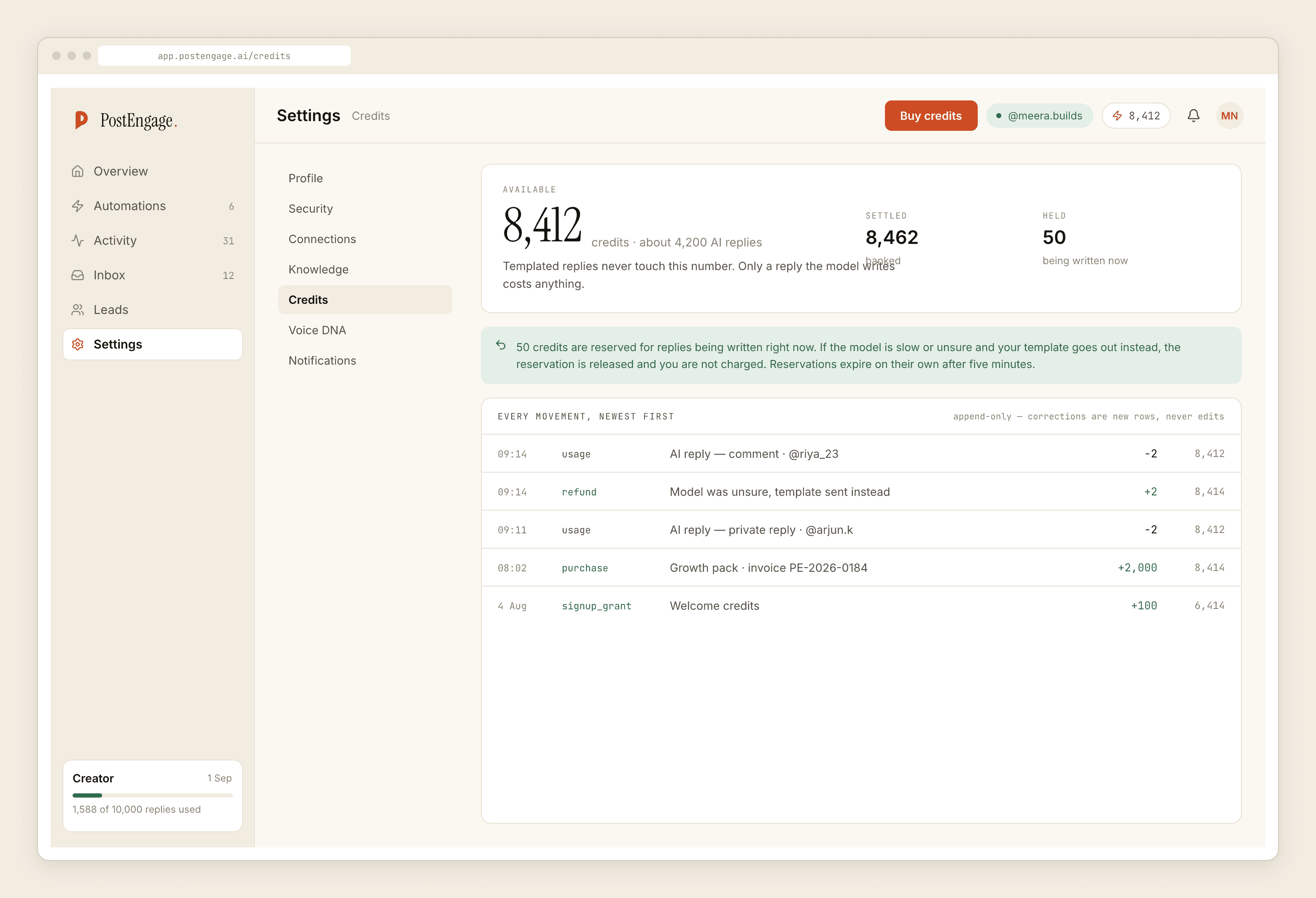
Cheapest per unit is not cheapest per month
The trap is that per-unit rates are only comparable when both parties count the same unit, and in this category they do not.
Priced by who you hold
Priced by work performed
Which one is cheaper for you is decided entirely by your own inbox, not by the rates. Count two weeks of real messages and sort them: questions that repeat, questions that are genuinely one-off. If a handful of answers cover most of the inbox, a work-based meter is cheap. If almost every message is its own situation, a held-contact meter probably wins.
That count takes an afternoon and it is the only part of this analysis nobody can do for you. The metering question in full is the companion to this page.
The costs that never appear on either meter
Three, and together they are usually larger than the software bill.
Your time. A cheap tool that needs an hour a week of maintenance is not cheap for anyone whose hour is worth something. This is the cost that makes genuinely free options expensive.
Switching. Whatever you pick, leaving it costs a fortnight of degraded replies and a rebuild of every automation. Choosing the cheapest thing and moving twice is more expensive than choosing the second-cheapest and staying. Migration is worth pricing before you commit.
A bad send. One template landing on top of an angry customer, or a wrong price going out to two hundred people, costs more than a year of the difference between two vendors. This is the argument for paying attention to what a tool refuses to send rather than to its rate card.
The cheapest tool is rarely the cheapest month, and never the cheapest year.
How to actually get a comparable number
Do not ask for the rate. Give each vendor the same specific month and ask for a total.
- Write the month down. Number of conversations, roughly what kinds, how many new contacts you would be holding at the end of it. Use last month's real numbers.
- Ask for the total including Meta's charge. A vendor who can produce that has thought about your case. One who redirects to the pricing table has answered a different question.
- Ask for the same month, doubled. This is where the shape shows. It is also the month you are hoping for.
- Ask where the cliff is. Almost every plan has a threshold where the next unit costs a step rather than an increment. Find it before you cross it.
- Ask what happens at the ceiling. Stop sending, auto-upgrade, or bill the overage. All three are reasonable and only one is what you assumed.
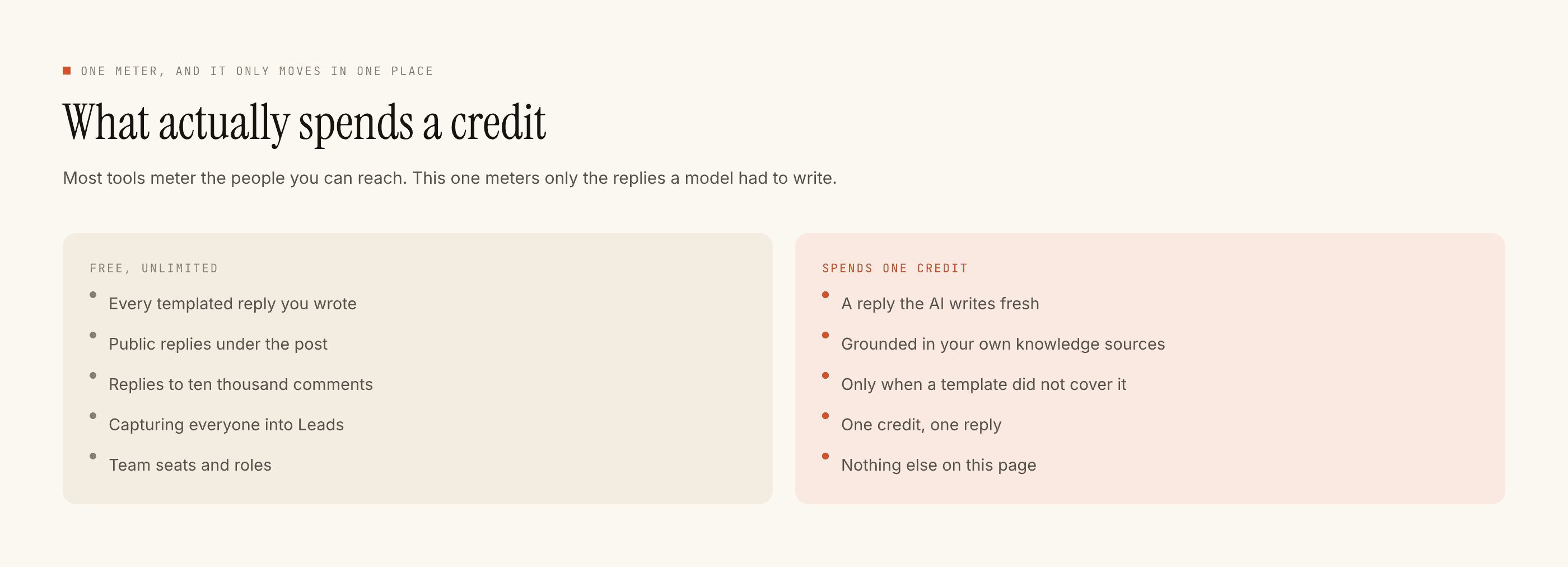
Our own numbers, since they are the only ones we can quote
On Instagram, which is the whole product: templated replies are free and unlimited, so a repeated question costs nothing however many times it is asked. A credit is spent only when the model writes something new. One credit, one reply. The free tier is 100 credits with no card and packs start at ₹499.
That is cheap for a predictable inbox and expensive for an unpredictable one, which is the same trade described above, applied to us. For the Indian cost model on WhatsApp specifically, this covers the levers.