Comparison · 5 min read
Utility Conversations: Where Two Meters Compound

Marketing spend on WhatsApp is a decision you make once a quarter. Utility spend is not a decision at all — it is a consequence of doing business. Orders get placed, so confirmations go out. Things get dispatched, so dispatch messages go out. Appointments get booked, so reminders go out.
That makes utility the most forecastable line on this channel and the easiest one to get structurally wrong, because it is where the platform's charge and your vendor's charge stack on top of each other and multiply by your order volume.
What the category is for
A utility conversation exists to tell somebody about a thing that already happened between the two of you. An order they placed. A booking they made. A payment they sent. The justification for interrupting a private inbox is that the person is already waiting for the information.
Which is also the boundary. The moment the message does anything besides that — a discount code under the tracking link, a "while you are here, our new range is live" — it is not a utility message any more, whatever you declared when you submitted it.
A utility message is allowed to be useful and nothing else. The upsell at the bottom re-categorises the whole thing.
Which categories exist, what each permits, and what each costs in your market are all Meta's to define and to revise. Check Meta's own documentation for the current definitions before you write a single template, because recategorisation is discovered at review time and it is discovered late.
The compounding problem
Two meters run on this channel and only one of them is on the vendor's pricing page.
What Meta charges
What the vendor charges
On marketing, that stacking is annoying. On utility, it compounds, because utility volume is proportional to your order volume and your order volume is the thing you are trying to grow.
Work it through on your own numbers. A vendor plan whose meter is per message is a per-order tax that grows exactly as fast as you do. A plan metered per contact charges you forever for everybody who ever bought once. A plan with a bundled allowance is fine until the month you exceed it, and the overage rate is usually the least prominent number on the page.
None of these is dishonest. They are different bets about what kind of customer the vendor wants. The mistake is evaluating them at today's volume.
Which utility messages are actually worth sending
The predictability of this category makes it tempting to notify on everything. Resist that, for two reasons that have nothing to do with money and one that does.
The money reason: every notification is a conversation charge, and a business that messages on six order events instead of three is paying a multiple on every order for information nobody asked for.
The other two reasons are worse. A customer who receives six updates per order learns to ignore all of them, including the one that mattered. And the more routine your messages become, the closer they sit to the line where somebody mutes or blocks the number your order queries also arrive on.
- Notify on state changes the customer would otherwise have to ask about. Order confirmed, dispatched, out for delivery, delivered. That is usually enough, and often fewer than that is enough.
- Never state something your systems cannot verify. A delivery date you got from an optimistic estimate is a promise your customer will hold you to, and the follow-up thread costs more than the message saved.
- Make the reply useful. A utility message that gets a reply has opened a conversation window, which is the cheapest place on this channel to be helpful. Design the message so a confused customer can just answer it.
- Keep the opt-in real. Utility does not mean unconditional. Consent still applies, and a customer who asks you to stop has to actually stop everywhere.
The unit economics question worth answering once
Take one order. Write down every message it will generate over its life — confirmation, dispatch, delivery, the query it might prompt, the review request if you send one. Price each at today's category rate for your market. Add the vendor's meter. That is your messaging cost per order.
Now compare it to your margin on that order. For most Indian businesses the number is small and entirely reasonable. For low-margin, high-volume categories it is occasionally the difference between a profitable line and an unprofitable one, and nobody has ever discovered that from a pricing page.
Do the calculation once, redo it when Meta changes something, and you will never again be surprised by a messaging invoice.
What we run today
PostEngage does not ship WhatsApp. On Instagram, where it does run, this category of message does not exist — there is no outbound notification, no broadcast, and no way to message somebody who did not contact you first. That removes the compounding problem entirely, and it also removes a genuinely useful capability. Both halves of that are true.
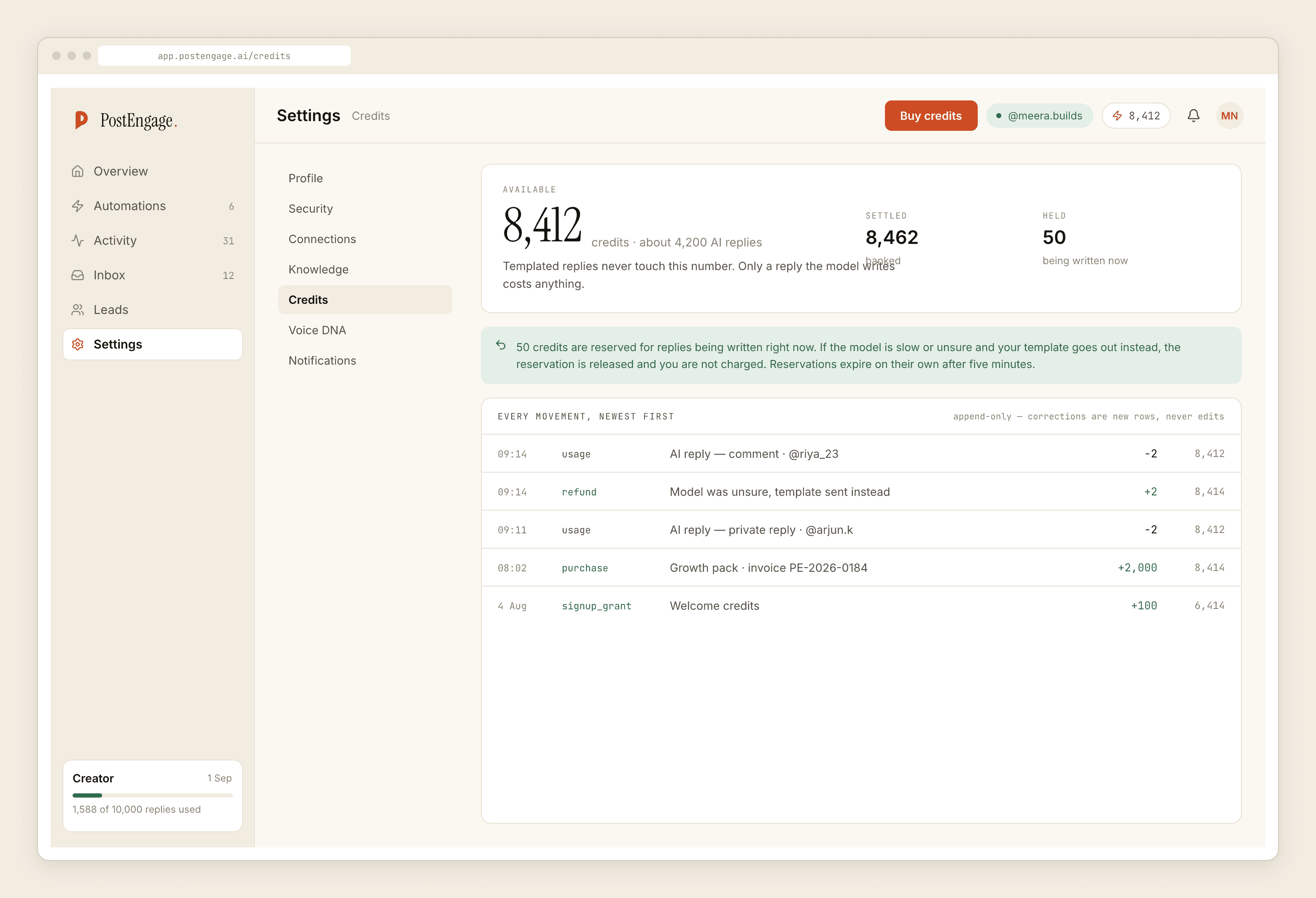
Our meter is a credit, spent only when the model writes a new reply. Templated replies are free and unlimited. The free tier is 100 credits with no card, and packs start at ₹499.
If the two-meters problem is your actual question, it is covered in full here. If you are designing the order messages themselves, the ecommerce post is about saying only what your system knows. And if one of your utility messages is a passcode, that is its own category with its own rules.