Comparison · 5 min read
WhatsApp Cloud API vs the Business App: Two Products

PostEngage does not ship WhatsApp — it runs Instagram comments and DMs — so this page is not steering you toward anything of ours. It exists because the single most common expensive mistake on this channel is setting up the wrong one of these, and finding out afterwards.
The WhatsApp Business app and the WhatsApp Cloud API are not a small version and a large version of the same product. They are different products with different mechanics, and moving between them is not an upgrade button.
What each one actually is
The Business app is an app. You install it on a phone, it holds a number, and a person uses it the way people use WhatsApp — by opening it and typing. It has its own built-in conveniences of the greeting-message and saved-reply kind, and Meta's documentation is the place to confirm what those include today, because that changes.
The Cloud API is not an app at all. There is no interface. It is an interface for software: your system, or a vendor's, sends and receives messages programmatically. Nobody opens the Cloud API. If you have the Cloud API and no software attached to it, you have nothing you can use.
Business app
Cloud API
The app is a product you use. The API is a component you build on. Almost every mistake here comes from expecting the second to behave like the first.
The number can only be in one place
The part that catches people, and the reason this is a decision rather than an experiment.
A phone number lives in one of these arrangements at a time. Moving a number onto the API means it stops being the number in the app on somebody's phone — you stop opening WhatsApp to answer customers, because answering now happens through whatever software you attached.
That trade is fine when you meant it. It is a bad surprise when the shop owner expected to keep replying on their phone as before and discovers the conversation now lives in a browser tab that only the office computer has open.
Decide deliberately which number you are moving. Many businesses keep the personal-service number in the app and put a separate number on the API for the automated work, which costs a second number and avoids the whole problem.
What you gain, and what you give up
Going to the API is not strictly more. It is different, and something is genuinely lost.
- You gain multiple people on one number. Several colleagues answering through shared software, with assignment and a record of who said what. The app was not built for that.
- You gain automation that runs when nobody is holding the phone. Replies at 2am, answers that draw on your own data, capture into a system.
- You gain a record you can audit and export. Conversations, refusals, consent, all as data rather than as messages on one person's handset.
- You give up the simplicity. Verification, a webhook, template approvals, and a vendor or a developer in the loop permanently. Setting it up is a project, not a signup.
- You give up replying from your own phone in the ordinary way. For a one-person business this is often the deciding cost, and it is routinely underweighted.
How to tell which one you need
Three questions, and they settle it faster than any feature list.
Does more than one person need to answer the same number? If yes, you are heading for the API eventually. If no, you very probably are not.
Does anything need to happen when nobody is looking? Automatic replies overnight, a message triggered by an order in another system, capture into a database. That is API territory by definition.
Would losing phone-based replying hurt? For a business whose service is one person's attention, this can outweigh everything on the other side.
If all three answers point at the app, use the app. It is not a lesser choice — it is the right tool for a very large number of businesses, and a great many Cloud API projects exist because somebody skipped this question. What "free" covers on this channel is the companion to that decision.
Where we actually are
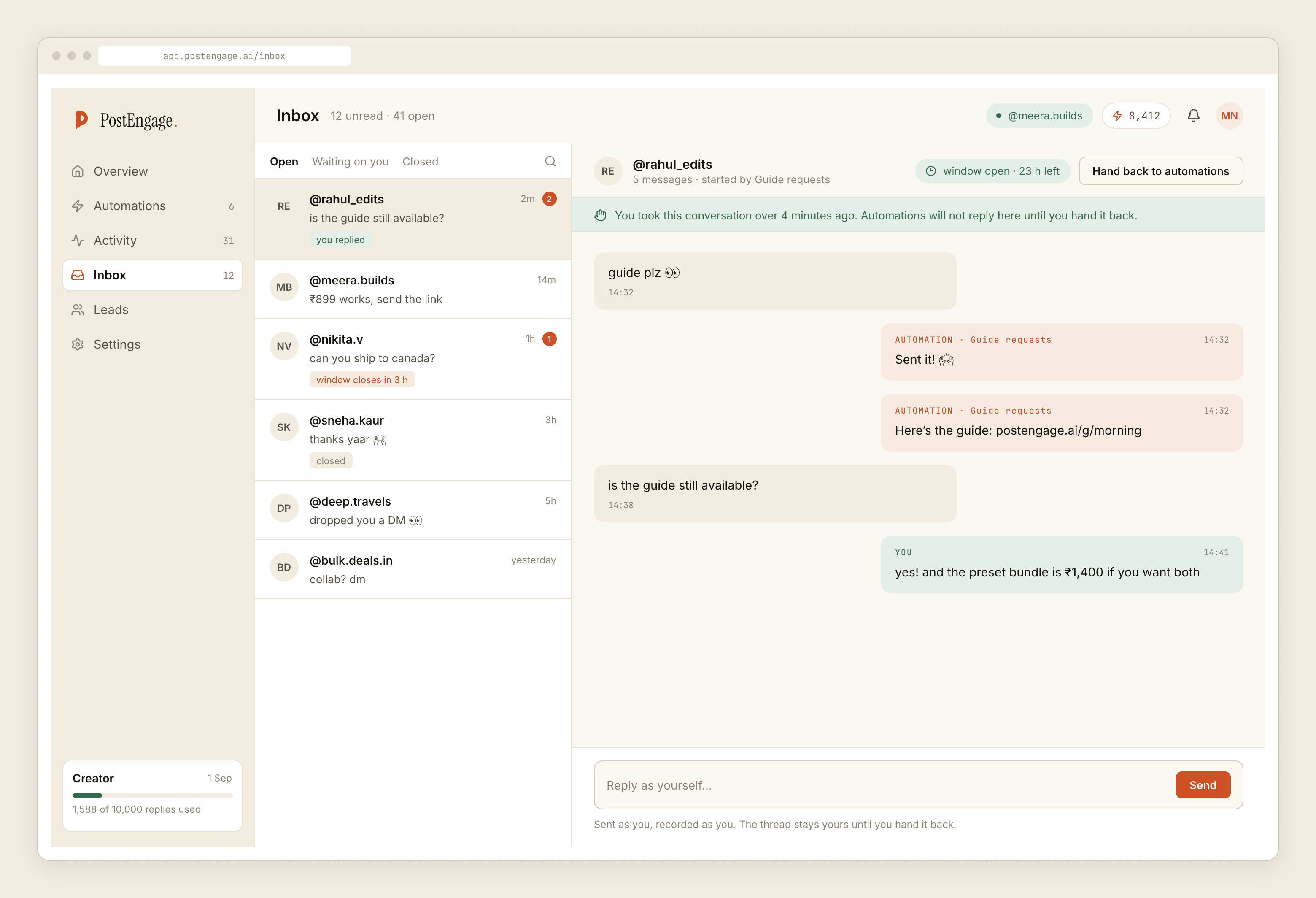
PostEngage answers Instagram comments and DMs on the official Graph API — a different platform with different rules, and the reason we can describe the API-versus-app trade at all is that we live on the API side of the same kind of divide. Ten named checks before every send, a recorded reason for every refusal, templated replies free and unlimited, credits spent only when the model writes something new, 100 free credits with no card, packs from ₹499.
For the Indian specifics of getting onto the Business API at all, that is covered here.