Playbooks · 5 min read
Small Business on WhatsApp: Should You Set This Up At All

Nearly every article aimed at a small Indian business on this subject assumes you have already decided. This one does not, because for a lot of shops the correct answer is no, and nobody writing about it has an incentive to say so.
So: you run a printing shop, a tiffin service, a boutique, a repair business, a bakery. You are the owner, and often the only person. Should you build automated messaging?
First, know which product people are talking about
Two entirely different things get called the same thing, and the confusion costs people money.
The free WhatsApp Business app is an app you install on a phone. It gives you a business profile, a catalogue, labels for organising chats, an away message, a greeting, and quick replies — canned answers you send with a shortcut. It is free, it takes twenty minutes to set up, and there is no verification process, no template approval and no per-message cost.
The WhatsApp Business Platform is the API. It needs a Meta Business account and business verification, messages you initiate go out as templates that Meta reviews, and Meta charges for conversations — with rules, categories and rates that vary by country and change often enough that any number in an article is unreliable. You reach it through a provider, who charges you too.
Most of what a one-person shop wants already exists in the free app, under a menu they have not opened.
The honest test
Ask three questions, in this order.
- How many identical questions do you answer a day? Not messages — identical questions. Price list, timings, delivery area, are you open. If it is under a couple of dozen, quick replies in the free app solve it entirely and cost nothing.
- Do you need to start conversations, or only answer them? This is the real dividing line. Answering people who message you first is what the free app does. Reaching out first — order updates to a list, a reminder to fifty people — is what the platform exists for and what you pay for.
- Would you miss money if a message waited three hours? A tiffin service taking tomorrow's orders until 8pm, yes. A tailor, honestly, no. If nothing is lost by a delay, an away message telling people when you reply is a complete solution.
Two noes and a maybe means do not build anything. Set the away message, write six quick replies, label your chats, and get on with the work.
What it actually costs, in things other than money
The bills are the visible part. The invisible costs are what makes small businesses abandon this after two months.
Being reachable. Once customers learn that a business replies at 11pm, they message at 11pm. An automated reply does not reduce that expectation, it establishes it. The messages that need you still need you, and now they arrive at night.
Maintenance. Every template with a price, a date or a menu in it goes stale. A template is not a thing you write once; it is a thing you own. A shop with eleven automations and no time to check them is sending customers last season's prices.
Setup work. Verification, a provider account, templates written and submitted for review, a number you can dedicate to it. That is real hours, and for a business with one pair of hands they are the same hours as the actual work.
If the answer is yes, build four things and stop
For the shops where it genuinely pays — enough volume, real outbound need, money lost to slow replies — the useful set is small.
Worth building
Skip
That last one matters more for a small shop than a big one. Customers send voice notes and photographs constantly — a picture of a fabric, a screenshot of a payment, a spoken order. None of it is matchable text, and all of it must go straight to you.
The keyword list nobody gets right the first time
One technique that is worth the half hour. Do not invent your trigger words — harvest them. Scroll back through fifty real messages and write down the exact strings people typed.
You will find that "how much" arrives as price, rate, kitna, kitne ka, daam, charge, price kya hai, and ? on its own after a photo. Case and punctuation fold away in most matching, but spelling and script do not: kitna and kitne are different words to a machine, and so are daam and दाम. The list from real messages will be longer and uglier than the one you would have written, and it will actually work.
What we run today
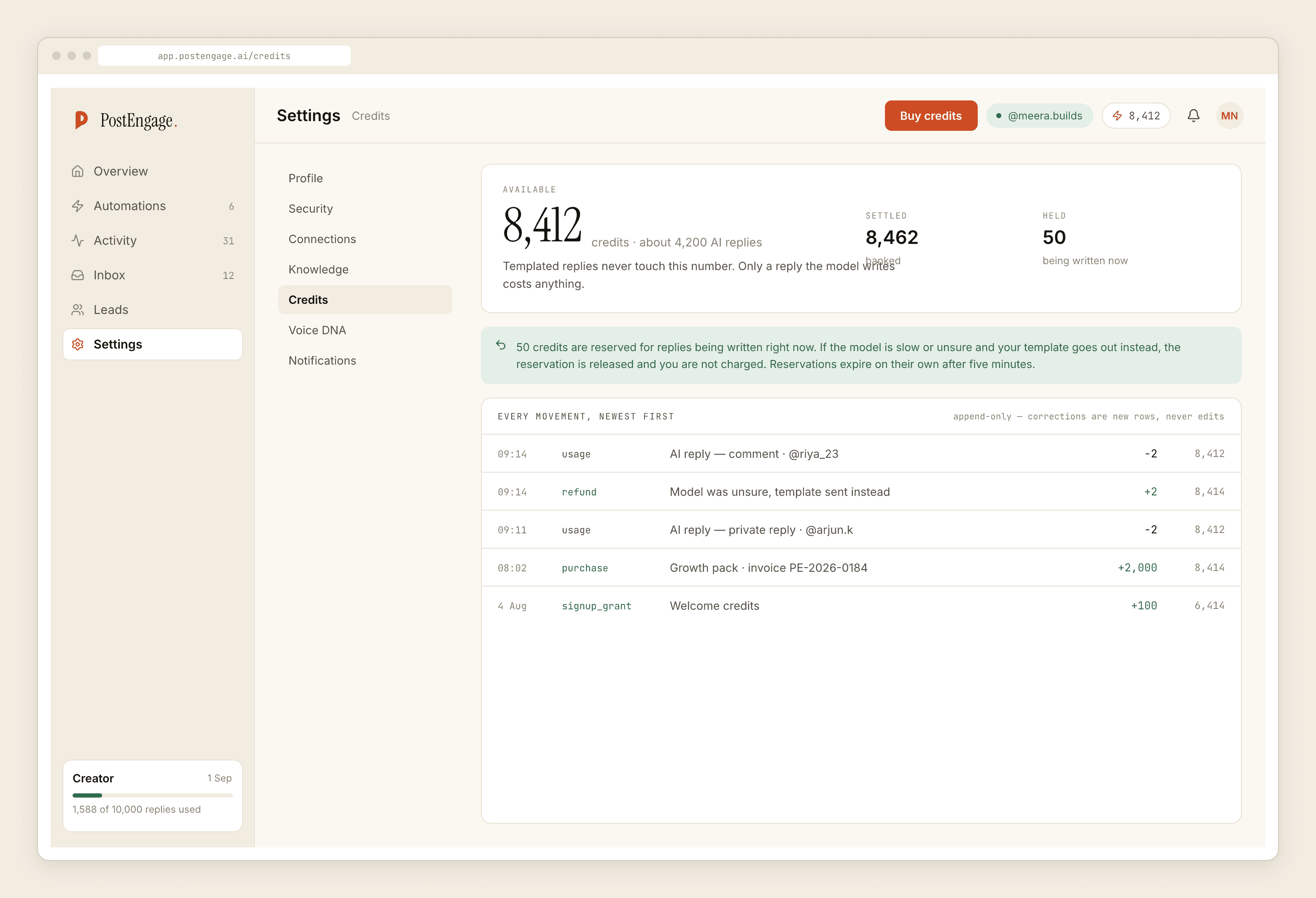
PostEngage answers Instagram comments and DMs through the official Graph API. That is the entire product — there is no WhatsApp in it, on any plan. This post is about the channel because small businesses search for it, and the useful thing to tell them is sometimes that they do not need this.
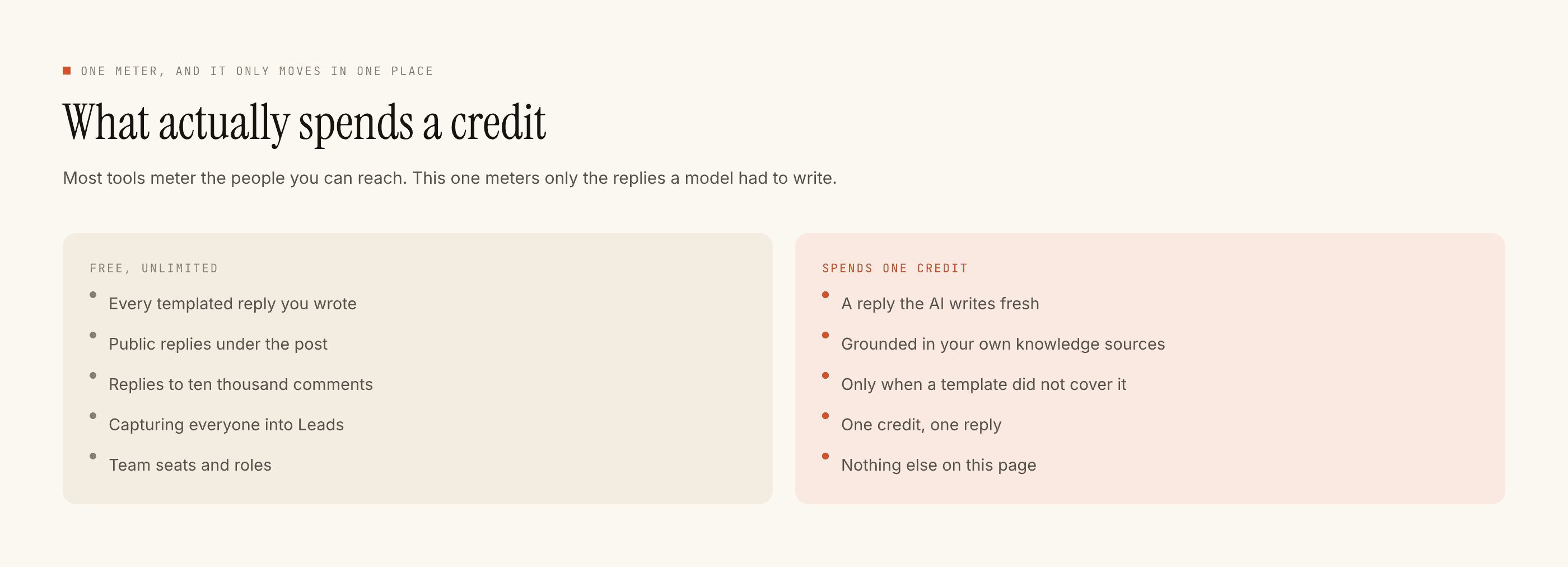
If Instagram is where people find you, the mechanics there are fixed: a comment stays answerable for seven days, a DM thread for twenty-four hours, restarted only by their own next message. Templated replies are free and unlimited — a credit is spent only when the AI writes new text — so the repetitive tail costs nothing. The free tier is 100 credits with no card, and packs start at ₹499.
Related: what this channel costs in India, free versus paid, and Instagram tools for a small business.