Playbooks · 4 min read
What a Nonprofit Should and Should Not Automate on WhatsApp

We do not ship WhatsApp, so nothing here describes a feature. It is about a sector where the usual automation advice is not merely unhelpful but actively harmful, and where two narrow uses are unusually valuable.
The distinguishing fact is who is writing to you. A nonprofit inbox mixes donors, volunteers, journalists and — depending on what you do — people in the middle of the worst week of their year. One inbox, four populations, and an automated reply that is fine for the first is unforgivable for the fourth.
Sort the inbox before you automate any of it
Safe to answer instantly
Never
The right-hand column is not a long tail. In most organisations it is a small share of messages and nearly all of the consequence.
The two things worth automating
The donation questions. They repeat endlessly, the answers never change, and answering them in thirty seconds rather than three days measurably changes whether the donation happens. Where the money goes, what proportion reaches the programme, whether the receipt is tax-deductible, how to give monthly.
The volunteer logistics. Where to turn up, what to bring, whether the session is still on. This is the message with the highest gratitude-to-effort ratio in the sector, because somebody is standing at a bus stop wondering.
Neither requires knowing anything about the person, which is exactly why both are safe.
The negative keyword list is the build
On most projects the trigger list is the work. Here it is the opposite: the list of words that must stop an automation is the design, and it needs writing by somebody who has read a year of real messages.
Start with the obvious distress vocabulary and then add the words your particular cause attracts, in every language your audience writes in. Include the transliterations — people in a hurry type Hindi in Latin script, and a rule that only matches Devanagari will miss them entirely.
In this sector, the automation is defined by what it refuses. Everything else is a detail.
Reporting and consent, briefly
Two things that bite nonprofits specifically.
Donor consent is not volunteer consent. Somebody who gave once has not agreed to hear about your campaign, and the fact that a database has both in one table is not an argument. Keep the purposes separate, because the person does.
Beneficiary data is not marketing data. If you hold anything about people you serve, it does not belong in a messaging tool at all, and certainly not in one shared with the fundraising team. The privacy inventory post is the closest thing to a checklist we have written.
What the same problem looks like on Instagram
PostEngage answers Instagram comments and DMs, and the shape carries across exactly. The automation stands down the moment a person replies by hand, which is the feature that matters most here — a colleague who steps into a difficult conversation is not competing with a template.
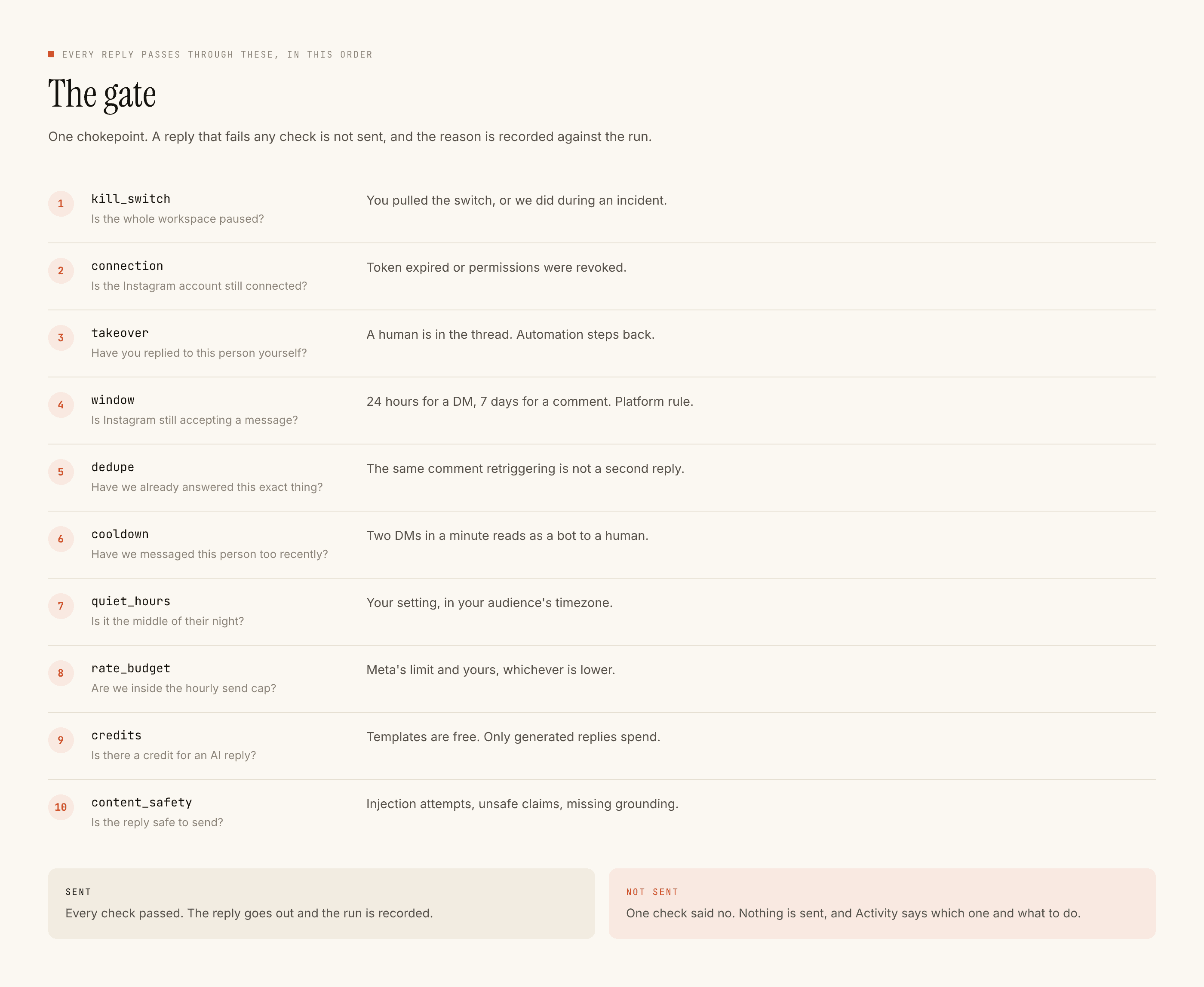
Quiet hours matter more here than anywhere else, too. An automated reply at 3am to somebody who wrote at 3am is worse than silence, and it is worth setting before the first automation goes live rather than after.
The thing that goes wrong most often
Not a bad automated reply. A good one, sent to the wrong person, at scale.
The pattern is always the same. A keyword rule is written for donors — "donate", "support", "help" — and the third word is the one that ruins it. "Help" is what a donor types when offering it and what somebody in trouble types when they need it, and no amount of care in the reply's wording fixes a rule that cannot tell the two apart.
The fix is not a cleverer rule. It is removing the ambiguous word from the trigger list entirely and letting those messages reach a person. You lose the instant answer for a handful of donors, and you avoid the outcome that would have ended up on somebody's timeline.
The measurement question
There is no analytics product here on any channel, and for this sector that is less of a loss than it sounds. The numbers worth watching are countable by hand: how many donation questions arrived, how many got an answer the same day, and how many conversations a person took over.
That third number going up is a good sign, not a bad one. It means the routing is working.
Where to read more
For the consent question underneath all of this, the opt-in post goes deeper. For the Instagram version of nonprofit automation, which is the channel we actually run, that is here.