Playbooks · 6 min read
Nonprofit Instagram DMs: Who Actually Owns the Inbox

Three paid staff, a couple of dozen volunteers, and an Instagram account that was set up in 2021 by someone doing an internship who has since moved cities. The password is in a WhatsApp thread. The person who posts most weeks is a volunteer who is brilliant and available on Saturdays.
That is the actual operating context for most small organisations, and it is what decides whether automation helps or quietly makes things worse. The donor-facing questions — what to say when someone offers money, how to handle a disclosure, what belongs in a public comment — are covered in the post on running a charity account. This one is about the boring half: access, rotas, and who is accountable for a message sent in the organisation's name on a Wednesday night.
Start with the connection, because it will break
The automation runs against a connected Instagram account. Nothing sends if that connection lapses, and the gate records the refusal rather than guessing — that is the correct behaviour and it is also the behaviour that surprises people three months in.
Connections lapse for ordinary reasons. Somebody changes the password after a scare. Somebody removes an app from the Business account while tidying up. Somebody's two-factor is on a phone number that no longer exists. In a company, that gets noticed the same morning. In a small organisation, the automation stops and nobody realises for a fortnight, because the thing it used to do was invisible when it was working.
Takeover creates ownership without assigning it
This is the one that specifically catches volunteer-run inboxes, and it is worth understanding before you go live.
Takeover means that the moment any human replies by hand, automation stands down in that thread permanently. That is exactly what you want. A generated line landing under a coordinator's carefully worded reply would be much worse.
But look at what it does inside a rota. A Saturday volunteer opens the app, sees a message, types a warm two-line reply, and closes the app. That thread is now un-automated forever, and the person who owns it is a volunteer who will not be back until next Saturday. Nothing flags it. Nothing reassigns it. There is no queue, no assignment, no escalation, no internal note — none of that exists in this product.
Every hand-typed reply is a small transfer of responsibility, and in a volunteer team the responsibility often lands on somebody who is not there tomorrow.
The fix is procedural, not technical. Decide who reads the inbox on which days, say out loud that replying to a thread means owning that thread until it is closed, and have one person sweep the inbox weekly for conversations that stopped mid-sentence.
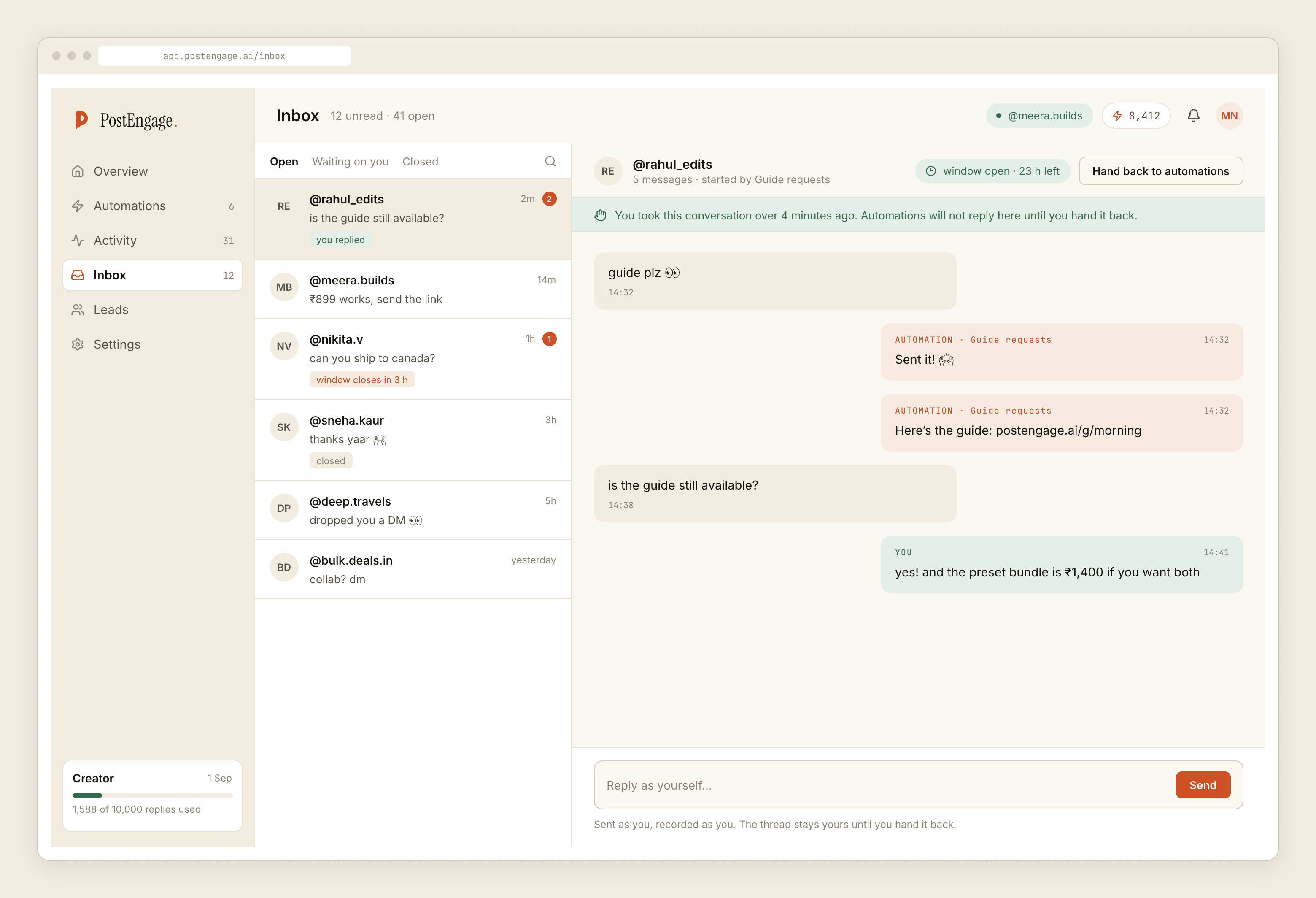
The window does not care about your rota
Seven days to reply to a comment. Twenty-four hours to reply inside a DM thread, restarted only when the other person writes again. Official Graph API, no exceptions, no plan that changes it.
For an organisation where the inbox gets checked on Wednesday evenings, the DM clock is brutal and the comment clock is generous. That asymmetry should shape what you build. Put your effort into the comment automations — a post about a volunteer drive, a keyword in the caption, a public acknowledgement and a private reply with the details — because those have a week of slack in them.
Do not build anything that depends on a human following up inside a DM within a day, because on the weeks when your one part-time comms person is at a funder meeting, nobody will.
The three-in-the-morning problem
An automated reply going out at 3am from an account nobody is watching is a specific risk for a small organisation. If it is right, nothing happens. If it is wrong — a stale template about an event that finished, a cheerful line under a difficult message — it sits there for nine hours with your name on it and no one to catch it.
Quiet hours is the control. Set it to the hours when nobody could plausibly intervene. You will answer a few messages more slowly, which for this kind of account is not a real cost, and you remove the class of failure where the organisation's only public voice is a template at 3am.
One person who can stop everything
Something will happen. A story breaks about your sector, a service you run has a bad week, a post lands badly, or a beneficiary posts something in your comments that changes what your account should be saying.
The kill switch stops every automation immediately, and it is the first check in the gate — before connection, before anything. What matters is not the button. It is that everyone in the organisation knows it exists, knows who can press it, and knows that pressing it in a moment of doubt is the correct call and nobody will be annoyed about it afterwards.
Write that in the same document as the two login names. It takes one line.
What this costs, honestly
Templated replies are free and unlimited. A credit is spent only when the AI writes a new reply, one credit per reply. The free tier is 100 credits with no card, and packs start at ₹499.
An organisation running fixed, agreed wording — volunteer sign-up details, where to find the annual report, what your services actually are, how to reach the office — can run a long way on templates alone. That is not a trick. It is what the pricing is shaped like, and it happens to suit an account whose replies should be consistent and pre-agreed anyway.
There is nothing to negotiate, no nonprofit tier to apply for, and no discount process. What is on the page is what there is.
What it will not do
It does not take donations. There are no payment links, no donation buttons, no fundraising pages, no receipts, no tax paperwork. If you want money to move, the automated reply contains a link to wherever that already happens, and that is the whole of the integration.
There is no CRM sync — supporters captured to Leads leave as CSV and you import them yourself. No WhatsApp. No scheduled sends, no reminders, no broadcast to your followers, and no way to message anyone who has not messaged you first. No analytics product, so it will not tell a funder what your engagement did.
And it cannot post for you. No caption tool, no calendar, no scheduling. The account still needs a human who writes.
If you are weighing this against paying somebody a few hours a week, that comparison is its own post, and what the free tier actually covers is worth reading before you plan a budget line around it.