Comparison · 5 min read
ManyChat Alternatives in 2026: Pick by Use Case, Not Features
Nobody switches tools because a comparison table told them to. They switch because something specific broke, and then they go looking for a tool where that thing does not break. So the useful version of this article is not a ranked list. It is a way of naming the thing that broke.
In our inbox, people leaving ManyChat are usually leaving for one of four reasons. They do not have the same answer.
The four reasons, and they point different directions
| What broke | What you actually need |
|---|---|
| The bill grew faster than the account did | Pricing metered on work done, not on audience size |
| The replies read like a bot | Generated replies grounded in things you actually wrote |
| A Reel travelled and the automation embarrassed you | Rate limits, dedupe, and a kill switch that is one click |
| You only ever used the Instagram part | A smaller tool that does Instagram and nothing else |
If none of those describe you, the honest advice is to stay. ManyChat is a capable product with a wider surface than most things in this category, and migrating a working setup costs a fortnight you will not get back.
Pricing model beats pricing page
We are not going to quote anyone's current price. Vendors change them, and a stale number in an article is worse than no number. What is stable is the shape.
Most of this category, ManyChat included, has historically metered on contacts: how many distinct people your automation has ever spoken to. That number only goes up. A person who asked one question in March and vanished is still on the bill in December.
The other shape is metering on work performed. A reply sent costs something. A dormant contact costs nothing, because nothing is being sent to them.
Per-contact pricing bills you for reach. Revenue comes from conversion. Those are not the same number.
Neither model is dishonest. They break in different places. Per-contact pricing is comfortable if your audience is small and buys reliably, and punishing if you make one video that travels. Per-reply pricing is comfortable if most of your replies are the same four answers, and gets expensive if every single reply needs a model to write it from scratch.
Which is why the split matters. On our side, templated replies are unlimited and free. Credits are only spent when the model actually writes something new. Most accounts find that eighty percent of their inbox is four questions, and those four answers cost nothing to send forever.
ManyChat is better than us at several real things
Worth saying plainly, because a comparison that admits nothing is not a comparison.
Where ManyChat wins
Where we win
If your business runs on WhatsApp, this is a short conversation. We do not do WhatsApp. Not "coming soon", not on the roadmap. Stay where you are, or pick something else that does.
Same answer if you need a Shopify cart recovery flow wired into a Messenger sequence, or a CRM sync, or any of the several hundred integration paths that a bigger tool has and a small one does not. Feature count is a real advantage. We are not going to pretend otherwise.
What a smaller tool can do that a bigger one finds hard
Say no on your behalf.
Every automation tool can send a message. The difference between them is what happens in the moment before sending, when something is slightly wrong. The reply is a little off. The person already got an answer four minutes ago. It is 2am. The post is going viral and there are 900 comments in the queue.
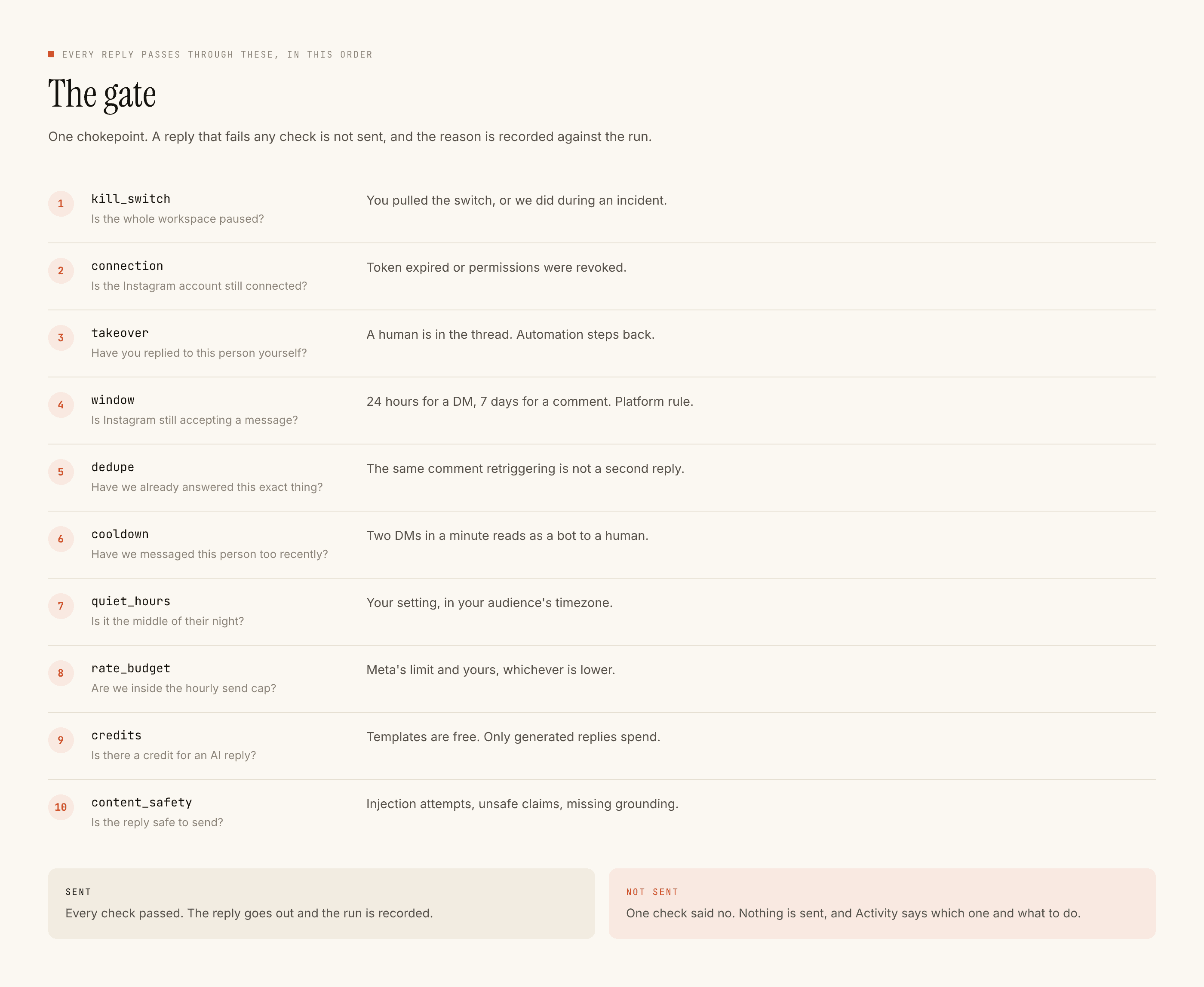
Ours runs the same ten checks in the same order every time: kill switch, connection, takeover, window, dedupe, cooldown, quiet hours, rate budget, credits, content safety. First failure ends it and the reason is written down. When the model is slow, unsure, or writing something not grounded in your own words, your template goes instead of the generated draft. Nothing clever happens at 2am.
How to test an alternative without betting the account
Two weeks, one account, no migration.
- 01
Leave your existing setup running
Do not switch anything off. You are adding a second opinion, not replacing a system you still depend on.
- 02
Connect the new tool to one account and one post type
Comments on Reels, or DMs from story replies. One surface, so you can actually read every reply it produced.
- 03
Read the drafts, not the dashboard
Open twenty replies it sent. Would you have sent those? That question decides this, and no metric answers it.
- 04
Make it fail on purpose
Comment twice from a second account. Comment at midnight. Check that dedupe and quiet hours actually held, and that the tool can tell you why it skipped something.
- 05
Then decide about the bill
By now you know whether the replies are usable. Price a tool that does not work is not a saving.
If you are here mainly because of cost, the arithmetic on why the bill grows is a better read than this one. If you want the direct head to head, we wrote PostEngage vs ManyChat and tried to be fair in it.
Where we land
The alternative worth picking is the one that solves the thing that broke. If the thing that broke was reach, buy reach. If it was the bill, look at what is being metered. If it was a reply going out that made you wince, look at what runs before the send.
We built for the last one. That is a narrow product, deliberately. Narrow is only a virtue when it is the right narrow.