Playbooks · 5 min read
There Is No Shop Integration Here. The DM Still Matters.

Clear the ground first, because this is an area where tools promise a lot.
There is no shop integration in this product. No product catalogue, no shopping tags, no stock or inventory data, no cart, no checkout, no order lookup, no shipment tracking, no payments, no refunds, no abandoned-cart recovery. Nothing here can tell you whether an item is available, whether an order shipped, or what somebody bought.
It replies to comments and direct messages on Instagram, through the official Graph API, and that is the boundary of what it can see.
So it does not sell anything. What it does is remove the specific thing that stops a sale, which is narrower than a sales machine and is genuinely worth having.
The question that blocks the purchase
Watch what actually happens under a product post. Somebody is interested enough to type, and almost every one of those messages is a small blocker sitting between them and the buy button.
Will this fit me. What is it made of. Do you ship to my pincode. Is this the same one from the reel. What's the difference between these two variants. Is the colour like the photo. Is it machine washable. Kitne din mein aayega.
Every one of those is a fixed fact about the product. None of them requires knowing anything about the customer, the order, or the inventory. All of them can be answered by a template, at three in the morning, for free, at any volume.
You are not automating a sale. You are automating the removal of one specific doubt, fast enough that the person is still holding their phone.
That is the whole honest claim, and it is a better one than most people expect, because the alternative is that the question sits unanswered until Monday and the person buys something else on Saturday.
Send the product page, not the shop
The single highest-leverage detail, and the one people skip because it means more automations.
A link to your store homepage drops somebody who asked about one specific kurta into a grid of two hundred. They will not go looking. A deep link to that exact product, from an automation restricted to that post under Advanced, is the difference between a reply that works and one that is technically a reply.
The page also carries the price, which solves a problem quietly. A price typed into a template is a figure your account keeps repeating after the sale ends, the GST changes, or the SKU is discontinued. "Full details and current price are on the product page" survives all three.
Three sentences that must never be automated
"In stock." Nothing here can see stock. Not a plan limit, not a setting — there is no inventory data. An automated availability claim is a promise about a shelf the system has never seen, and the person finds out at checkout.
"Your order is on the way." No order lookup. A reply that sounds like it checked has lied about the only thing the customer cared about, and they will stop looking for help somewhere that could actually give it.
A discount code with no end date in the template. This one is the quiet money-loser. DIWALI20 typed into an evergreen automation is a code your account keeps handing out in March. Campaign codes belong in temporary automations with a switch-off date written down the day they are built, in the same list as taking the banner off the site.
Matching folds case, punctuation and Latin accents, so Refund, refund. and REFUND are one word. It does not fold Indic vowel signs, and it matches whole words: return will not catch returns. Write both.
A build that behaves
- One automation per product post you actually push. Not per SKU — per post. Restricted to that post, with a trigger word you put in the caption yourself. No caption line, no comments, no flow, and nothing here writes captions.
- Public reply short and content-free. Everyone scrolling reads it. It should not contain the price, and it should not say "in stock". "Sent 📩" repeated four hundred times reads as a wall; vary it.
- Private reply: the product link, one useful line, and nothing else. Size guide if that is the blocker, material if that is the blocker. Pick the one question that post actually generates.
- Capture on, and name the person who exports. Leads leave as CSV. There is no CRM sync and no connector into your store.
- Rate budget before anything you expect to travel. An uncapped automation answering thousands of comments an hour is how a good day starts looking like spam. A comment stays answerable for seven days, counted per comment, so the queue drains long inside the window.
- Test on yourself. The whole pipeline, delivered to your account. It catches the error everybody makes: duplicating an automation for the next product and forgetting to change the link.
The clock is why speed is the whole benefit
A DM thread stays open for twenty-four hours from the customer's last message, restarted only when they write again. There are no sequences, no scheduled follow-ups and no broadcasts — the platform does not permit the message, so no tool on the official API has them.
Which means the abandoned-cart nudge people ask for does not exist here in any form, and the entire value has to land in the first reply. A person who asked about a size at 11pm and gets the answer at 11:01pm is inside the moment they were buying in. The same answer on Monday arrives into a closed thread and a decision already made.
Cost
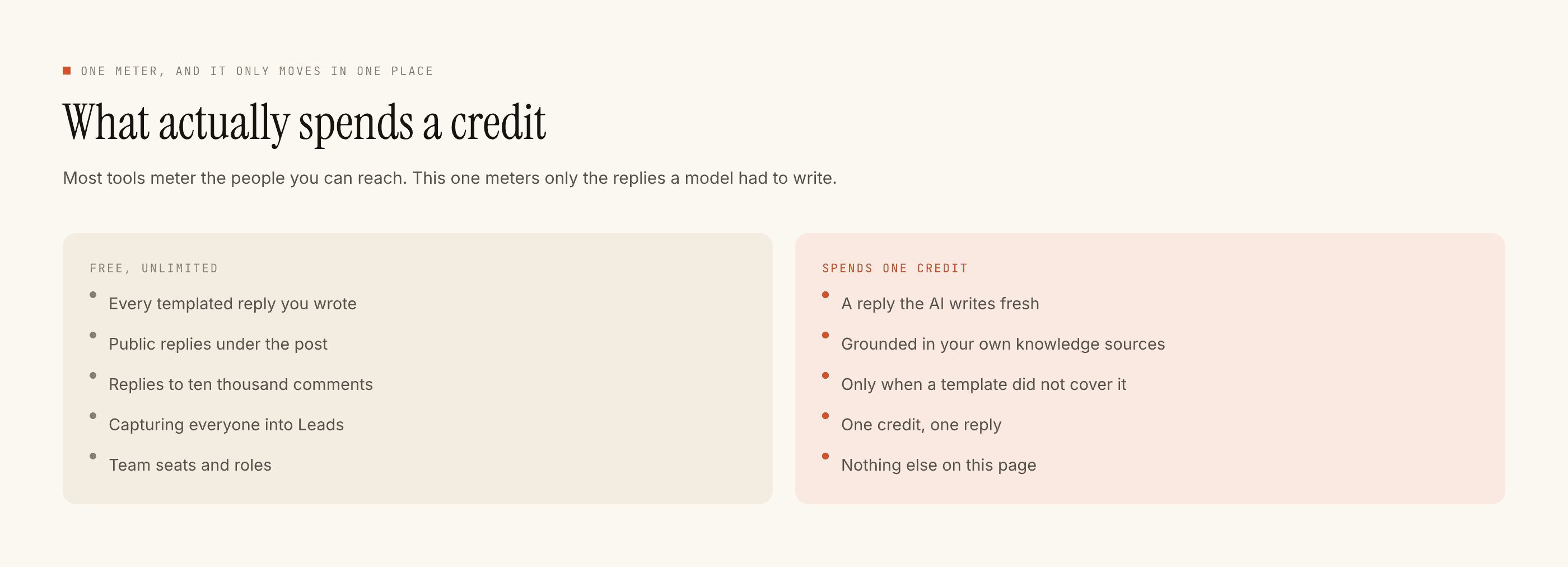
Templated replies are free and unlimited. A credit is spent only when the AI writes a new reply, one credit per reply. A shop account built the way this post describes runs almost entirely on templates, because product facts are fixed, which means the busiest half of the inbox costs nothing at all. Free tier is 100 credits with no card; packs start at ₹499.
Takeover stands the automation down the moment anyone replies by hand — no template landing underneath a message your team wrote carefully.
If you sell direct and want the wider shape, the ecommerce post covers it, and what selling on this platform honestly looks like is the more strategic read. For keeping the conversation on-platform instead of pushing everyone to a bio link, that argument is here.