Playbooks · 5 min read
Instagram SEO and the Post That Keeps Working Months Later

We have no SEO features. No caption generator, no hashtag tool, no keyword research, no ranking tracker, no analytics of any kind. Nothing in this product affects how far a post travels or where it appears in anybody's search results.
So if you are here for a tool, this is the wrong page. What follows is what "Instagram SEO" means when you strip the packaging off it, and the one place it genuinely touches automation — which turns out to be a more useful connection than any tool would have been.
What Instagram SEO actually is
Nobody outside Meta knows the ranking mechanism, and anyone writing confidently about it is describing a guess. What is observable is simpler and enough to work with: Instagram has a search box, people type words into it, and results come back — accounts and posts.
That means the words attached to you are the raw material. Specifically:
Your name field. Not your handle, the display name underneath it. It is a searchable field and most accounts waste it on the same string as the handle. "Meera" is a name. "Meera — handmade lamps, Jaipur" is a name and three search terms.
Your captions. The words in them are words about the post. If your caption never contains the phrase somebody would type to find what you sell, you have not given search anything to match.
Your alt text. Available on every post, ignored by nearly everyone, and it costs one sentence.
That is most of it. The rest of the discipline is writing plainly about what you actually do, in the words your customers use rather than the words your industry uses — bridal lehenga price rather than curating occasion wear.
The genuine link to automation
Here is the part worth the post.
The comment window is seven days per comment, not per post. It is counted from the moment each individual comment was written, not from when you published.
So a post from March that surfaces in a search result in September, and picks up a comment that day, gives you a full seven days to answer that person. The automation you wrote in March is still live, still matching, still sending. Nothing about the post's age reduces it.
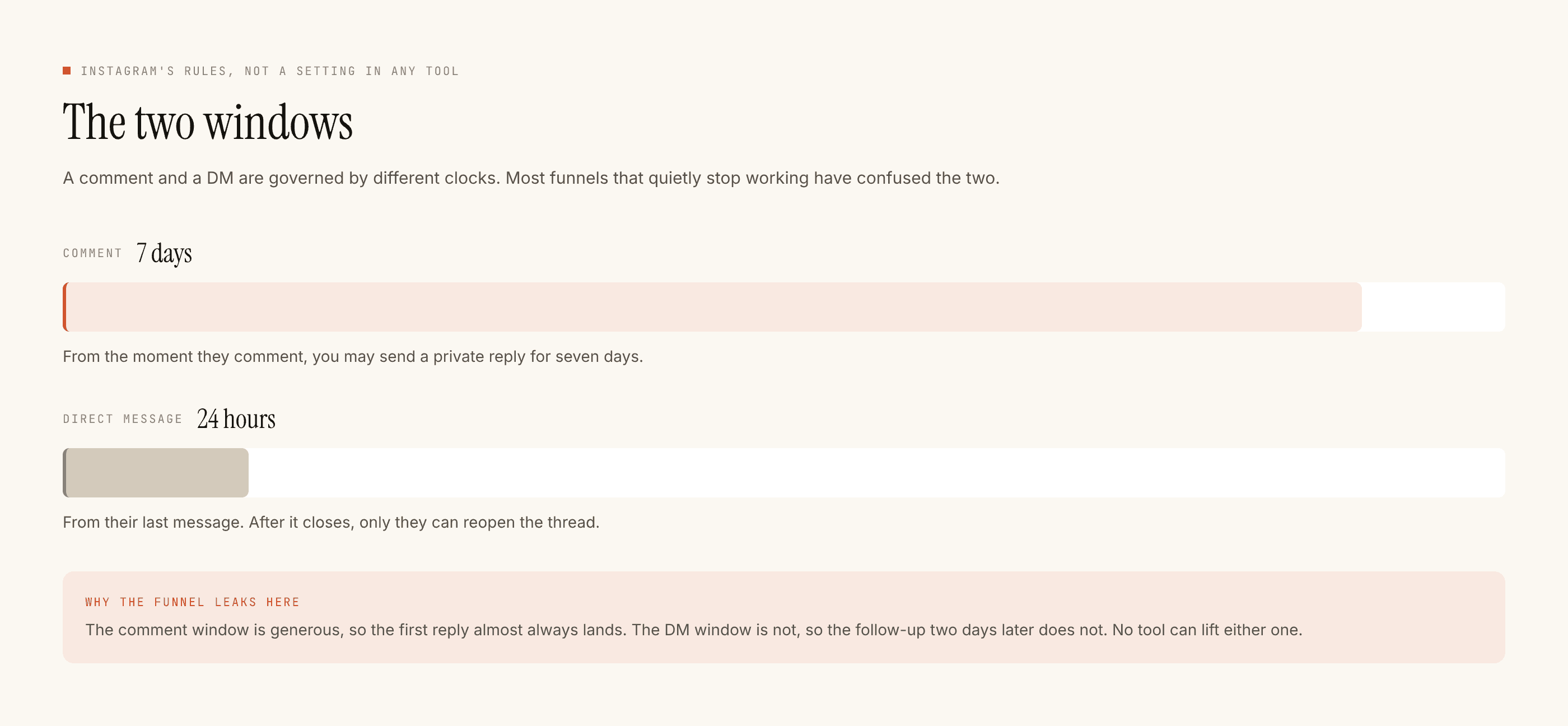
This is the opposite of the habit most accounts have. People switch off automations on old posts for tidiness, or because a campaign ended, and in doing so they turn off the only thing that would have converted the search traffic they spent months earning.
A post that ranks is distribution you already paid for. An automation switched off for tidiness is the only thing standing between that distribution and a conversation.
What follows from it
- Leave the automations on your evergreen posts. The ones answering a question that will still be asked next year — sizing, pricing, how a service works, what is included. Those are also the posts most likely to be found by search, which is not a coincidence.
- Make the searchable word and the trigger word the same word. If people find the post by typing "price", the ask on that post should be
PRICEand the keyword list should contain it. One word doing two jobs is cleaner than two words doing one each. - Write the caption so it survives being found cold. A search visitor arrives without the context your followers have. The caption should say what the thing is before it says anything clever.
- Check the old automations still tell the truth. This is the real cost of leaving them on. A rule written in March that quotes a price you changed in June is worse than no rule, and it will keep confidently quoting it to every person search sends you.
- Put the review in the calendar, not in your memory. Once a quarter, open every live automation and read what it says out loud. It takes an hour and it is the only maintenance this needs.
The failure mode nobody warns about
An evergreen post that ranks well and carries a stale automation is a slow, quiet problem. Nothing breaks. Nothing appears in the blocked list, because the reply is sending perfectly — it is simply wrong.
You find out when somebody arrives expecting last year's price. By then the message has gone out to everyone search sent you since the price changed.
This is an argument for fewer automations rather than more, and for each one being specific enough that you notice when it is out of date. A rule that says "the price list is in the DM" ages badly. A rule that says "comment SIZE and I will send the chart" ages fine, because the chart is a link to a thing you can update in one place.
What we do not do, restated
No caption writing, no hashtag suggestions, no content calendar, no scheduling, no publishing, no Explore placement, no analytics, no follower growth, no ranking reports. We reply to comments and direct messages on your Instagram account, through the official Graph API, inside the windows it allows.
The honest version of this post is therefore short on tactics and long on one point: the searchable half of your account and the automated half of your account are connected by exactly one mechanism, and it is the seven-day-per-comment window. Everything useful you can do here follows from taking that seriously.
If you want the mechanics of the comment surface in full, the reference covers each field and each check. If the words are what you are working on, keyword choice is the post. And if you are deciding which posts deserve a rule at all, that question has its own answer.