Playbooks · 5 min read
Which Reels Deserve an Automation, and Which Do Not

The moment automation is set up, the instinct is to attach it to everything. Every Reel gets a keyword, every keyword gets a rule, and within a month there are fourteen automations running and nobody remembers what half of them say.
That instinct produces worse results than being selective, and not for the reason people assume. It is not about volume limits. It is that an automation is a promise attached to a specific piece of content, and most content has no promise to make.
What an automation actually costs
Four currencies, none of which is money on the first one.
Your keyword space. Words are finite and overlap is expensive. Two rules that both contain link will fight over the same commenter, and the gate resolves that with dedupe and cooldown refusals rather than with a coin toss. A growing dedupe count is not a log entry, it is a design smell — usually two of your own automations arguing.
Your followers' patience. A regular follower who comments under three of your Reels in a week receives three cold openings, each one introducing an account they have followed for a year. First-time senders only, under Advanced, exists precisely because of this, and it is a patch on a problem better solved by having fewer rules.
Your inbox. Every automation you switch on adds conversations that you now have to finish. The automation buys the first answer. The second, third and fourth turns are yours, and an account running fourteen rules is generating homework at a rate one person cannot clear.
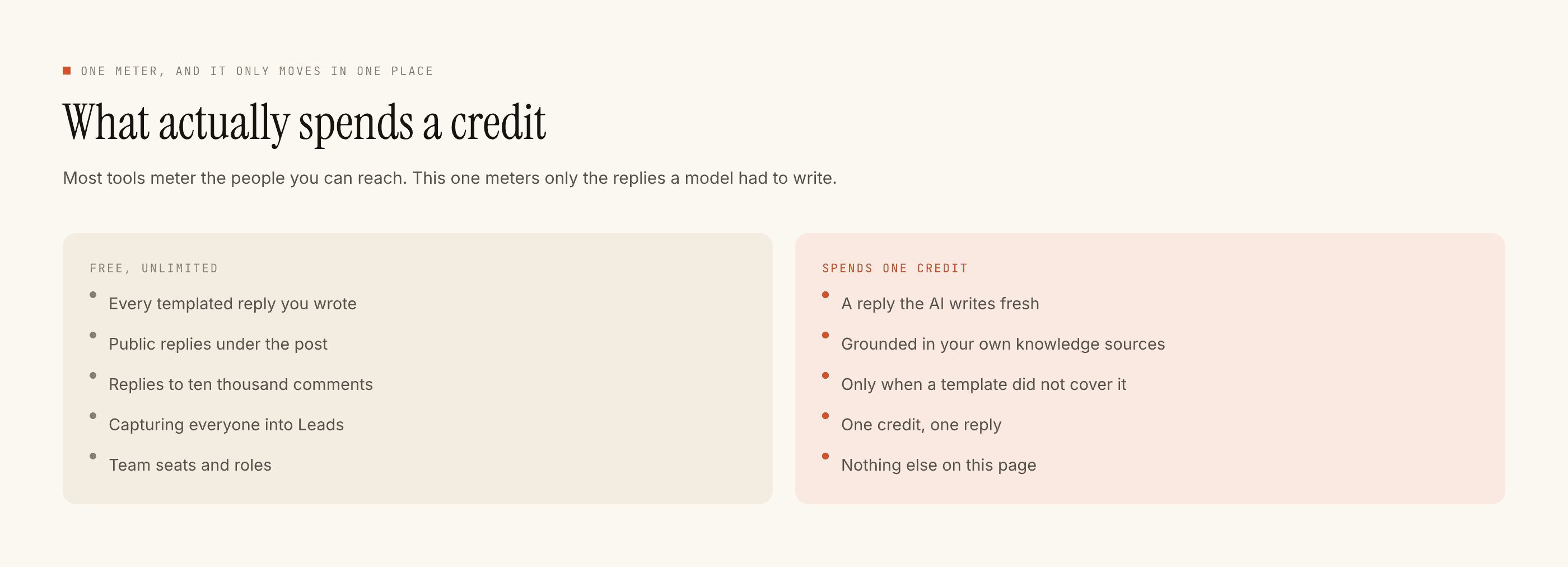
Credits, eventually. Templated replies are free and unlimited, so a broad set of template rules costs nothing directly. But the rules you wanted to be smart are the ones spending credits, and the noise from the rules that should not exist is what makes the smart ones look expensive.
The test
Three questions, in order. A Reel that fails any of them does not get an automation.
- Is there one specific thing a viewer of this Reel will want? Not "more information". A named object: the price list, the size chart, the booking link, the recipe, the checklist. If you cannot name it in three words, there is nothing for the keyword to stand for.
- Can you deliver it in one message? The private reply is a single message with a clock on it. Something that needs a call, a form, a payment or four back-and-forths does not fit, and dressing it up as a one-message answer sets up a disappointment.
- Would you be happy answering this question two hundred times? Because that is what a Reel that travels does. If the honest answer is that you would want to tailor each one, the automation is the wrong tool and you should be reading the comments by hand.
Reels that reliably fail the test
Pure entertainment. A trend audio with your face on it is doing brand work, not sales work, and bolting comment INFO onto it produces a stream of people who wanted nothing.
Behind the scenes. Fine content, no object attached. The people who comment want to say something nice, and answering a compliment with a price list is worse than saying nothing.
Anything about a problem or a complaint category. If a Reel is likely to attract people describing something that went wrong, that comment section should reach a person. Put those words on the negative keyword list, and if the whole Reel is that shape, do not automate it.
Collaborations and reposts where the comments are about the other account. Your keyword appearing in a comment that is addressed to someone else is a match you do not want.
What being selective buys you
Fewer rules means each one can be sharper. A single automation on the one Reel a month that actually sells something can afford a keyword nobody else uses, a private reply written for exactly that offer, and a negative list tuned to that comment section. Fourteen rules cannot each have that, because you will not maintain them.
Three automations you can recite from memory beat fourteen you have to open to remember.
It also makes the account read as a person. An audience notices when every single post produces an identical mechanical response, and they notice when the response only shows up where it makes sense. The second reads as someone running a business. The first reads as a bot farm, regardless of how well the copy is written.
The Reels that do earn one
They tend to share a shape: the Reel demonstrates a thing, the thing has a price or a variant or a availability question attached, and the natural next thought in a viewer's head is a question you can answer in one message.
Product demonstrations. Before-and-afters where people will ask what you used. Anything with sizes, dates, slots or tiers. Educational Reels where the promised resource is real and downloadable. In every case the object exists before the Reel does, which is the actual tell.
For those, the funnel mechanics are worth doing properly rather than approximately — the Reels to DM funnel is built for strangers and spikes, and neither of those behaves like your normal comment section.
An audit worth an hour
Open every automation you have running. For each one, answer: what is the object, when did it last fire, and would I be embarrassed if a stranger screenshotted the reply.
Switch off the ones with no object. Narrow the ones that overlap. What survives is usually a third of what you started with, and the account's replies get noticeably better the same week, because the ones that remain are the ones you actually thought about.
One exception to the switching-off instinct: do not turn off a rule on an older Reel purely for tidiness. Each new comment on that Reel opens its own seven days, so a video that resurfaces months later is free distribution for an ask you already wrote. Turn off the rules that were wrong. Leave the ones that were right, however old the post is.
If the words themselves are where things are going wrong rather than the choice of post, keyword selection is its own afternoon, and the full reference for comment automation covers what each field in the builder is actually for.