Playbooks · 6 min read
Saves Mean Later. A DM Is How Later Gets Answered
Start with the disclaimers, because they are large and everything useful is on the other side of them.
Nothing in this product touches the algorithm. It does not affect your reach, your ranking, your distribution, or how any post is shown to anybody. It also cannot see a save. There is no analytics here — no save count, no share count, no reach chart, no engagement rate, no comparison against last month. If you came looking for a tool that improves those numbers, this is not one, and the longer version of that refusal is worth reading because the effect that is real is smaller and more human than the headline.
So there is no version of this post that tells you how to optimise for saves. What there is, is one genuine connection, and it is a timing one.
What a save actually is, from the other side
Forget ranking for a second and think about what the person did.
A like is a reaction. It happens in the moment, costs nothing, and means roughly "noted". A save is different in kind: it is somebody putting your post in a drawer to come back to. A share is somebody handing it to a specific person with an implied "look at this".
Both of those are statements about the future. Not now, but later. I want the recipe when I am at the shop. I want the price when I have talked to my husband. I want the studio timings when I decide to start going.
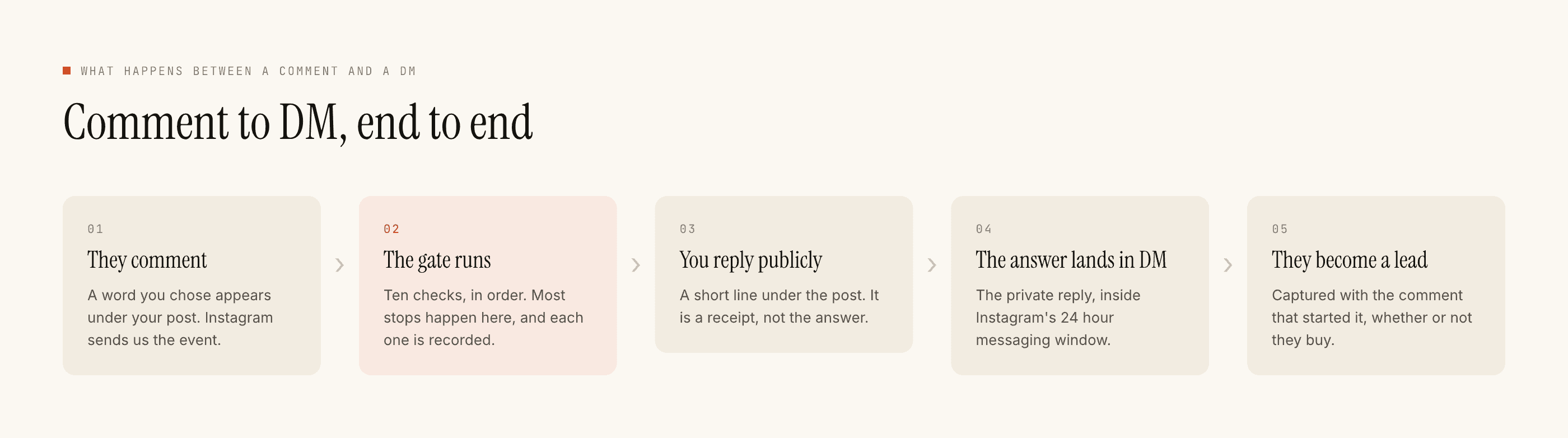
That is the connection. This product is not a ranking tool, but it is entirely a tool about when — two windows, one seven days long and one twenty-four hours, and almost every decision in it is about timing. Saves and shares are the behaviour that generates delayed intent, and delayed intent is exactly what those windows catch or drop.
A save is a person telling you they will be back. Everything you have built about your automations assumed they were arriving for the first time.
Four things that follow, and they are all settings
One: stop scoping automations to launch week. The most common build is an automation on the newest post, switched on for a couple of days while the reel is doing numbers, then forgotten. A saved post produces its comments after that. Somebody saved it on Monday, came back on Thursday, and typed PRICE under a post whose automation has been off since Tuesday.
The seven-day comment window is the whole opportunity here. A comment can be answered for seven days after it was posted, which lines up almost exactly with the tail of a post people are returning to. Leaving the automation on for that full week costs you nothing — templated replies are free and unlimited — and catches the people whose intent was strongest.
Two: a shared post brings strangers, and your public reply is their first impression. When somebody forwards your reel, the person who arrives has never seen your account. They read the comments before they read your bio. Forty identical public replies reading "DM sent! 💌" tell them something you did not intend. Vary them, keep them short, and read your own comment section as somebody who has never been there.
The Advanced setting for first-time senders only becomes genuinely relevant here too, in both directions: it stops your regulars being greeted like strangers, and it means a shared post full of new people is the case it was designed for.
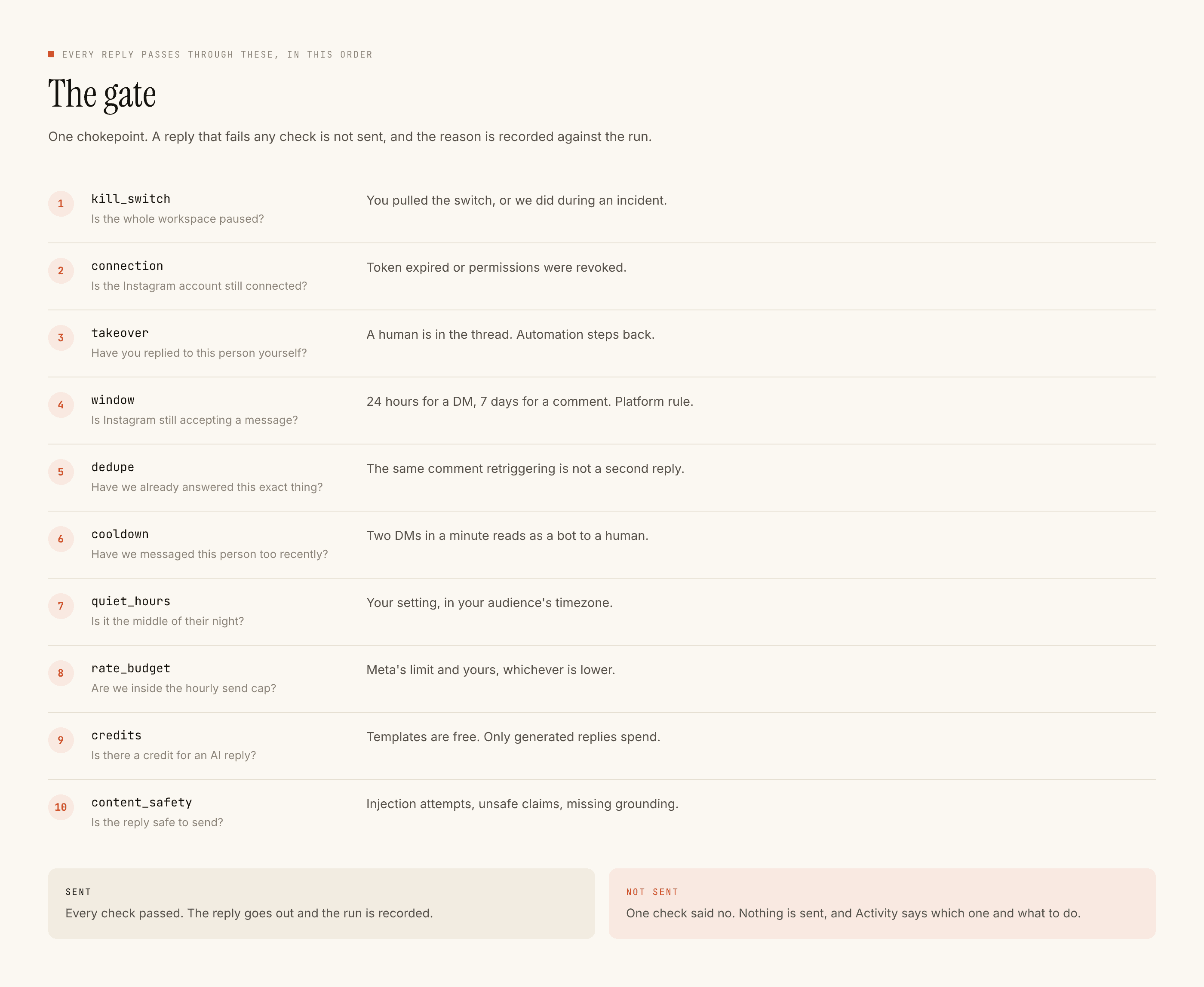
Three: an old post waking up is a load event. Something you posted in November gets shared into a group chat in February and produces a hundred comments in an afternoon. That is a spike arriving on an automation you have not looked at in months. The rate_budget check turns it into a queue rather than a burst, and the seven-day window absorbs the delay comfortably.
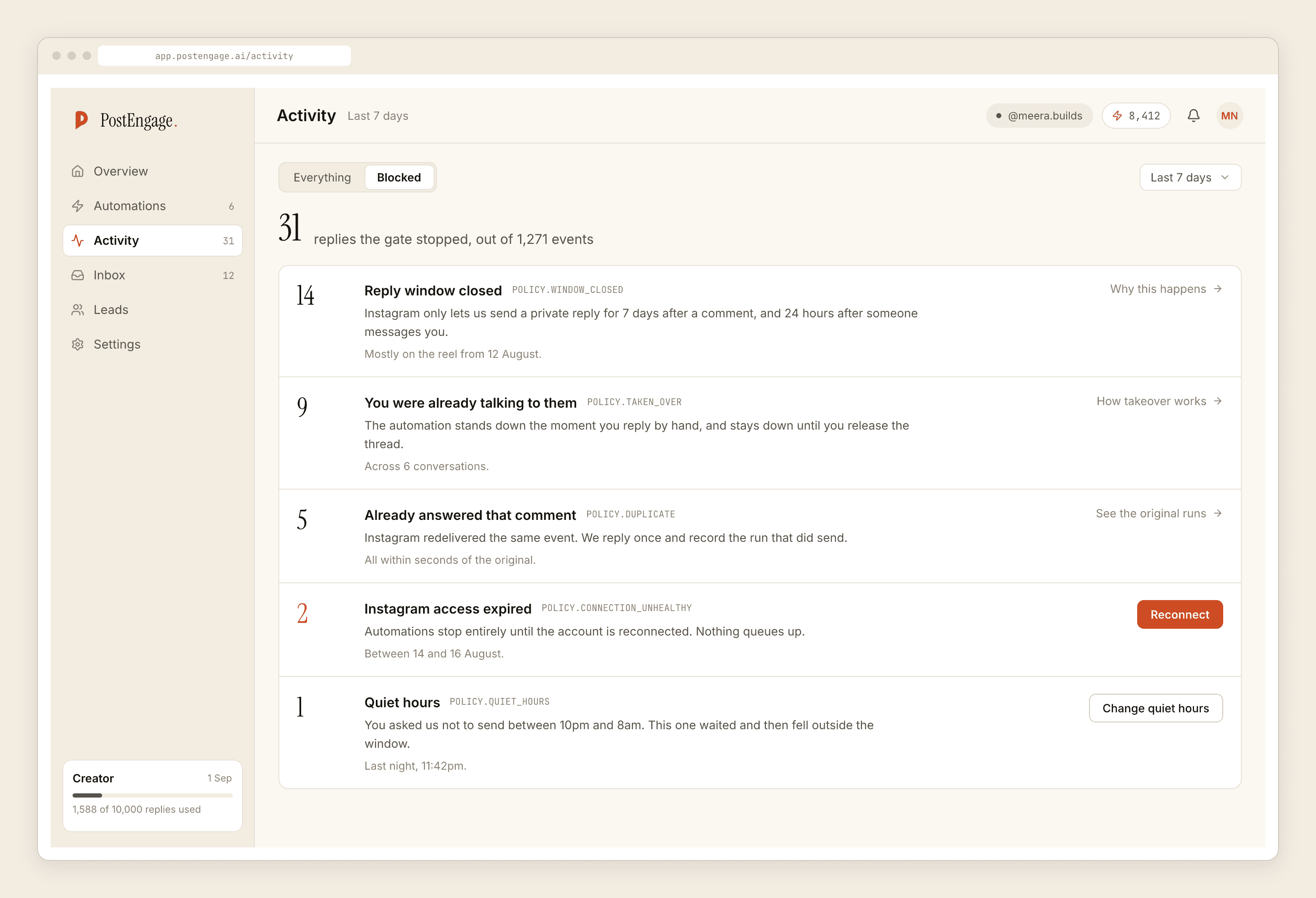
Four: your most-saved post is the one most likely to embarrass you later. This is the sharpest consequence and nobody plans for it. The posts that get saved and shared are the ones that keep working for months, which means their automations keep answering months later. If the reply contains a price, a date, a discount or a stock claim, it is now wrong and it is being sent by a machine to a stranger.
Any sentence with an expiry belongs to a campaign automation you will switch off, never to an evergreen one. The teardown discipline exists precisely because good posts outlive the offers written into them.
What you can count, since you cannot count saves
You will not get save data from us and you should not expect it from a reply tool. What you do get is the other half of the story, and it is arguably the more useful half.
Replies sent. Replies blocked, with the reason. People captured to Leads, with what they typed and which post caught them. How many of them wrote back — which is the only unambiguous evidence that a real person read the message and engaged with it.
Notice what that gives you: a post-by-post read of which content produces conversations, not impressions. Your most-saved post and your most-conversation-producing post are frequently not the same post, and the second one is the one to make more of. What each of the three stores can and cannot tell you, including the joins that do not exist between them, is documented before you build a spreadsheet on top of it.
The part that is not ours
Whether people save your posts is a content question. Whether you write "save this for later" in the caption, whether the carousel is worth returning to, whether the reel answers something people need twice — none of that is software. We reply to people. We do not create posts, and there is no caption tool, no hashtag tool, no content calendar and no performance prediction here.
What we can do is make sure that when somebody does come back on Thursday to the thing they saved on Monday, and types one word under it, they get an answer while they are still holding the phone. That is a smaller claim than the headline this post was originally given. It is also one that survives being asked for a source.