Compliance · 5 min read
Reels Automation in 2026: Surviving the Night It Travels

Reels automation is easy on an ordinary week. Forty comments arrive, forty replies go out, nothing interesting happens. The reason to think about it at all is the other night — the one where a Reel leaves your audience entirely and comes back with two thousand comments waiting by morning.
That night is a load event, and it is the only one your account will experience without choosing to. Everything below is about what happens during it and what you can only do beforehand.
What a spike actually looks like from the inside
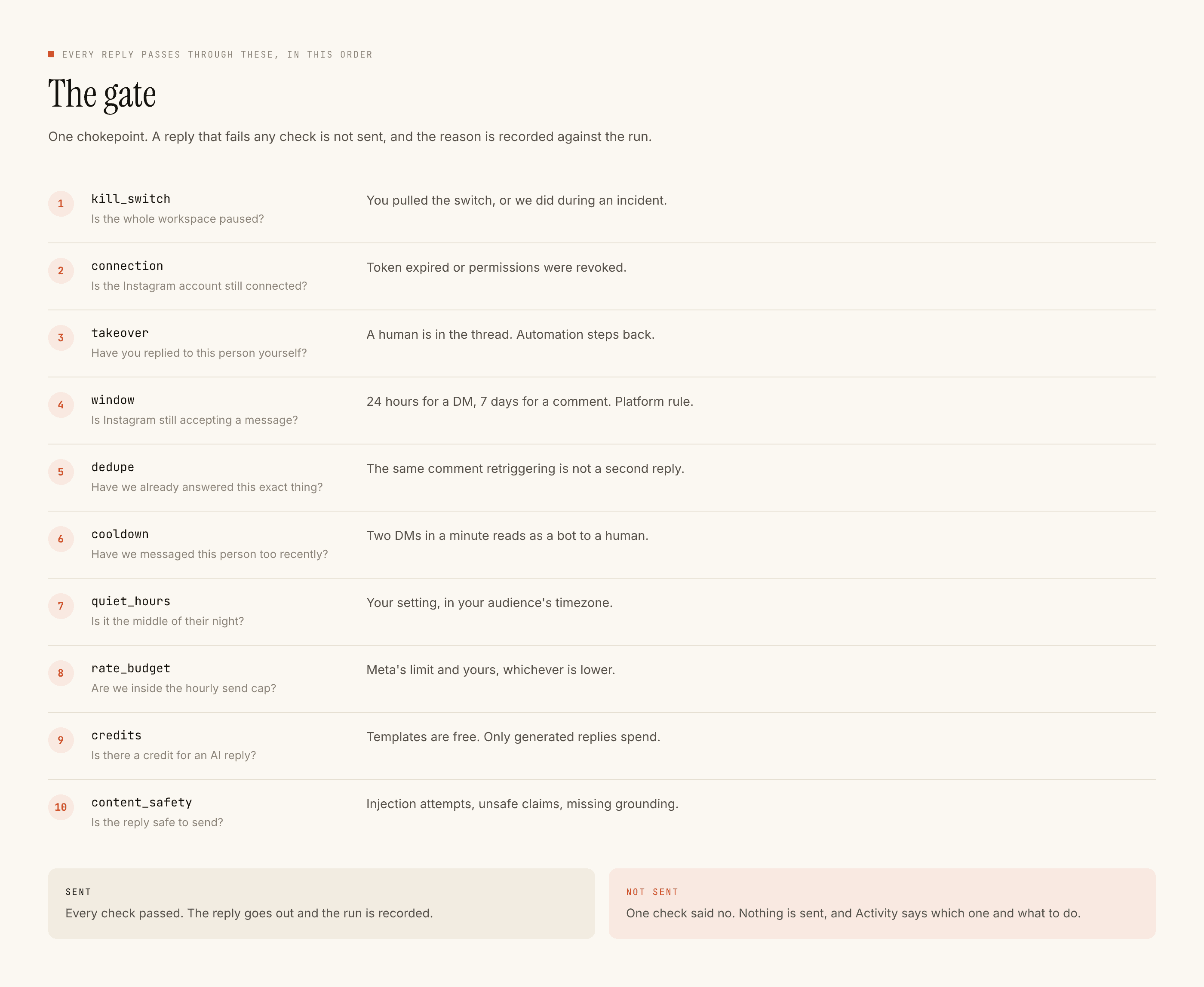
Comments arrive faster than replies can leave, which is by design. The gate every reply passes through includes a rate budget, and once the hourly allowance is used the remaining matches are held rather than sent.
So the morning after a Reel travels, your Activity screen is a long list of blocked rows. This alarms people the first time and it should not. A pile of rate-budget refusals on your best night is the single healthiest thing that screen can show you.
The alternative is worth being explicit about. Without a cap, two thousand messages leave as fast as the API will accept them, some proportion of the recipients report them, and the account picks up a delivery problem that outlives the Reel by a long way. The cap converts a burst into a queue. The queue drains over hours.
Why the queue draining slowly is fine
Because the comment window runs per comment, not per post. Each comment opens its own seven days from the moment it was written.
A person who commented at 2am and receives their reply at 9am is still inside their window with days to spare. So is the person at the back of a queue that took most of the day to clear. The thing a spike genuinely threatens is your account's standing, not your deadline — and the queue protects the first without endangering the second.
The cap only ever looks like a limit on your best night. That is exactly the night it exists for.
The four checks that do the work
Rate budget. The hourly ceiling. It is the difference between a spike and an incident.
Dedupe. Instagram redelivers webhook events, and it redelivers more of them when there are more of them. The same comment arriving three times produces one reply, and the two refusals are logged. During a spike the dedupe count climbs alongside the volume, which is normal.
Cooldown. One person commenting eleven times under a Reel that is clearly working gets one reply, not eleven. Enthusiastic commenters are common on a travelling Reel and none of them want a message per comment.
Quiet hours. Reels travel at night. This is the check with a real cost during a spike, and it is a decision rather than a default — holding until morning is usually right, but it means the queue that was going to drain overnight now drains starting at 8am, on top of the fresh comments arriving by then.
What only works if you did it beforehand
None of the following can be done at 3am while the thing is happening.
- Decide template or AI before you post. Templated replies are free and unlimited. A credit is spent only when the AI writes a new reply, one credit per reply. On a normal Reel that distinction is academic. On a two-thousand-comment night it is the whole cost of the event, and the honest design is a templated first turn for everybody and AI reserved for the second turn, where the person has asked something a template could not have anticipated.
- Check your credit balance the day you post. Credits sit ninth in the gate, so running out reads as a wall of blocked rows rather than an error you notice. The free tier is 100 credits with no card, and packs start at ₹499.
- Scope the automation to specific posts. Under Advanced. A rule watching the entire account will fire in comment sections you were not thinking about, and a spike is the worst time to discover which ones.
- Write the negative keyword list for strangers, not followers. A travelling Reel brings people who are not your audience at all. Reversals like not interested, the spam patterns you have seen, and anything trolls type under videos in your niche.
- Know where the kill switch is. It is first in the gate and it stops everything instantly. Find it on a calm afternoon so that finding it is not the thing you are doing during the event.
First-time senders only, and why it matters more here
Under Advanced there is a setting that limits an automation to people who have not messaged you before. On an account that posts Reels regularly it stops the same loyal follower being greeted from scratch under every video, which is the fastest way to make an automation feel like a machine to exactly the people you least want to lose.
During a spike it does something else useful: it keeps the queue pointed at strangers, who are the reason the spike is valuable.
The morning after
Read Activity before you read anything else.
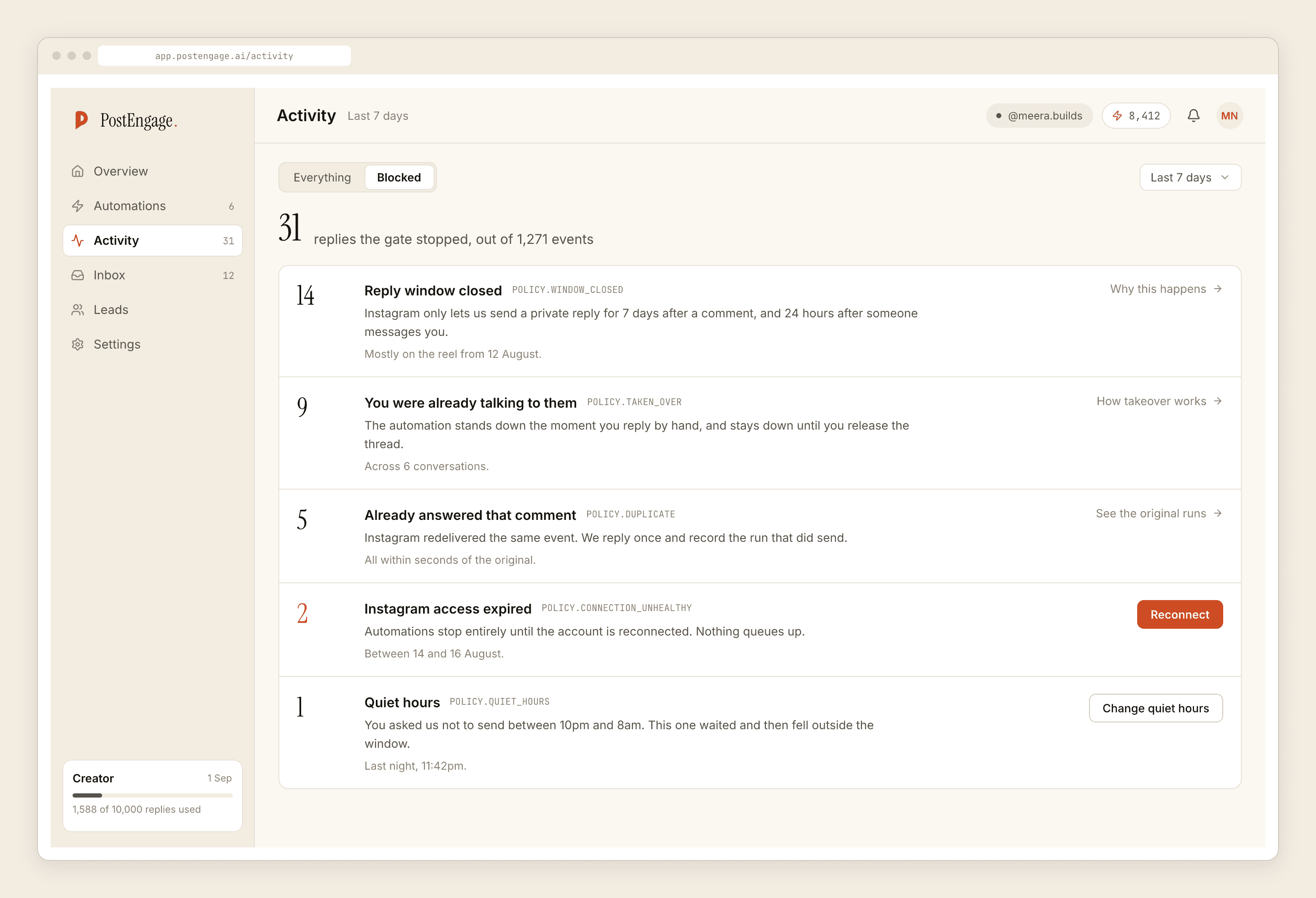
Rate budget and dedupe rows: expected, ignore them. A large takeover count: you were answering by hand faster than the automation, which is fine and means the rule could be narrower. Closed windows: comments that aged past seven days, which after a single night should be rare and after a month of neglect will not be. A connection row is the only genuine emergency, because it means nothing went out at all.
What none of this makes better
Automation does not affect how far a Reel travels. It does not predict which Reel will travel. There is no analytics product here, no scheduling, no publishing, and no feature that finds you the people who watched without commenting.
It answers the people who wrote to you, at a rate that does not put the account at risk, for as long as their windows stay open. On a night when two thousand people write at once, that turns out to be a great deal — but it is worth being clear that the spike is your content's doing, not the software's. If you are deciding which Reels deserve an automation in the first place, that is a separate and more interesting question, and the safety argument underneath all of this is laid out here.