
Most guides in this category open with a list of tactics. This one opens with a definition, because the definition is not a matter of preference here and getting it wrong is what makes the tactics fail.
A lead, on Instagram, is a person who has sent you something. A comment, a story reply, a message. That is it, and the reason is mechanical: you are permitted to contact people who contacted you and nobody else. A follower you cannot message is not a lead. A viewer is not a lead. Somebody who saved the post, screenshotted the price and thought about it for a week is not a lead, however warm they feel.
So Instagram lead generation is exactly one thing wearing a longer name. It is message generation.
The four events that produce a message
Everything permitted downstream traces back to one of these, and each one starts a clock.
- A comment on your post or Reel. Public. You may respond for seven days, counted per comment rather than per post, which means an old post that keeps being found keeps producing conversations.
- A story reply. Already a DM, landing straight in the inbox with the twenty-four hour clock running. The trigger almost nobody sets up.
- A direct message. Somebody wrote to you unprompted. Twenty-four hours from their most recent message, restarted only by their next one.
- A story mention or a tag. Somebody put you in their story. It arrives in the inbox and behaves like a message.
There is a fifth, and it is bought rather than earned: a tap on a click-to-DM ad makes the person the sender, which is precisely why that conversation is allowed to exist. We do not run ads or touch Ads Manager, but the resulting thread lands on this side like any other.
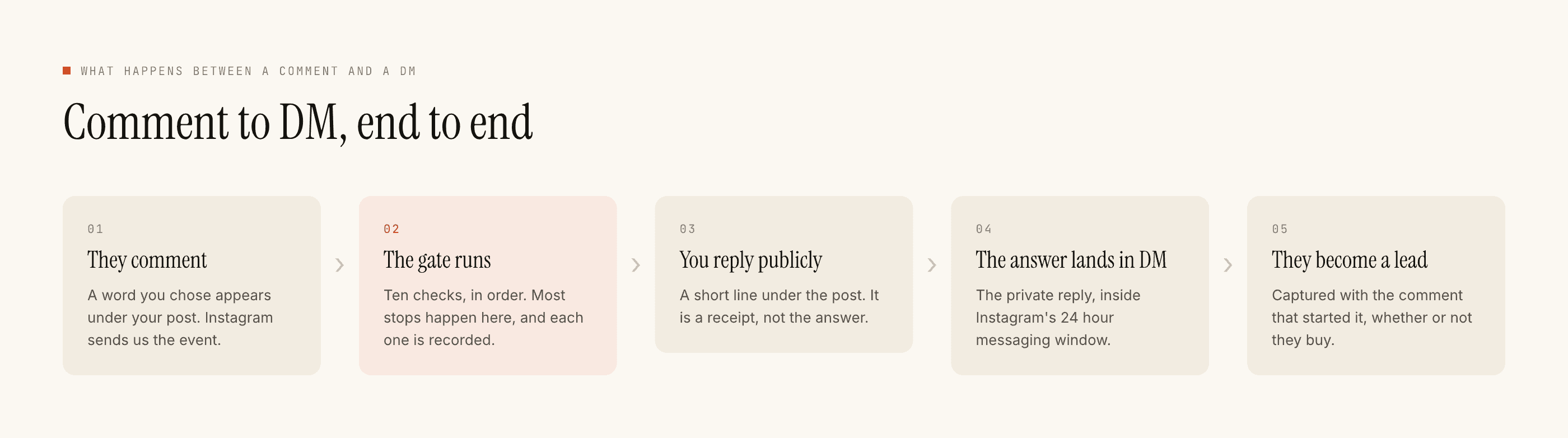
What automation does with those events, and where it stops
It answers them. That is the honest boundary of the whole product and it is narrower than the category usually admits.
A trigger matches words in what they typed. Ten checks run in a fixed order — kill switch, connection, takeover, window, dedupe, cooldown, quiet hours, rate budget, credits, content safety — and a reply that fails one is not sent, with the reason recorded. Then a public reply appears under the post and a private reply opens the thread.
The person becomes a lead record at that point: their handle, the message that created them, which post produced them, and any email or phone number they typed themselves. Nothing is inferred from a profile. If they did not send it, it is not there.
You are not generating leads. You are answering people fast enough that they stay in the conversation.
What is not lead generation, stated plainly
This part matters more than the tactics, because it is where money gets spent on things that cannot work.
Cold DMs. There is no permission to message somebody who has not messaged you. Not on a plan, not with a workaround. The full refusal explains what the tools advertising it are actually doing.
Welcome messages to new followers. A follow is not a message, so it opens nothing and triggers nothing. Same wall.
Scraped follower lists. Same wall again, plus a second problem, which is that a list of handles you cannot contact is not an asset.
Follower growth. We have no growth features, no publishing, no scheduling, no hashtag tool and no analytics. Reach is upstream of everything here and we do not touch it.
The three things that actually move the number
Given all of the above, there are only three levers, in order of how much they matter.
The ask. Whether the post tells people what to type and what they get for it. This is content, not software, and it loses more potential leads than every other stage combined. "Comment below!" is not an ask. "Comment SIZE and I'll send the chart" is.
The match. Whether your keyword list contains the words people actually typed. Matching is whole-word and it folds case and punctuation, so Price? and price are one thing — but price and pricing are not, and neither are kitna and kitne. The mechanics are documented here and this is where most lists are too thin.
The first reply. Whether it answers the question and ends with something a person can respond to in three characters. Their reply is the only thing that restarts the window, and it is also the only unambiguous evidence you have that anybody read anything.
What you get to keep
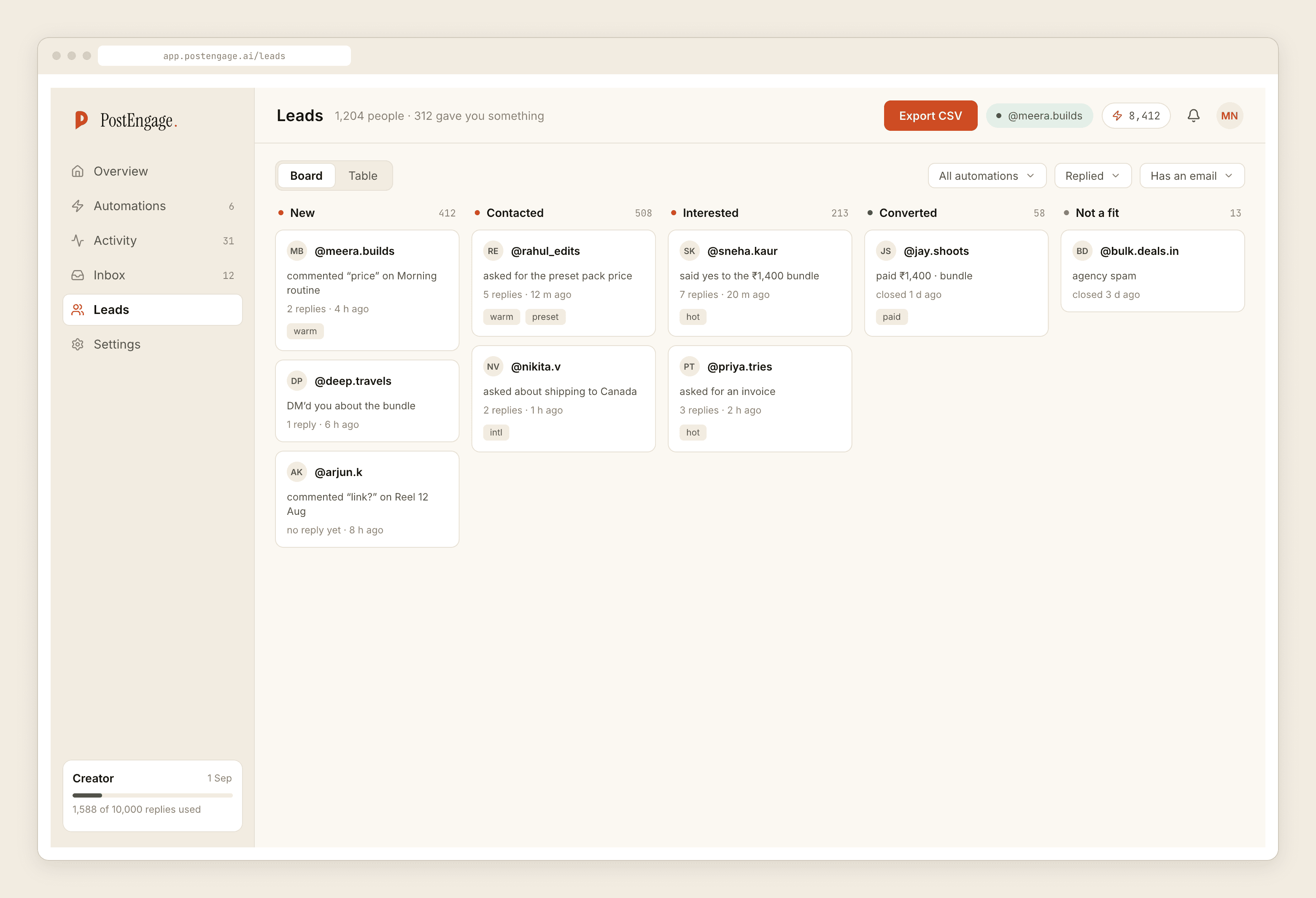
Leads export as a CSV. There is no CRM sync, no Zapier, no webhook and no email sending — the file is the entire handoff, and what happens next happens in a tool that is allowed to send.
There is also no attribution. Nothing here knows whether a lead bought anything, and no honest report will claim otherwise. Working the ROI out by hand is the version that survives being asked for a source.
Where to start, if you are starting
One post. One word. One answer worth receiving. Build it, run Test on myself, go live on that single post, and read the blocked list that evening. Then add the second one. The first hundred leads is the week-by-week version of that, and it is deliberately slower than it sounds.