Playbooks · 5 min read
Click-to-DM Ads: The Tap Is What Opens the Window

Let us get the boundary out of the way, because it decides how useful the rest of this is to you.
We do not run ads. There is no Ads Manager integration, no campaign creation, no audience builder, no targeting, no budget field, no spend reporting, and no way to see that a campaign exists at all. If you buy click-to-DM ads, you buy them in Meta's tools, with Meta's billing, in a browser tab that has nothing to do with this product.
What this post is about is what happens after the tap, because that part is real, it is permitted, and it explains a rule that confuses almost everybody who tries to automate Instagram messaging.
Why a paid conversation is allowed when a cold one is not
The rule underneath the whole platform is that you cannot message someone who has not messaged you. No tool on the official API can open a thread. That is why there is no outbound, no cold DM, no retargeting, no win-back — the wall is described in full here and it does not have a door in it.
A click-to-DM ad looks like an exception. It is not. It is the cleanest illustration of the rule you will find.
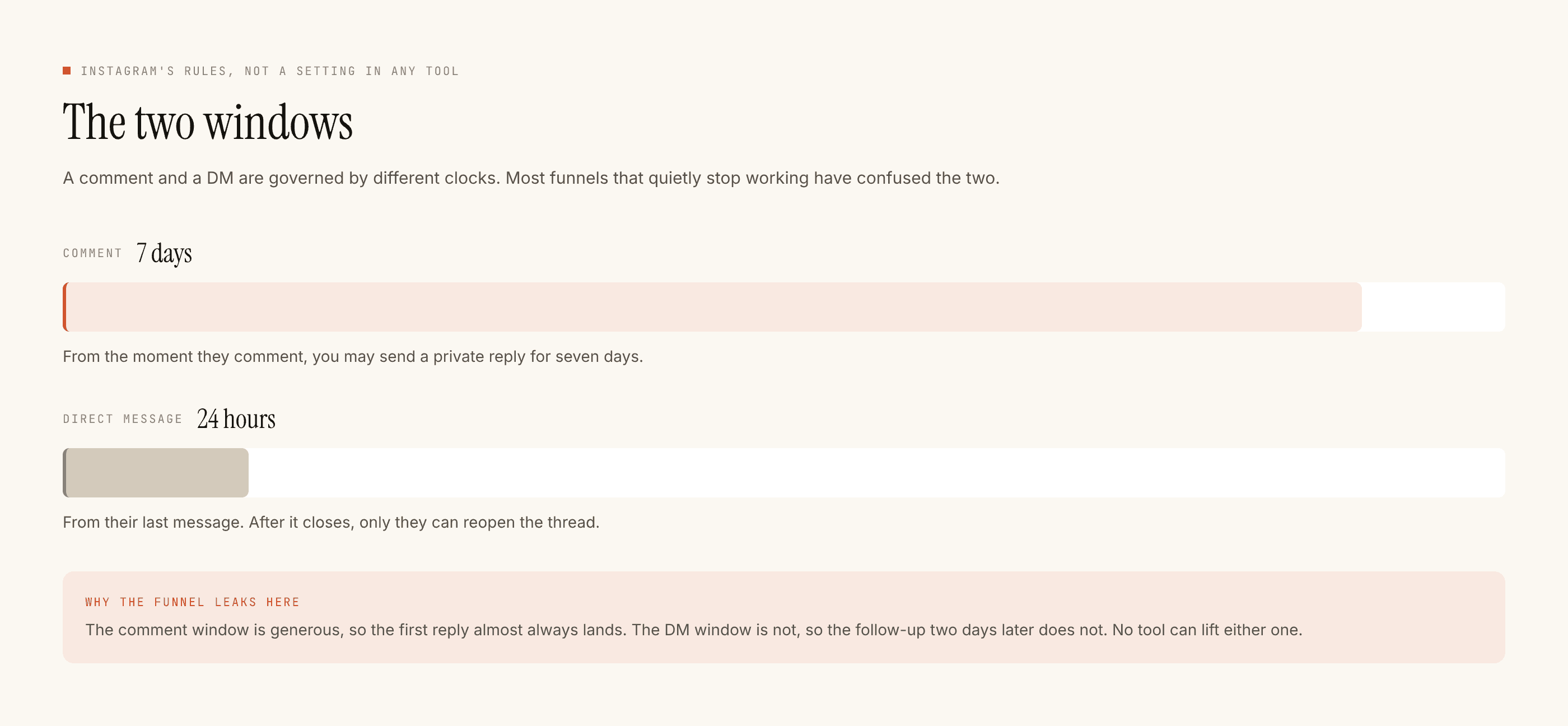
When somebody taps that ad, the app opens a message thread and they send the first message. Not you. The advertiser wrote the text that gets pre-filled, but the send is theirs, made by their thumb, on purpose. That inbound message is what opens the twenty-four hour window, exactly as a message typed by hand would.
You did not reach them. You bought a placement, and then they chose to write to you. The distinction sounds legal. It is actually the whole architecture.
What actually lands on this side
One inbound message, in your inbox, indistinguishable in structure from any other. It arrives with a handle, whatever text the tap sent, and a clock that started the moment it arrived.
The ten checks run on your reply the same as always — kill_switch, connection, takeover, window, dedupe, cooldown, quiet_hours, rate_budget, credits, content_safety — and a blocked reply records its reason in Activity. Nothing about a paid origin changes the order or relaxes any of them.
And nothing tells you the origin. There is no campaign field on a lead record, no source attribution, no cost per conversation. If the pre-filled text is distinctive enough you may be able to recognise it by eye, and that is genuinely the extent of it. Attribution on this channel is a model, not a measurement, and paying for the traffic does not change that.
The thing that is different, and it is not what people expect
Everyone assumes paid traffic is colder. The more useful difference is that the first message tells you nothing.
When somebody comments PRICE under a reel, they chose that word. It is a signal, small but real: they read the caption, they wanted the thing enough to type. When somebody taps a click-to-DM ad, the message they sent was written by your marketing team. "Send me the details" arrived because it was already in the box.
So treat the opening message as a placement, not as a statement of intent, and put the qualifying question in your first reply instead of assuming it was already answered.
The overnight problem, which is specific to paid
Ads deliver at three in the morning. People tap at three in the morning. Your quiet hours, if you set them sensibly, hold the reply until eight.
That is correct behaviour for organic comments and it is a genuine tension when you have paid for the tap. Eight hours later the person is at work and the intent has evaporated, and you spent money on it. There is no clever resolution. Either you narrow quiet hours on the nights a campaign runs and accept the overnight replies, or you accept the delay and write a first reply that survives being read in the morning. Decide it in advance rather than discovering it in Activity.
The same goes for rate_budget. A campaign that delivers well produces a burst of inbound in a short window, the cap holds the queue, and the last few people are answered later. On comment traffic the seven-day comment window absorbs that easily. On DM traffic it eats into a twenty-four hour clock, so know your cap before the campaign runs, not during it.
What the automation is honestly for here
The same job it does everywhere: the answer that goes out before you have seen the message.
Templated replies are free and unlimited, which matters more on paid traffic than anywhere else — a campaign that works produces a spike, and a spike of templates costs nothing. A credit is spent only when the AI writes a new reply, one credit per reply, and on a burst of near-identical opening messages there is usually nothing for it to write. Free tier is 100 credits with no card, packs from ₹499.
Then takeover does the rest. The moment you reply by hand in a thread, automation stands down in that thread. On a paid conversation that is the transition you want as early as possible.
If you are going to do this
Buy the placement over there. Then treat the arriving conversation as what it is — a stranger who tapped once, whose first message you wrote for them, with a twenty-four hour clock already running.
Have one template ready that answers the offer's most obvious question in full, ends in a closed question, and does not contain a link. Have your negative keyword list already covering the traffic ads attract that you do not want replied to. Know where the kill switch is before the campaign starts.
And keep the two ledgers apart when you report on it. The spend is exact and lives in Meta's tools; the conversations are exact and live here; what connects them is your judgement, clearly labelled. What can and cannot be stopped on the reply side is documented, and it is the same list whether the tap was free or paid for.