
A post that gets a hundred comments and produces no conversations is not a mystery, and it is almost never a copywriting problem. There are six places the chain breaks, they fail in a fixed order, and five of the six are visible if you look at the right screen.
Work through them in this order, because a fault early in the chain makes everything after it untestable.
One: nobody was asked to do anything
The commonest fault, and the one people skip because it feels too obvious.
If a hundred comments say "🔥" and "love this", the post did not ask for anything. Those are reactions, not requests, and no automation converts a reaction — nor should it, because answering "🔥" with a price list is worse than silence.
The fix is content, not configuration: name a word and say what arrives. "Comment
GUIDE and I'll send it" produces the word guide. "Link in bio" produces
scrolling.
Two: the word you chose is not the word they typed
Matching is literal. price does not match pricing, kitna does not match
kitne, and दाम does not match दम — those are different words and stay
different.
Three: the automation was not live on that post
Automations attach to specific posts. A post published after you built the automation, or a post you forgot to include, receives nothing.
This is the one that produces the "it worked last week" report. Check what the automation is scoped to before assuming anything downstream is wrong.
Four: the gate stopped it, for a reason it will tell you
Now you can start reading rather than guessing.
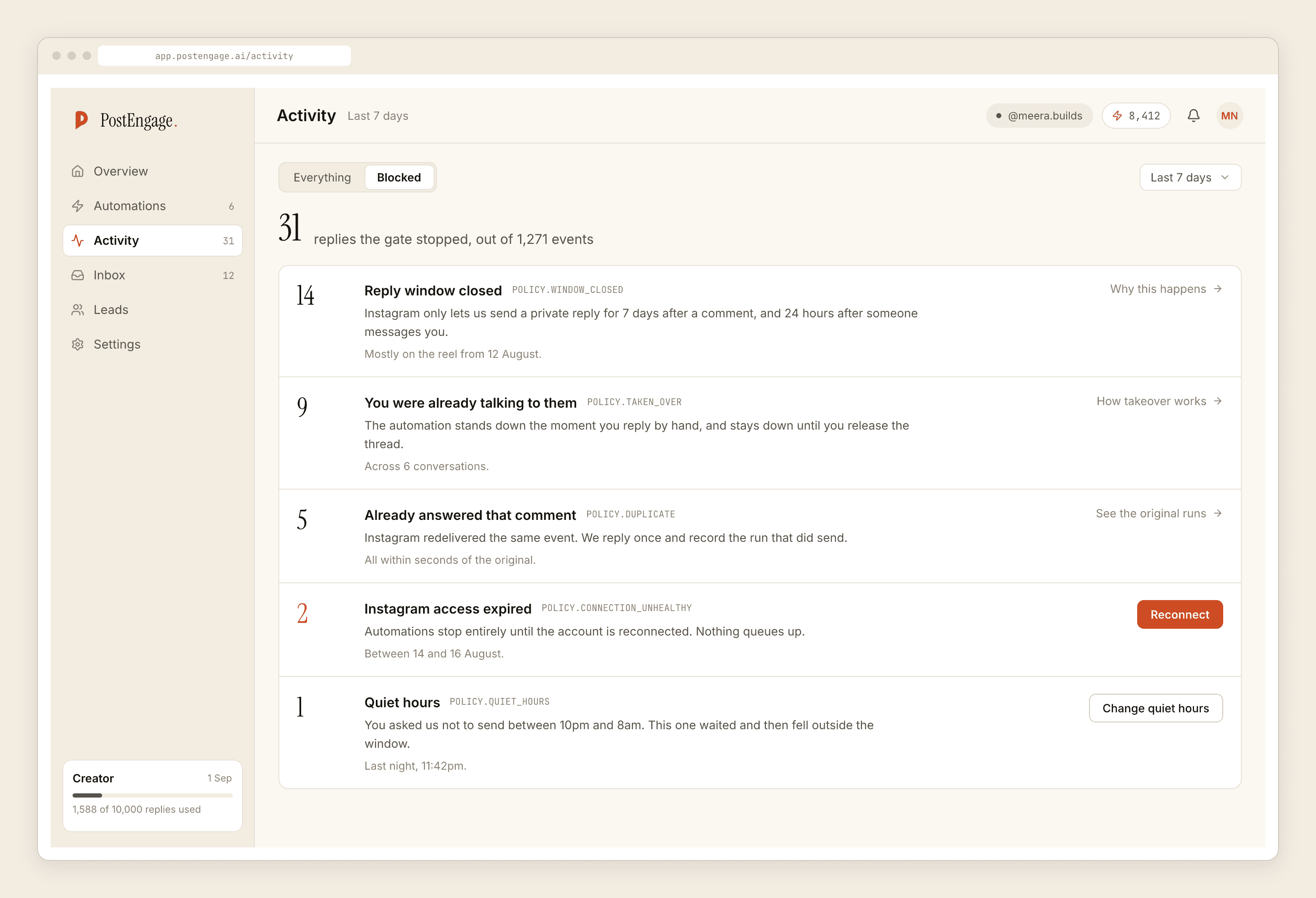
Three rows explain most of it:
- Window closed. The comment is older than seven days, or the DM thread is past twenty-four hours from their last message. Not a fault — the platform's rule, and nothing reopens it.
- Rate budget. A post that travelled overnight hit the hourly cap and the rest queued or were dropped. Expected on a spike, and the reason a viral post converts worse per comment than a normal one.
- Already answered. Instagram redelivers events; dedupe means one reply per comment rather than three.
If the blocked list is mostly these, the automation is working correctly and the problem is somewhere else.
Five: the public reply is doing the wrong job
Some accounts convert comments into public replies and stop there.
The public reply is a receipt, not the answer. Two words — "sent it" — tells the commenter something arrived and tells everyone else reading that this account responds. A paragraph in public is worse on both counts, and a link in it may reduce how far the post travels.
The actual answer belongs in the DM, and it is the DM that has to be worth replying to.
Six: the private reply does not earn a second message
This is where most of the remaining loss sits, and it is the only one that is genuinely a writing problem.
Their reply is the only thing that restarts the twenty-four hour clock. So a first message that does not invite one has ended the conversation, however polite it was.
Ends it
Continues it
Answer the literal question in the first sentence, then ask exactly one closed question. That is the whole craft, and it moves this number more than anything else on this list.
What you cannot diagnose, and should stop trying to
There is no analytics product here, no funnel report, no attribution. You cannot see who read the DM, whether they clicked a link, or what they did afterwards.
What you can count by hand, once a fortnight, in about ten minutes:
- How many comments contained a question at all.
- How many produced a DM.
- How many of those DMs got a reply back.
- How many conversations you personally took over.
That fourth number is the one that has ever mattered. If it is zero while the first is large, the fault is at step one or step six, and those are the two worth your afternoon.
The order matters
Checking the reply copy while the automation is scoped to the wrong post wastes a week. Work down the list: was there an ask, does the word match, is it live here, what did the gate say, is the public reply short, does the private reply invite an answer.
Five of those six take under two minutes each.
If you want the trigger mechanics in depth, the keyword guide covers them. If step six is where you landed, the reply craft post is here.