Playbooks · 4 min read
Asking for UGC in a DM Without Taking What Is Not Yours

The mechanical part of user-generated content is easy: people tag you, you ask if you can repost, most say yes. The part worth writing about is that the asking has requirements, and automation makes it very easy to get them wrong at scale.
Start with the thing that is not true. A tag is not permission. Someone photographing your product and mentioning your account has shared it with their followers. They have not licensed it to you for advertising, and in most places the copyright is still theirs. Reposting without asking is common and it is still taking something.
Why the ask belongs in a template
This is the one place where the free, unlimited option is also the correct one, for a reason beyond cost.
A consent request is a fixed sentence that has to arrive intact. It says exactly what you are asking for, and its wording is the record of what the person agreed to. A generated reply is composed fresh each time, so it will phrase the ask slightly differently for every person — which means forty people agreed to forty subtly different things, and none of them are quite the sentence you meant.
A permission you cannot quote back later is not a permission you can rely on.
Write it once, keep it exact, send it every time. Templated replies cost nothing here, and credits are spent only when the model has to write something new — so the correct choice and the free choice are the same choice.
What the automation can and cannot see
Worth being precise, because it shapes the whole design.
What arrives
What does not
That last one matters most. You cannot reach out to somebody whose post you liked. If you want their permission, they have to have written to you, or commented on something of yours, first. Everything else is a manual conversation you have by hand.
A setup that is honest
- Ask in the caption, not in a DM you cannot send. "Tag us and comment SHARE if you're happy for us to repost" turns a passive tag into a message you may legitimately answer.
- One narrow keyword.
share, or whatever word you asked for. Not a broad list — this reply should only go to people who opted in by typing. - A template that states the full ask. Where it will appear, for how long, and whether paid ads are included. Two sentences, unchanged, every time.
- Ask them to reply yes. Their reply is both the consent and the thing that restarts the twenty-four hour window, which you will need if there is anything to sort out.
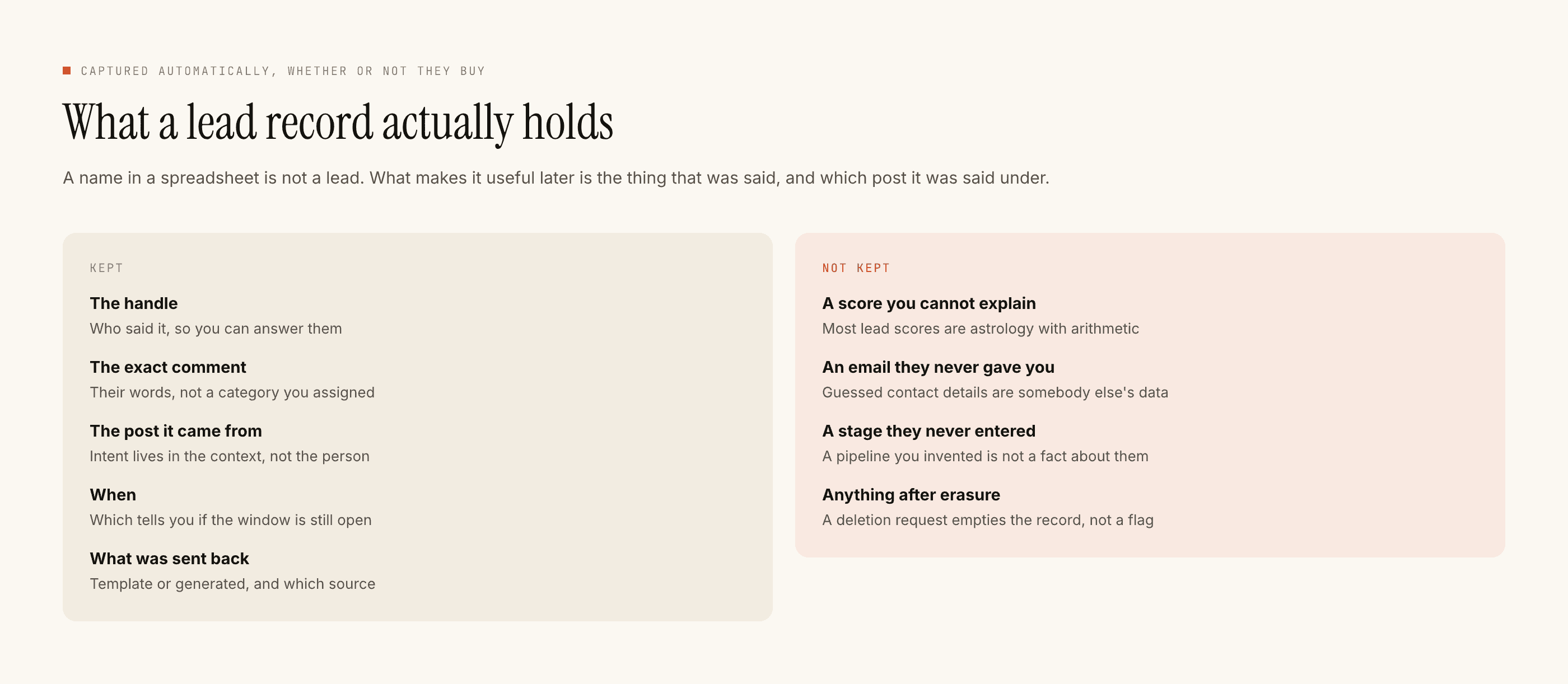
- Keep the thread. The lead record stores what they typed and which post it came from. That is your evidence, and it is the only reason the record is worth anything here.
The four things not to automate
- A repost that has already happened. Never send a message that implies you have used something before they agreed. "We've featured your post!" is not consent, it is notification.
- Anything with a photo in it. Nothing reads images, so an automated reply about a specific picture is a reply about a picture the system cannot see.
- A follow-up chase. You cannot send one anyway once the window closes, and a person who did not reply has given you their answer.
- A reply to somebody withdrawing permission. That is a person's job, immediately, and it belongs on the negative keyword list:
remove,take it down,delete,hata do.
Credit them properly
An automated ask is fine. An automated relationship is not. If you use somebody's photograph, credit them where it appears, in the way they asked to be credited, and take it down promptly if they change their mind.
None of that is enforced by software. It is the part that makes the automated half acceptable, and it is manual by design.
What none of this does
There is no rights-management feature here, no consent ledger, no image recognition, no tracking of where a photograph was used. Leads export as CSV and that is the whole record. If UGC is a meaningful part of how you market, you will want a real process for it, and this automates exactly one step of that process: asking clearly, in the same words, quickly.
If you want the ethics of a related ask, the testimonial post covers gating. If you need the disclosure rules for affiliate relationships, that is here.