Playbooks · 4 min read
Quiet Hours, Windows, and the Timezone You Forgot to Set

There is no send-time optimisation here, and it is worth saying why rather than just noting the absence. Send-time optimisation is an outbound idea: you hold a message and release it when the recipient is most likely to open it. Every send in this product is a response to something a person just did, and the best moment to answer somebody is when they asked.
What does exist is three clocks, and you set exactly one of them.
The three clocks
- The comment window. Seven days from each comment to send that person a private reply. Generous, and it runs per comment rather than per post — so an old Reel that resurfaces still works.
- The messaging window. Twenty-four hours from their last message. Only another message from them restarts it. Nothing you send extends it.
- Quiet hours. Yours. The one you choose, and the only one you can change.
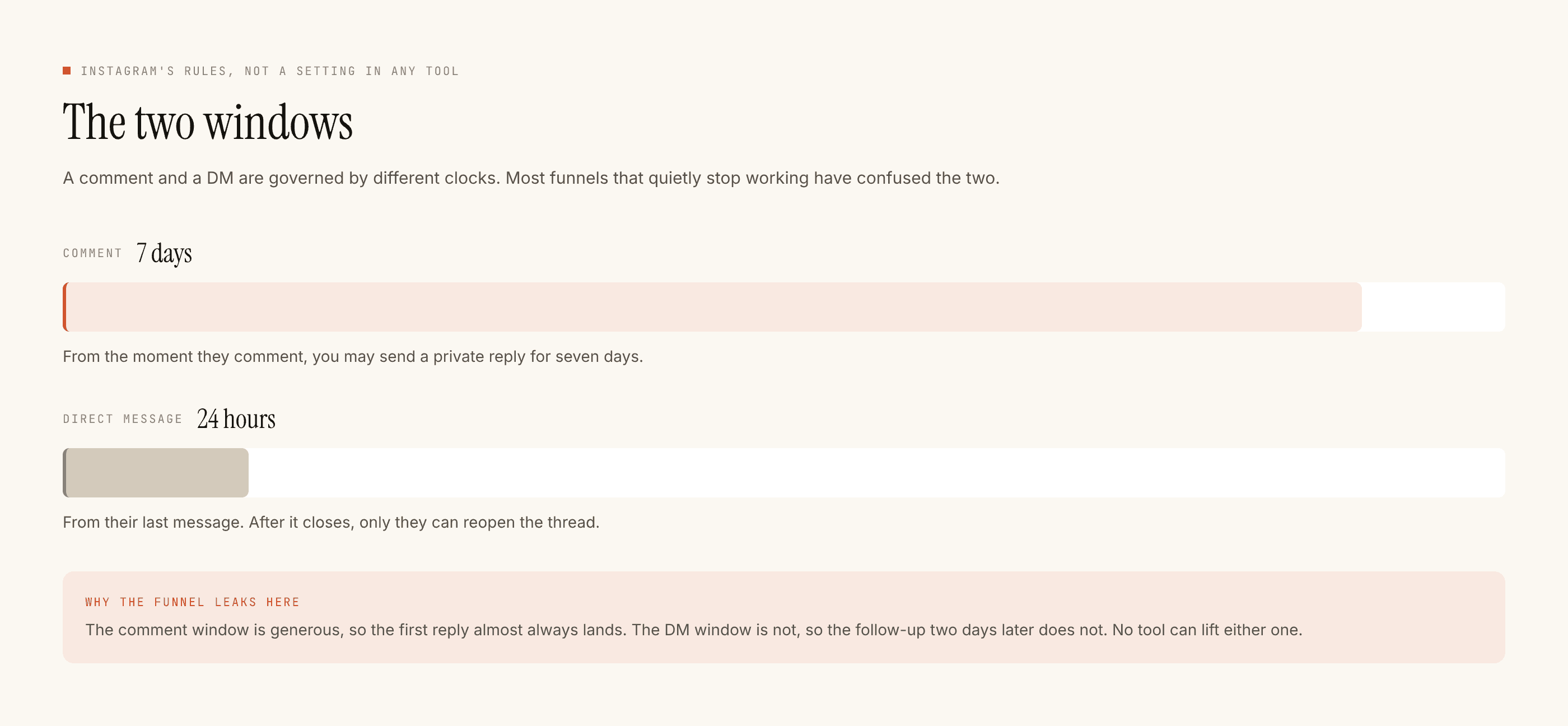
Quiet hours spend window, they do not pause it
This is the part that surprises people, and it is arithmetic rather than opinion.
Somebody messages at 11:40pm. Your quiet hours run until 8am. The reply goes out at 8am, which is fine. But the twenty-four hour window started at 11:40pm, not at 8am, so by the time you answer you have spent eight hours of it and have sixteen left for the whole conversation.
For one exchange that is irrelevant. For a conversation that needs three back-and-forths to reach an answer, it can be the difference between finishing and not.
Holding a reply does not pause the clock. It just means somebody else was awake for the part you slept through.
Set it in your audience's timezone, not yours
The commonest misconfiguration in this whole product, and the most invisible.
If you are in Delhi and most of your customers are in Delhi, the default is right. If you sell to the Gulf, or to a diaspora audience, or you moved and your audience did not, then 9pm-to-8am in your timezone is the middle of somebody else's afternoon — you are switched off during their most active hours and switched on while they sleep.
What a sensible default looks like
Roughly 9pm to 8am, in the audience's timezone, is what most accounts settle on and rarely regret. Two categories should argue with it:
Narrow the window
Widen it
The timing decision that is genuinely yours
Not when to reply — when to publish.
Automations attach to posts. A post published at 11pm gathers its first wave of comments inside your quiet hours, and every one of those replies waits until morning while their windows tick down. The same post published at 10am gets answered as the comments arrive.
That is a real scheduling decision with a real effect, and it belongs to whatever you use to publish. We do not schedule or publish anything — no calendar, no queue, no best-time-to-post suggestion. But if you are already choosing a publish time, this is a reason to choose it deliberately.
Reading whether it is working
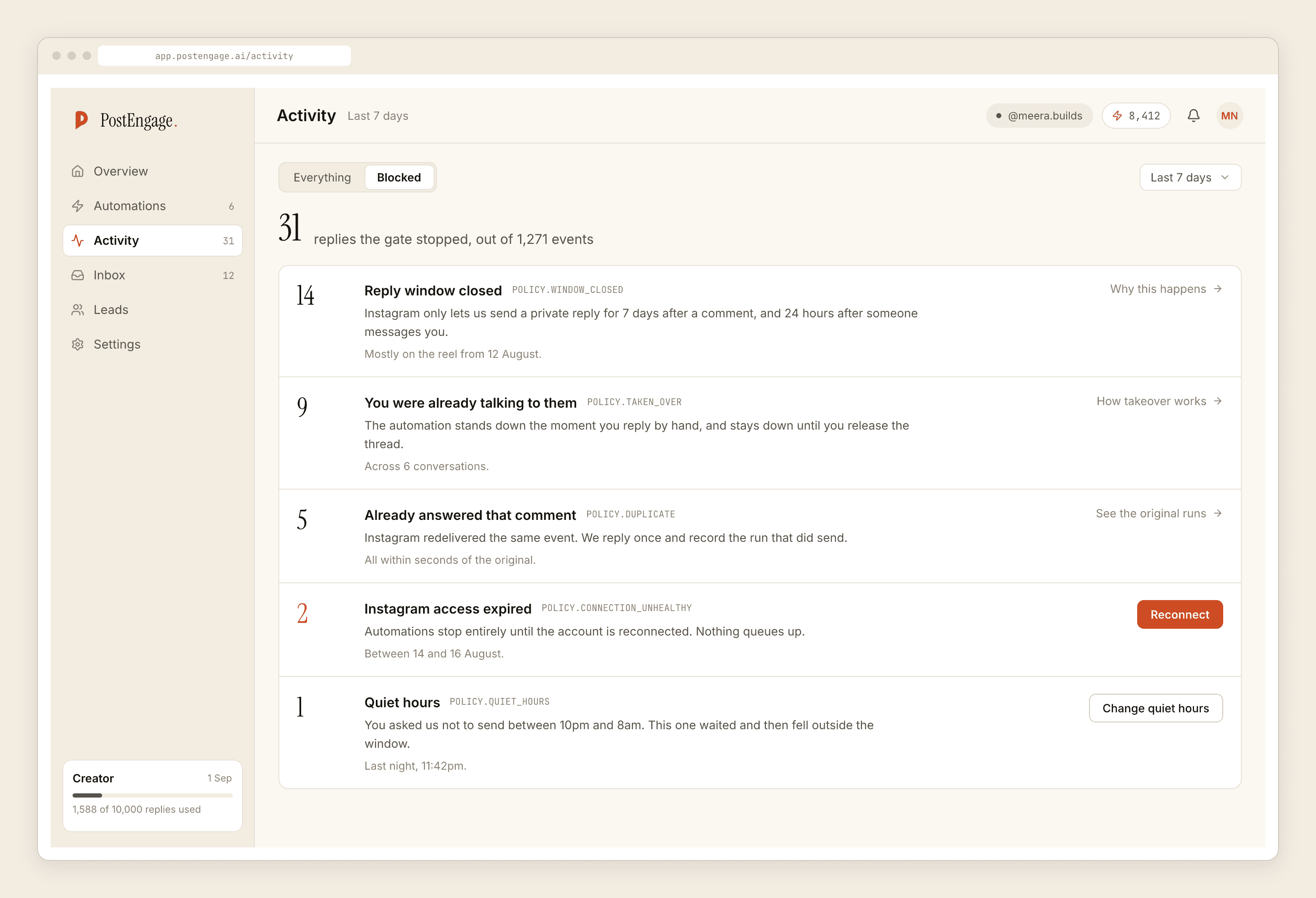
Open Activity, filter to blocked, and look at the relationship between two rows.
A stack of quiet-hours holds that released the next morning is the setting doing its job. A stack of quiet-hours holds followed by closed windows means the hours are consuming conversations rather than protecting people, and the window wants narrowing by an hour or two at the end.
There is no report that computes this for you. It is a thing you look at once a fortnight, and it takes about two minutes.
What none of this includes
No send-time optimisation, no per-recipient timing model, no delivery scheduling, no analytics on when your audience is active. The timezone field and the quiet hours range are the whole surface, and everything above is about setting those two things deliberately instead of by default.
If you want the full list of what stops a reply and why, the checks are documented here. If your audience is spread across several timezones, the multilingual and global post is the closer fit.