Playbooks · 6 min read
Fashion Brand Ops: Who Keeps the Size Chart True?

Fashion DMs: send a size chart, never a fit promise settles what the replies should say. Fit is a judgement about a body and a chart is a fact about a garment; the automation may send the second and must never send the first. It also covers the body-photo problem and how to write a returns template that does the reassurance work.
None of that is repeated here. This post is the operations half — the part that decides whether those templates are still true in June, and what happens to them on a drop night.
A fashion brand's facts move faster than its templates
Most businesses can write a template and forget it. A clothing brand cannot, because almost everything in a good reply has a season attached to it.
The size chart changes when the manufacturer changes, and it changes silently. Fabric composition varies between batches of the same style. The returns window is different during a sale at most brands, and that is the one that costs money — an evergreen template quoting the normal policy, sent at full volume during your end-of-season sale, is a promise you will honour a few hundred times.
The most expensive stale sentence in fashion is a returns window written in October and still going out during the March sale.
So the template library needs an owner and a cadence, and both should be written down:
- One named person signs off wording. Not "marketing". A person, who reads every live template end to end before it changes and after a season turns over.
- A short edit list. The failure is never malice. It is a well-meaning colleague adding a helpful sentence about a fabric on a Friday evening.
- A review the week a sale starts. Returns, exchange, shipping cutoffs. Every one of those has a sale-period version and an ordinary version.
- A review when a supplier changes. Nobody thinks of the size chart as a document with a source, and it is one.
Twenty minutes, four or five times a year. It is the whole maintenance cost of the thing.
Drop night is a different configuration from a Tuesday
A drop is a volume event on a schedule, which is unusual, and it justifies settings you would not run the rest of the time.
Build the drop automation as a temporary one. Named with the drop — SS-DROP-MAR-SIZES — and scoped under Advanced to the drop post only. Not account-wide. An account-wide automation on drop night fires under a reel from November, sending drop copy to somebody browsing your archive.
Set the rate budget before you post, not while it is happening. A drop that travels is exactly the scenario where a large pile of near-identical DMs goes out in an hour, and that is the shape Meta reads as spam regardless of how you authenticated.
Turn quiet hours off for the night, deliberately. A drop that lands at 8pm on a Friday is being decided at 9.40pm, in bed, against three other tabs. A reply at 8am has arrived after the decision.
Leave first-time-senders-only off during a drop. The people buying are the ones who bought last time. Filtering them out is precisely backwards.
Then tear it down. Sold through is the trigger, and the reel is not. A drop automation still running in May tells somebody a colourway is landing that landed and left.
The inbox nobody plans for: post-purchase
Here is the operational failure that catches new fashion brands, and it has nothing to do with fit.
Your product questions and your support questions arrive in the same inbox. "What size is this?" and "where is my order?" land three seconds apart, and only one of them has anything to do with the automation you built.
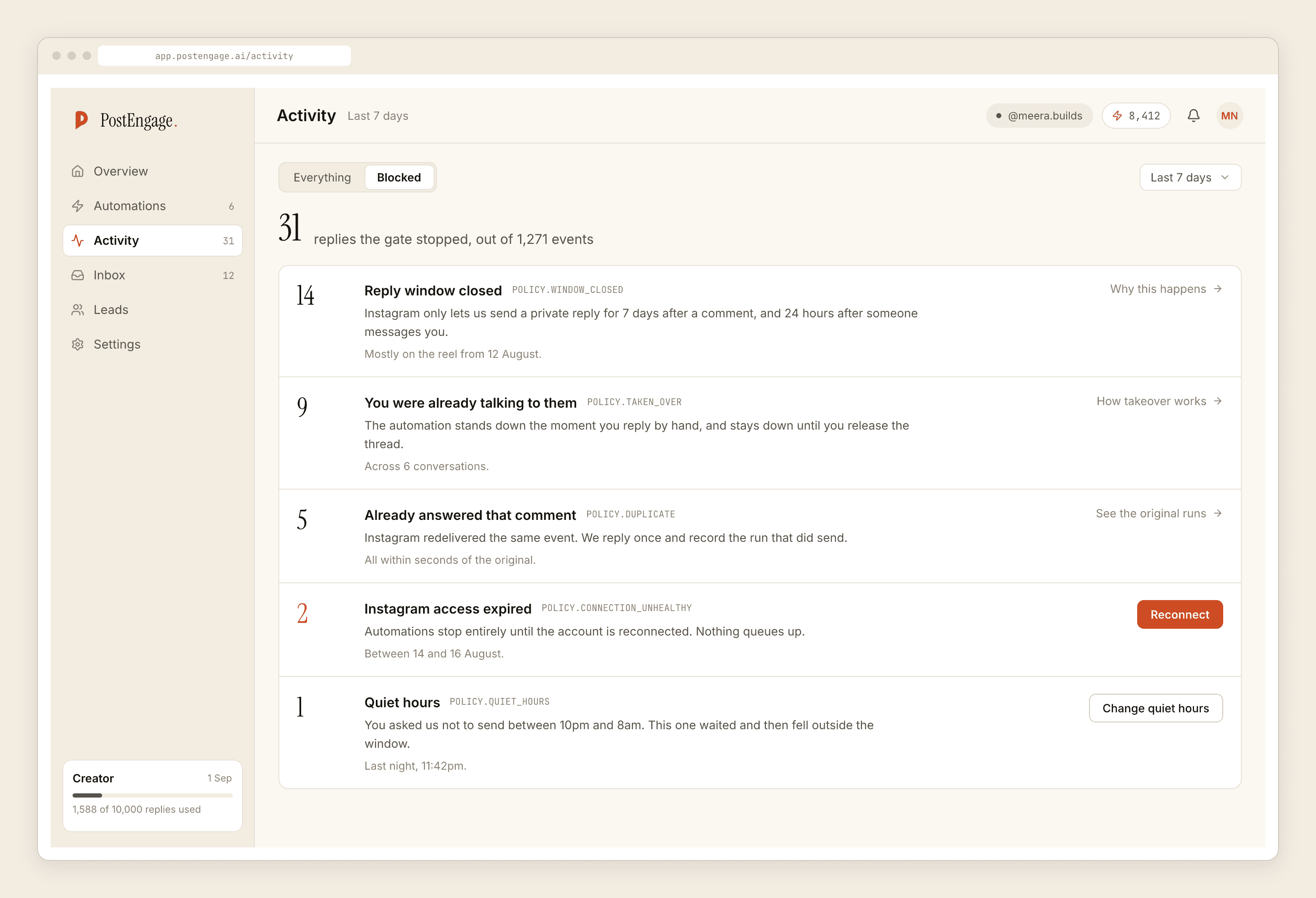
There is no order lookup here. No tracking, no shipment status, no exchange initiation, no refund status, no account lookup, no CRM. A customer chasing a parcel who receives a cheerful size chart is the review you will read next week.
So the post-purchase vocabulary goes on the negative keyword list before you go live, in the words your customers actually use: order, tracking, awb, kab aayega, not received, delivered nahi hua, wrong item, damaged, return, exchange, refund, cancel, complaint.
Those messages get no automated reply and sit in the inbox where whoever does support can see them. That is the correct outcome, and it is worth checking a fortnight later against what actually arrived.
The archive keeps selling things you stopped making
The other seasonal problem. A reel from two seasons ago is still discoverable, still gets comments, and the automation attached to it is still sending a size chart for a style that is discontinued.
Two approaches, both fine. Give every collection automation a season in its name so a stale one is visible when you scan the list. Or keep one evergreen automation that is deliberately vague — it points at the current collection page rather than describing a garment — and let it inherit the archive.
The one thing not to do is leave a style-specific automation running on a style you cannot sell. It converts interest into disappointment at your own expense.
What the team arrangement should be
If an agency runs your account, the trigger word and the two replies ship with each post as part of the delivery, and somebody at the brand still owns the returns and sizing wording, because the agency does not know when your policy changed. If the brand runs it, the same person who approves campaign copy approves template copy, for the same reason.
Takeover means the moment anyone on your team replies by hand, the automation is out of that thread permanently. On a shared fashion inbox during a drop, that is doing a lot of quiet work.
The money, briefly
Templated replies are free and unlimited, and for a clothing brand that is most of the inbox — size charts, fabric care, shipping, returns, what a cut is like. A credit is spent only when the AI writes a new reply, one credit per reply. Free tier is 100 credits with no card, packs from ₹499.
The credits go on the genuinely unusual message, which in this inbox is usually somebody describing an alteration, and that one should reach a person anyway.
The edges
No catalogue or inventory access, so nothing confirms a size is in stock. No order or shipping lookup. No payment links. No CRM sync — leads leave as a CSV. No WhatsApp, no scheduled sends, no broadcasts, and no messaging anybody who has not messaged you first, which rules out telling your followers the drop is live.
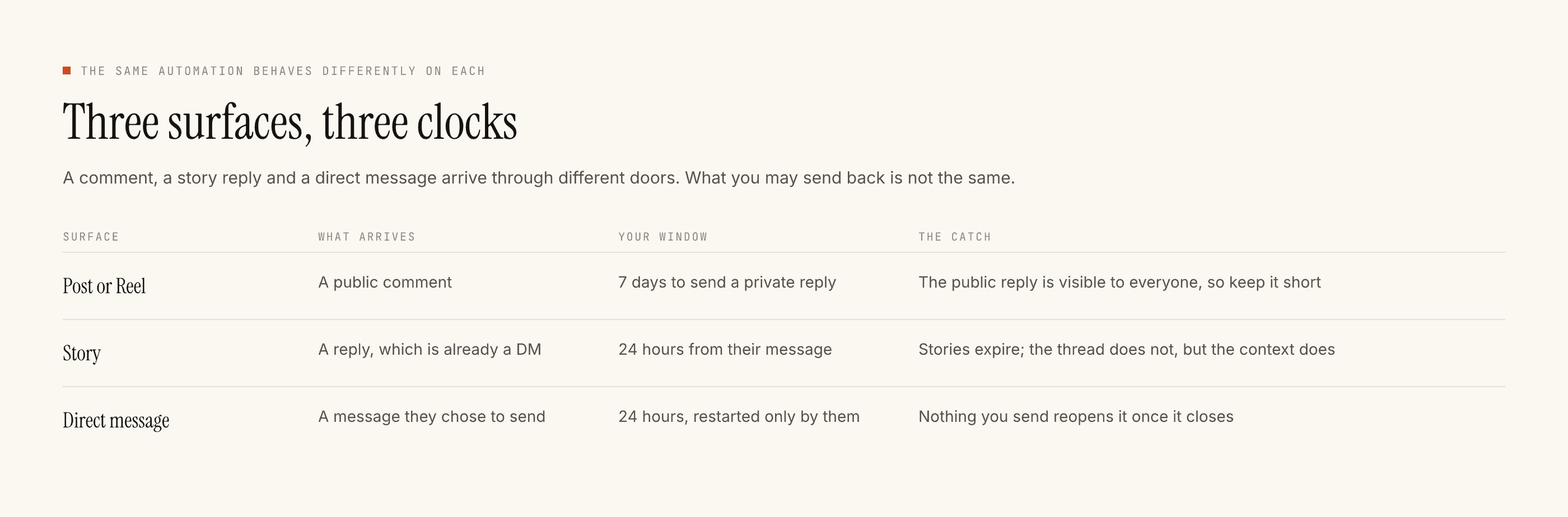
Official Graph API only: seven days to reply to a comment, twenty-four hours inside a DM thread, restarted only by the customer's message.
Set the owner and the review cadence before the next drop. The reply content itself is the other half, and if your store runs on Shopify, that post covers where the catalogue side genuinely does and does not connect.