Playbooks · 5 min read
D2C Brands on WhatsApp: Two Inboxes Wearing One Name

A marketplace seller has one job on messaging: tell people where the parcel is. A D2C brand has two, and they are not related to each other.
Half the thread is somebody who has not bought anything and is deciding whether to. The other half is somebody who has already paid and is now quietly worried. Same number, same window, completely different tone required, and the mistake most brands make is building for one and letting it answer both.
Inbox one: the doubt before the order
This is the half a marketplace never sees, because on a marketplace the reviews do the reassuring. On your own site there are no reviews from strangers, so the reassuring happens in the chat.
What people actually ask, in the order they ask it:
- Is this the real brand? The commonest and least anticipated. Somebody found the number in an ad, or forwarded from a friend, and wants to know they are not talking to a reseller with the logo. Answer it plainly, with the website domain and the handle, and never with a payment link attached.
- What is it made of, and where. Ingredients, fabric, grams, whether it is imported. Fixed facts, safe to template, and the ones that decide the purchase.
- Do you deliver to my pincode. A lookup, and a good automation if your data is current.
- What happens if I do not like it. The returns question, which is really the trust question in different clothes.
The returns answer deserves a line of its own. Say the actual policy — the number of days, who pays for pickup, what condition the item has to be in — and do not soften it into "hassle-free returns!" A brand that promises easy and then asks for the original packaging has manufactured its own complaint.
Cash on delivery reshapes that conversation
The Indian D2C inbox is different from the same inbox in a market where everybody prepays, and cash on delivery is why.
A COD buyer has committed nothing. There is no card charge to reverse, no sunk cost, no friction between deciding to buy and deciding to forget about it. That changes the pre-purchase conversation in a specific way: the questions get lighter, the intent gets softer, and a "yes bhej do" carries less weight than it looks like it does.
Prepaid intent is money. COD intent is a sentence, and sentences change their mind.
It also changes what your messages may claim. A confirmation for a prepaid order can say the order is confirmed, because it is. For COD there is a step in between — the customer still has to be at the door with cash — and a message that treats the two as identical will eventually be embarrassing. That whole problem, and what a pre-dispatch confirmation may honestly say, is its own post.
Inbox two: the anxiety after the order
The post-purchase half is quieter, more urgent, and easier to get wrong because it looks so mechanical.
The rule that holds: state events that have happened, from your own system, and nothing else. Order placed, payment captured, packed, handed to courier, last scan, delivery attempted. Those are records. When it will arrive is a courier's prediction, and passing it on in your own voice turns their estimate into your promise. The ecommerce post goes through the identification and lookup mechanics in detail.
What is specific to D2C here is the second-order anxiety. A first-time customer of a brand they discovered in a Reel does not have the "this always works out" reflex that an Amazon buyer has. Small gaps get read as fraud. The practical answer is not more messages; it is fewer, earlier, and dull. One clear dispatch message with a tracking link and a real support handoff beats five upbeat ones.
The voice question, which D2C cares about more than anyone
D2C brands build a voice deliberately — that is most of what the brand is — and then hand the inbox to a system that writes like a call centre.
The mismatch is more visible on messaging than anywhere else, because the customer is reading your sentence in the same font as their friend's. A brand that writes captions in easy Hinglish and then replies "Dear Customer, your query has been registered" has told the reader that the caption was the marketing and this is the actual company.
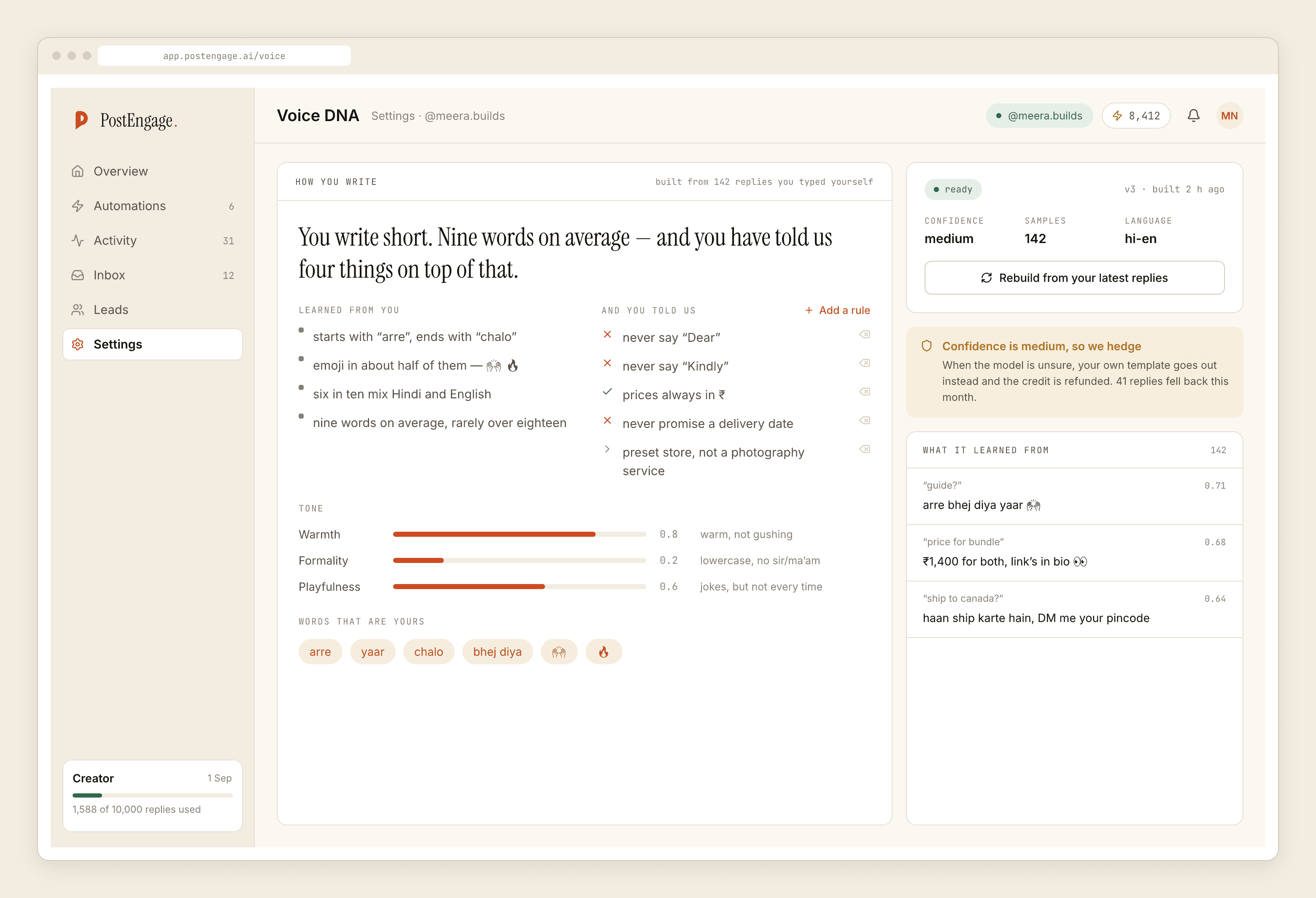
Two cautions, though. Voice belongs on the pre-purchase half. A dispatch notification should be plain — nobody wants personality attached to a delayed parcel. And a voice that sounds like a person raises the stakes on getting facts wrong, because a friendly confident sentence is believed harder than a formal one.
The bit everyone underestimates
Being on this channel means being reachable at 11pm by somebody who is annoyed, and having no way to be unreachable. That is not a reason to avoid it. It is a reason to decide in advance which messages a machine handles, which ones wait until morning with an honest acknowledgement, and which ones wake somebody up.
Meta sets the rules for the Business Platform — categories, approvals and pricing — and revises them; check their documentation rather than a blog's summary when you set up. The one thing no vendor can change is what the recipient will tolerate.
What we run today
PostEngage answers Instagram comments and DMs through the official Graph API, and that is the whole product. There is no WhatsApp in it. This post is about the channel because these pages get found by brands deciding how to handle it.
For the channel we do run: a comment is answerable for seven days, a DM thread for twenty-four hours, and only the customer's own next message restarts that clock. Templated replies are free and unlimited, a credit is spent only when the AI writes new text, the free tier is 100 credits with no card, and packs start at ₹499.
If Instagram is where the discovery happens for you, the tool comparison for Indian D2C is the sibling to this one.