Playbooks · 6 min read
Fashion DMs: Send a Size Chart, Never a Fit Promise

Read a week of a clothing brand's DMs and nearly all of it reduces to one sentence, asked twelve ways.
"Will this fit me?"
Sometimes it is "M chalega?" Sometimes it is a height and a weight. Sometimes it is a photograph of the customer with no other text. Occasionally it is somebody who already owns three of your things and just wants to know if this one runs small.
It is the highest-intent question in the inbox and it is the one an automation must never answer.
Fit is a judgement about a body. A chart is a fact about a garment.
That distinction is the whole post.
Your size chart is fixed information. Chest, waist, length, shoulder, sleeve, in centimetres, for each labelled size. It does not change with who is asking. It is exactly the sort of thing a template should send, instantly, at two in the morning, for free.
"Will an M fit you" is a different kind of statement. It depends on a body the system has never seen, on how the person likes to wear things, and on what the fabric does after one wash. A generated answer will be confident because confidence is what generation produces, and the cost of being wrong is not a bad review. It is a return, a refund, a shipping charge both ways, and a customer who now believes your sizing is unreliable.
An automated yes to a fit question is a return you have already paid for and not yet received.
The reply that is honest and still closes the sale
The good version does not refuse and stop. It converts a fit question into a measurement question, which the customer can settle themselves in about ninety seconds.
- Send the garment measurements, not the size label. Indian sizing is not consistent between brands and everybody knows it. A customer who wears L somewhere else has no information until they see numbers.
- Tell them to measure a garment they already own. Lay it flat, measure across the chest, double it, compare. This is more reliable than measuring a body, it takes a minute, and almost no brand tells people to do it.
- Say how the piece is cut. Relaxed, boxy, fitted, oversized by design. That is a fact about the pattern, not about them, so it is safe to automate and it is the thing they are really asking about.
- Say what the fabric does. Whether it has stretch, whether it shrinks, whether it is pre-washed. Fixed product facts, and the reason a correctly chosen size still disappoints.
- Point at the returns policy in the same message. Not as a disclaimer. As the reason it is safe to order.
None of that is a promise and all of it is more useful than "yes it will fit".
When somebody sends a photograph of themselves
This happens constantly in fashion and it needs a rule before it happens rather than after.
A customer sends a picture of their body and asks whether something will suit them. Sometimes the message has enough words to match a keyword and fire an automation, which is worse than it not matching at all.
Nothing automated should ever comment on a person's body. Not encouragingly, not neutrally, not with a product recommendation attached. It is a judgement about appearance made by software, and there is no version of it that reads well in a screenshot. Route these to a human every time, and if your account gets a lot of them, keep the routing template short and warm rather than clinical.
The size-level stock problem
A jewellery piece is one of one, and that post covers availability properly. Fashion has a subtler version: the product is in stock and the size is not.
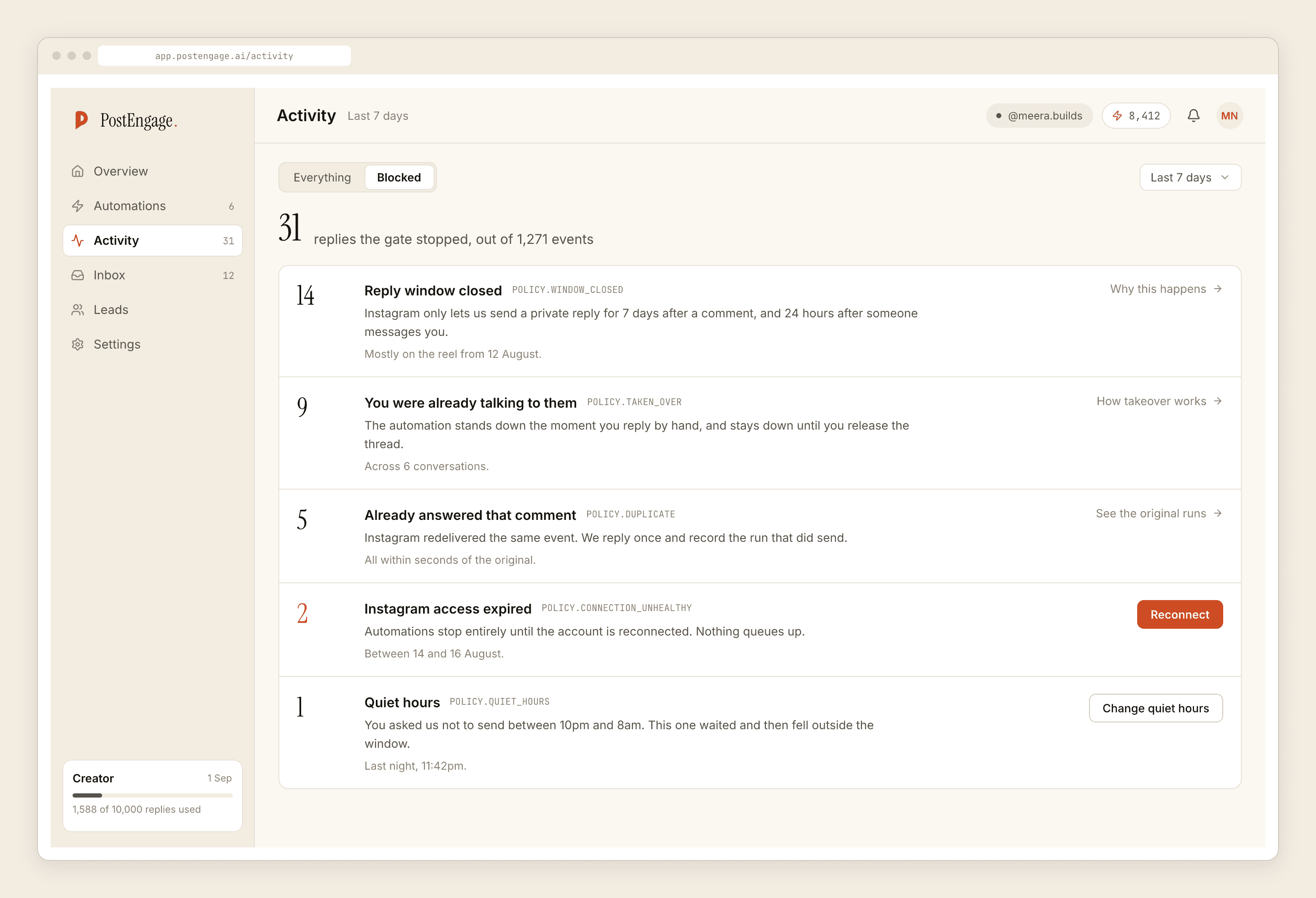
There is no catalogue integration and no inventory feed, so an automation cannot know that the M sold out on Saturday. It also cannot know that the restock arrives Thursday. Both of those are the kind of thing a customer will hold you to, and both are exactly what people ask under a drop post.
So availability by size goes on the negative list too, and the safe reply points at the product page, where the truth is at least being maintained by a system that knows.
Returns is the template that decides the conversion
If you cannot promise fit, the returns policy is doing the reassurance work, and it has to be specific rather than warm.
Split it by category in the template, because a single policy line causes every argument you will have. Regular stock, sale items, innerwear and swim, and anything altered or stitched to measure almost never have the same rules. Say the window, who pays the shipping, whether it is a refund or an exchange or credit, and what condition the item has to be in. Say it before the sale, in the same reply as the size chart, and you will lose the occasional order and gain the ones that were hesitating.
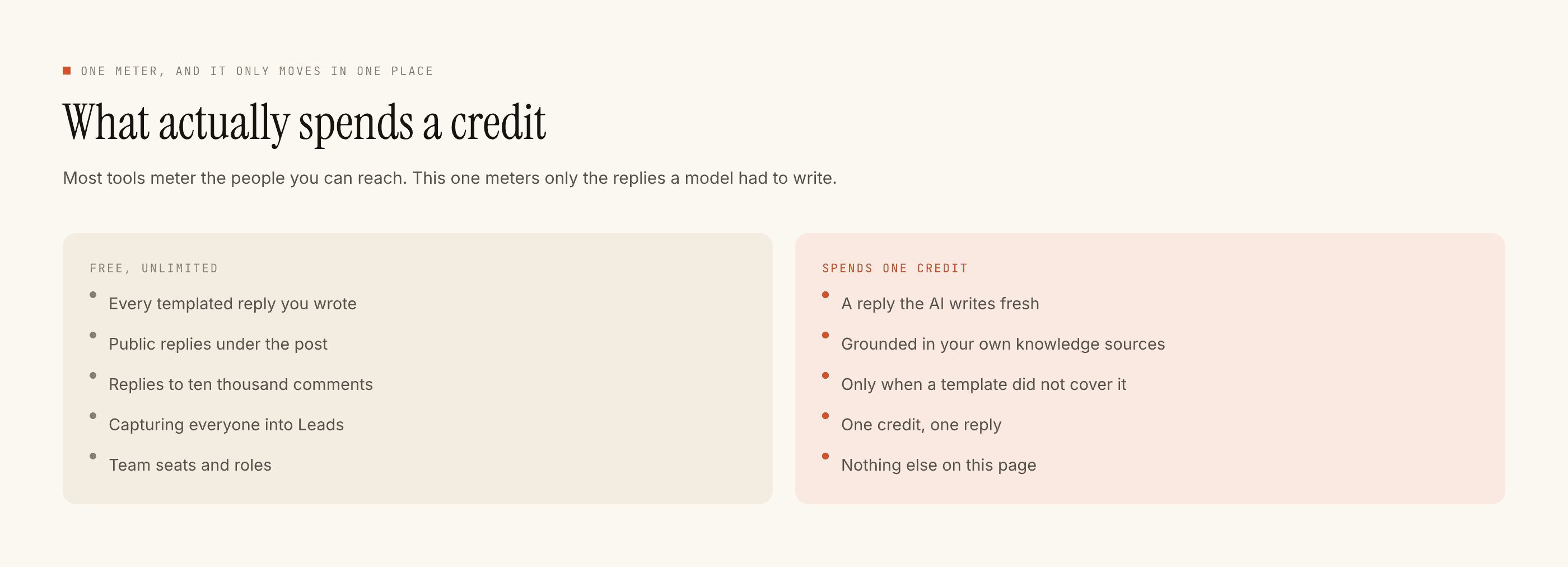
Templated replies are free and unlimited; a credit is spent only when the AI writes a new reply. Free tier is 100 credits with no card and packs start at ₹499. The credits get spent on the genuinely unusual message, which in this inbox is usually somebody describing an alteration — and that one should probably reach a person anyway.
The edges
No catalogue or inventory access, so nothing confirms a size is in stock. No payment links, no order lookup, no shipment tracking, no CRM sync, no WhatsApp, no scheduled sends, and no messaging anybody who has not messaged you first. Leads leave as a CSV, which is worth reading rather than importing: a month of captured questions will tell you which product page is missing its measurements.
Takeover applies the moment anyone on your team replies by hand. Comments stay answerable for seven days, DM threads for twenty-four hours, and that DM clock restarts only when the customer writes again — which is why a drop that lands on a Friday night needs the automation running on Friday night.
Build the fit refusal, then the measurement template, then returns. What actually stops a reply is worth reading before a drop, and if your store runs on Shopify, that post covers where the catalogue side genuinely does and does not connect.