Compliance · 4 min read
There Is No Warm-Up That Ends in a Cold Instagram DM

The pitch goes like this: you cannot cold DM people, but you can like a few of their posts, leave a thoughtful comment, watch their stories for a week, and then message them. By that point it is not cold, is it.
It is, and more importantly the platform does not care how warm you feel. This post exists to close that door properly, because it is the most persuasive of the workarounds and the one most often sold as a compliant technique.
The rule does not have a warmth parameter
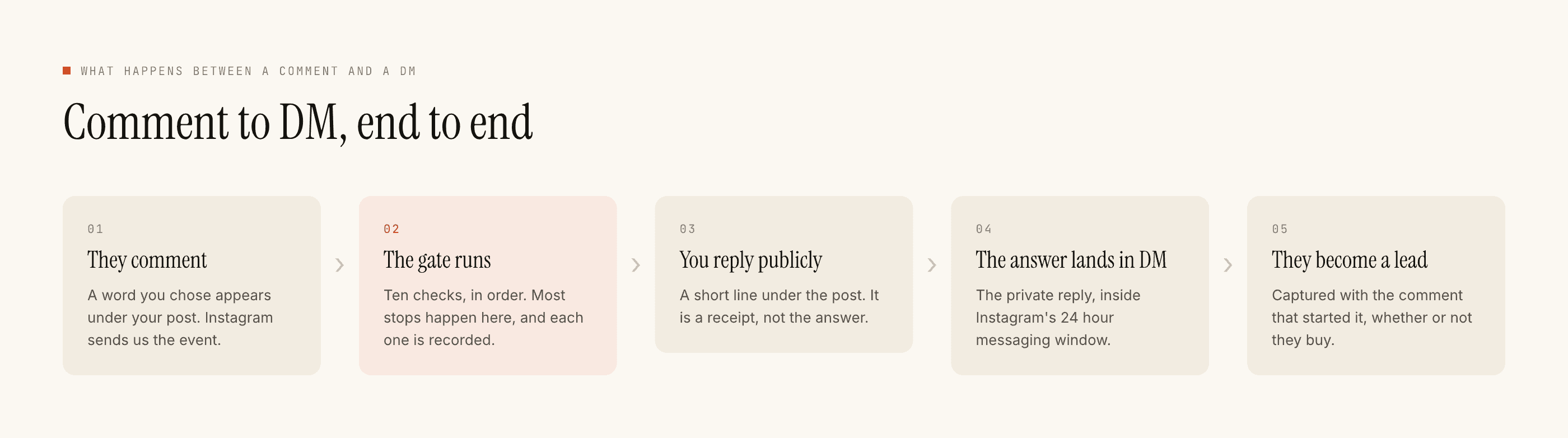
On the official Instagram API, a business may reply to people who have contacted it. A comment on your post gives you seven days to send one private reply. A direct message gives you twenty-four hours from their most recent message.
That is the complete list of permissions. There is no additional path that opens after some amount of prior interaction, because interaction is not what the rule is keyed on. The rule is keyed on who spoke first.
So a week of liking somebody's posts leaves you exactly where you started, with one difference: you have spent a week.
What the "warm-up" tools are actually doing
If a product performs the liking, viewing and commenting for you at scale, it is not using the API for those actions — there are no endpoints that do that on your behalf across accounts you have no relationship with. It is signing in as you and driving the app.
That is what breaks Meta's Platform Terms, and the account that carries the consequence is yours rather than the vendor's. The recognisable signals are consistent: a password field at signup, a browser extension, a requirement that your phone stays logged in, or the phrase "no Facebook Page needed".
We are not going to describe how those tools operate beyond that, because the description is the instruction.
Warming up is not a loophole in the rule. It is a longer route to the same refusal.
The version of this that is real
There is a legitimate thing underneath the bad advice, and it is worth naming because it is where the effort should go.
You cannot make someone message you. You can make messaging you the obvious next step, and you can make sure the message is worth sending. That is content and responsiveness, and both are slower and more boring than a warm-up sequence.
- Ask for something specific in the caption. "Comment PRICE and I'll send the list" turns a viewer into a comment, which is a permission.
- Answer the comments that already exist. A comment section where the last six questions went unanswered tells the seventh person not to bother.
- Make the first reply useful enough to earn a second message. Their reply is the only thing that extends the conversation.
- Reply while the window is open. Speed here is not eagerness, it is the difference between a conversation and an expired one.
If you genuinely need to reach people who have not contacted you
Then Instagram DMs are the wrong channel, and that is a channel decision rather than a tooling problem.
Email works if they gave you an address. Ads work, bought in Meta's own tools — and click-to-DM ad formats are interesting precisely because the tap makes the person the sender, which opens the window legitimately rather than circumventing it. We do not run ads and do not integrate with Ads Manager, but the mechanic is worth understanding as an illustration of the rule rather than an exception to it.
What does not work is any product promising the outcome without the permission.
The quieter reason not to do it
Set the terms of service aside for a moment.
A DM from an account you have never interacted with, that opens by referencing something you posted, reads as surveillance rather than warmth — especially when the person can tell it was assembled. The technique that is supposed to make outreach feel personal is the one that makes it feel worse, because the effort is visible and obviously automated.
The businesses that do well in this channel are the ones people chose to message. That is not a moral point, it is an observation about which conversations convert.
What to do instead this week
Read the comments on your last ten posts and count how many contain a question that never got an answer. That number is your actual pipeline problem, and it is one you are permitted to fix.
The full argument about which tools are safe is here, and the flat refusal on cold outreach is here.