Playbooks · 5 min read
Social Listening Ends at Your Own Inbox, and That Is Fine

Social listening, as the category is normally sold, means watching a platform for things you did not cause. Mentions that do not tag you. Comment threads under somebody else's post. A hashtag, an audio, a competitor's audience talking among themselves.
We do none of that. There is no monitoring of other accounts, no mention tracker, no keyword alert across Instagram, no hashtag watch. Nothing in this product reads anything outside your own account.
That is not a gap on a list. It is where the permission ends.
The microphone has a fixed range
Everything here runs on the official Instagram Graph API, and the API is event-driven in a specific direction. Instagram tells you about things that happened to you: a comment on your post, a reply to your story, a message sent to your inbox. It does not offer a feed of everything being said on the platform, and no amount of paying for a tool changes that.
Products that appear to listen more widely on Instagram are doing one of two things. They are reading public web pages by scraping, which breaks Meta's terms, or they are using an interface that was never offered for it. Neither is something to route around and neither gets described further here. The account you would be risking is the one your business runs on.
So listening becomes a content problem
You cannot widen the microphone. You can widen what people say into it, and that turns out to be the entire practical discipline.
Most accounts get a thin inbox not because their audience is quiet but because nothing they post asks for a specific answer. A reel that ends with "let me know what you think" produces fire emojis. A reel that ends with "comment the city you are ordering from" produces a dataset.
- Ask for one string, not an opinion. City, size, budget bracket, which of two products. One-word answers arrive in volume because they cost the reader nothing, and they arrive as text you can actually read back.
- Ask the objection out loud. A story sticker or a caption line along the lines of "reply with the one thing stopping you from booking" gets you the thing that a listening tool would have charged you to guess at.
- Put the question where a reply is one tap away. A story reply lands in your DMs. A caption question lands in your comments. Both are surfaces you legitimately receive; a question in a carousel's fourth slide is not.
You cannot hear more of the platform. You can make more of the platform speak into the part you already hear.
What your own inbox is genuinely better at
Listening tools sell you aggregation — a word cloud, a mention count, a sentiment line going up. What you have instead is the raw strings, unaggregated, from people who chose to write to you.
That is a worse dataset in one respect and a much better one in every other. It is smaller, and it is biased towards people who already know you exist. But it is verbatim, it is current, and it is first-hand. When somebody types is this same as the one on Amazon, you have learned something about your competitive position that no dashboard was going to phrase that clearly.
The comparison angle in particular is worth its own read rather than a paragraph here — reading your own inbox as a competitor analysis covers what buyers reveal when they tell you what they are weighing you against.
Turn it into a record, because there is no dashboard
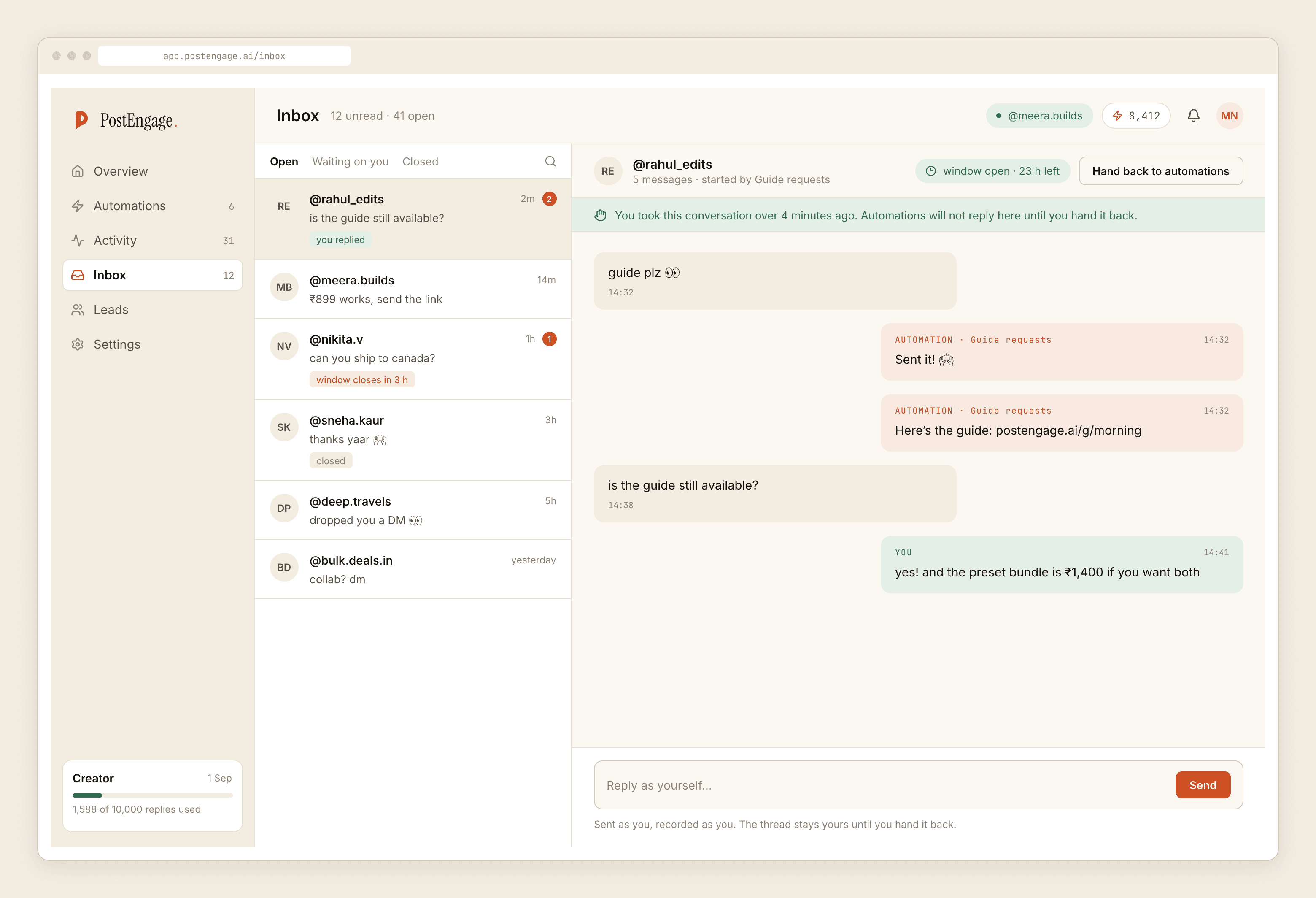
There is no analytics product here, so nothing accumulates on your behalf. If you want the pattern rather than the individual message, you have to leave yourself the note.
The lead record holds a stage, tags, interaction counts and a notes field. The habit that pays is writing one plain sentence when a conversation ends: what they asked, what they were comparing, what stopped them. Leads export as CSV, and a spreadsheet of thirty of those notes is a more useful listening report than most of what the category sells, because every row is a real person and you can go back and reply to any of them.
Nothing about that is automatic beyond the capture itself. That is the trade.
The honest ceiling
You will miss things. Somebody will complain about you in a comment section you do not own, and a review will appear somewhere you never look, and a competitor will run a campaign aimed at your customers and you will hear about it from a friend rather than from a tool.
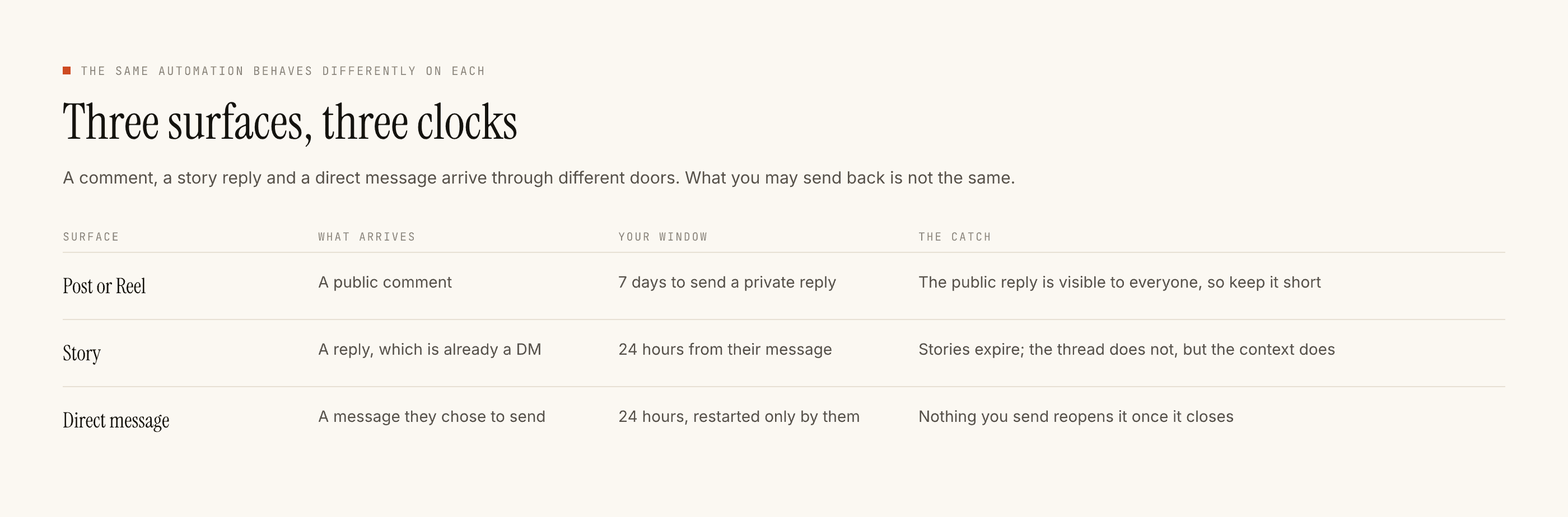
That is real and it is not fixed by this product or by any product that plays by the rules on this platform. What you get instead is that the conversations you can hear are ones you can also act on immediately — a comment is answerable for seven days, a DM thread for twenty-four hours after their last message — which is more than a mention alert ever gave anybody.
The trade, stated flatly: less coverage, no lag, and the right to keep your account.
For where the API boundary sits and why it sits there, the compliance post is the fuller version. For what a rising question in your own inbox actually tells you, that is a different signal and it has its own post.