Compliance · 5 min read
Car Dealership DMs: Never Automate a Price or a Promise

Three questions dominate a dealership's Instagram DMs. What is the price. Is it still available. What EMI will I get.
An automation should refuse all three. That is an uncomfortable opening for a post about automating a dealership inbox, and it is the honest one, because each of those questions is wrong in a different way and getting any of them wrong lands on the same showroom floor.
This post is the argument. If you have already accepted it and want the keyword lists and the build order, the build sheet is the companion post.
Stock moves faster here than anywhere you have automated before
A used car is one of one. So is a jewellery piece, and that post makes the availability argument well. A dealership takes that problem and multiplies it.
You have dozens of one-of-ones. Four salespeople are selling from the same list at the same time, on the phone, on the floor, and on three different marketplace apps. A unit gets booked at 11am, the token is taken at 11:20, and the DMS is updated at some point that afternoon if somebody remembers. New-car stock has the same shape with a different clock — allocations, colours, variants, waiting periods that move when the plant moves.
An automation has no view of any of this. There is no inventory integration, no DMS sync, no stock feed. It reads the words in a message.
By the time your automation says "yes, available", the car has been sold twice by people who work for you.
The damage is specific. A customer told by your account that a car is available drives across the city, and the argument at the desk is not with the software. It is with whoever is standing there.
The price question is not a price question
This is the part that is genuinely different from other retail, and it is worth spelling out because it looks like the easiest thing on the list.
There is no single number. There is an ex-showroom figure, an RTO component, insurance, an extended warranty someone may or may not want, accessories, a corporate or exchange or loyalty offer that changes with the month, and a discount that depends on how the quarter is going. What the customer means when they type "price kya hai" is the on-road number they will pay at delivery.
A template that sends a figure has just set that expectation. Everything after it is a negotiation that starts from your automation's number rather than from your manager's.
The safe version publishes the structure and not the total. That your quotes are on-road and include registration and insurance. That the variant changes it. That current offers are confirmed by the sales team on the day. Say the mechanism and customers accept it, because it is how buying a car has always worked.
A note on that list, because it catches people out. Keyword matching folds case, punctuation and Latin accents — so On-Road, on road and ON ROAD are all one word to it. It does not fold Indic vowel signs. दाम and दम stay two different words, which means Devanagari terms have to be listed the way your customers actually type them rather than the way you would spell them carefully.
Finance is the one you must not be clever about
Whether somebody gets a loan, at what rate, with what down payment, depends on the lender, on the applicant, and on rules that vary by jurisdiction and change. It is not a fact about your stock. It is a fact about a stranger's financial position, which your automation knows nothing about and will nevertheless answer confidently if you let it.
We are not going to tell you what your regulator permits a dealership to say about credit. Read that from whoever advises you. What is structurally true regardless is that an EMI figure sent in a DM is a number a customer will hold you to, and a fluent generated answer about approval odds is worse than no answer at all.
What you can say safely: that you work with several financiers, that the sales team runs an eligibility check, what documents are usually needed for one. Process, not outcome.
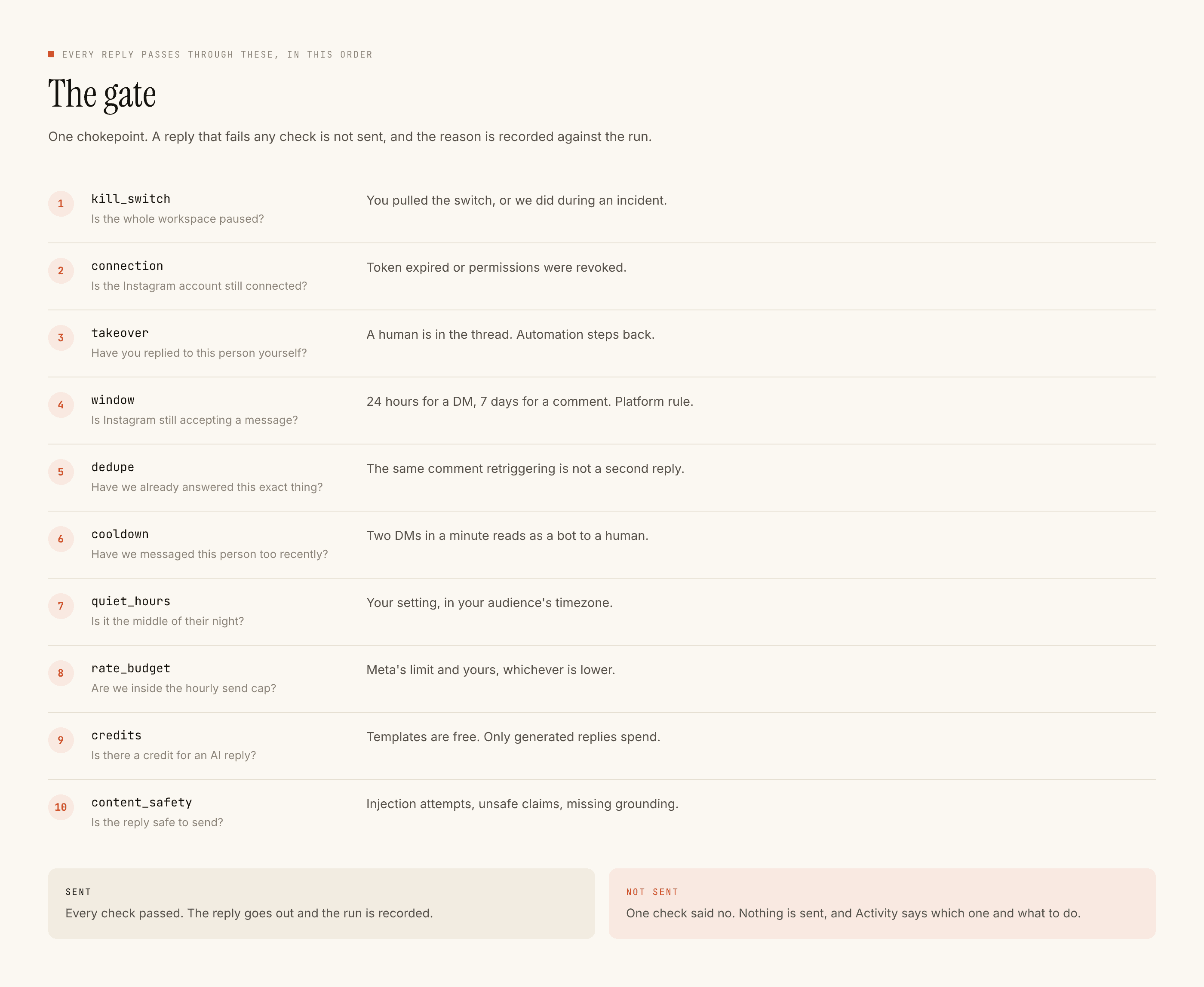
Every refusal is recorded, which is how you tune this
A blocked reply is not thrown away. It is written into Activity with the reason it was stopped.
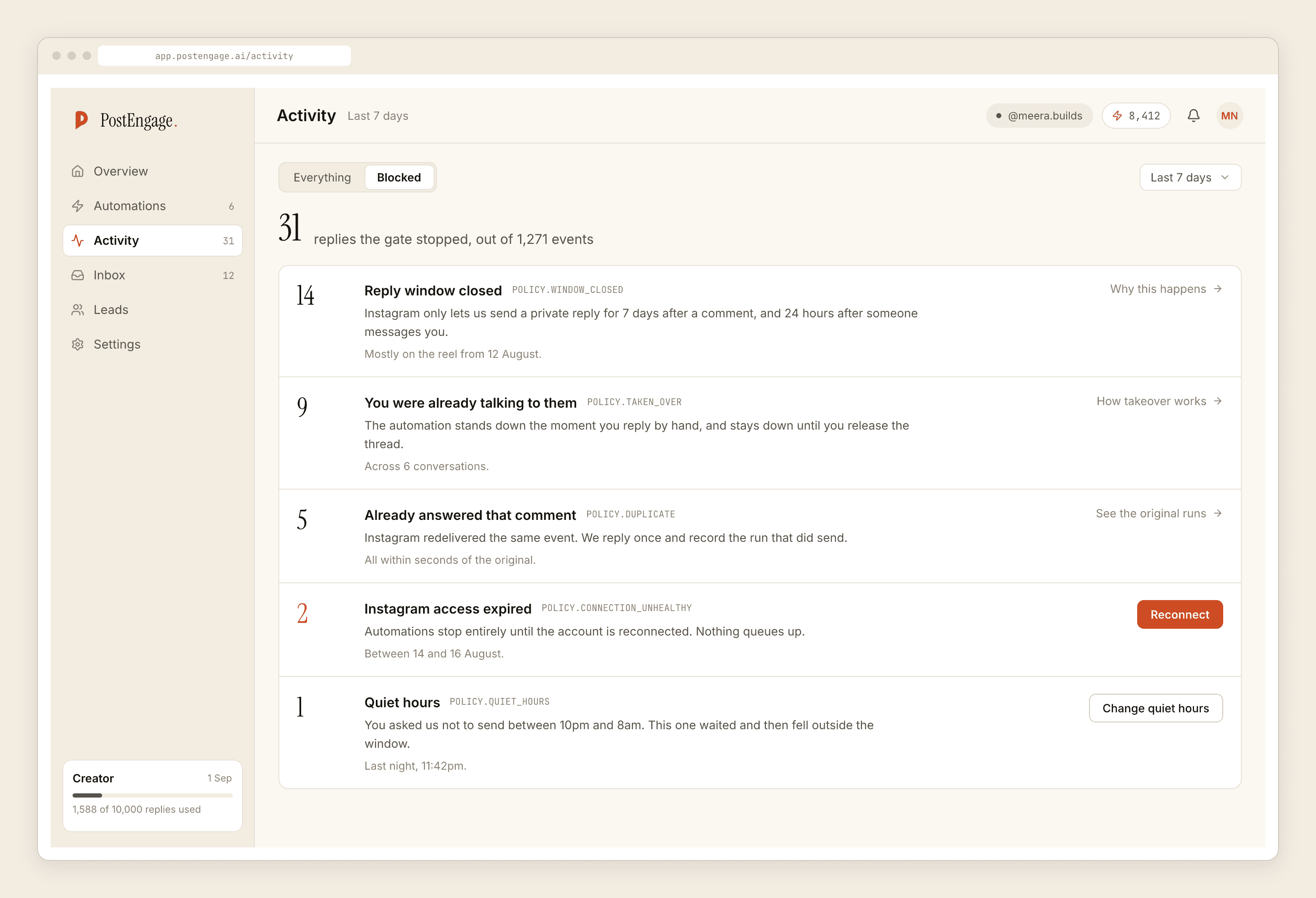
That log is where a dealership's keyword list gets good. You will find spellings you did not think of, a variant name your customers shorten, and an entire category of message you had not planned for — usually service bookings arriving on the sales account.
What is left, and it is more than it sounds
Showroom and workshop hours, and where you actually are, since the map pin is wrong for half the dealerships in the country. Which brands and variants you carry. Whether test drives are available and how one is arranged. What documents to bring for a purchase or an exchange. Service intervals, whether you do pickup and drop, whether you are an authorised centre. Whether a specific car in a reel is new or pre-owned, and its year and kilometres if that is already published in the caption.
All fixed. All templates. Templated replies are free and unlimited and a credit is spent only when the AI writes a new reply, which for a dealership means the enormous repetitive tail costs nothing. Free tier is 100 credits with no card, packs from ₹499.
And the edges: no DMS or inventory access, no test-drive booking because there is no calendar integration, no payment or token collection, no messaging anyone who has not written first, no WhatsApp. Leads export as a CSV that a sales manager works like a callback list. Comments stay answerable for seven days, DM threads for twenty-four hours, restarted only when the customer writes again.
Build the refusal, watch Activity for two weeks, then read what actually stops a send.