Playbooks · 5 min read
A WhatsApp Strategy That Survives Contact With Customers

The strategic fact about this channel is a tension rather than an advantage. Messages get seen, because the app is where people already are. And precisely because it is where people already are, an unwanted one is more irritating than the same message anywhere else.
Every real decision follows from holding both halves of that at once. A strategy built only on the first half is a plan to get blocked.
Reach is not the scarce resource here. Welcome is.
Start by sorting messages by who wanted them
Not by campaign, not by funnel stage. By whether the recipient would have asked for it.
They wanted it
You wanted to send it
The left column is close to free in reputational terms and is where nearly all the durable value sits. The right column costs something every time, and the cost compounds — each unwanted message makes the next one likelier to be reported.
Most businesses that damage a number do it by treating the right column as the whole strategy.
The strategy in one page
- Name the three messages you will send. Not campaigns — messages. Most businesses need fewer than five and try to build twenty.
- For each, write down who asked for it. If you cannot name the moment they agreed, that message is in the right-hand column and needs a much better reason.
- Decide your never-send list before your send list. Anything about somebody's money that has already moved, anything you cannot verify, anything a complaint arrives in.
- Choose a frequency you would tolerate yourself, then halve it for the first month.
- Make stopping trivial and make it work everywhere immediately. A stop that only pauses one campaign is not a stop.
What Meta's rules do to the plan
Two things are worth understanding structurally, and neither can be quoted precisely here.
Messages fall into categories that Meta treats differently, and business- initiated messages generally require a pre-approved template rather than free text. That is not a vendor limitation; it is how the platform is built, and it shapes what a campaign can even be.
The specifics — which categories exist, what they cost, how approval works, what the limits are — change, and vary by country. Take them from Meta's own documentation on the day you plan around them. Anything you read in a blog post, including this one, is a description of the shape rather than a current price list.
The asymmetry to build around
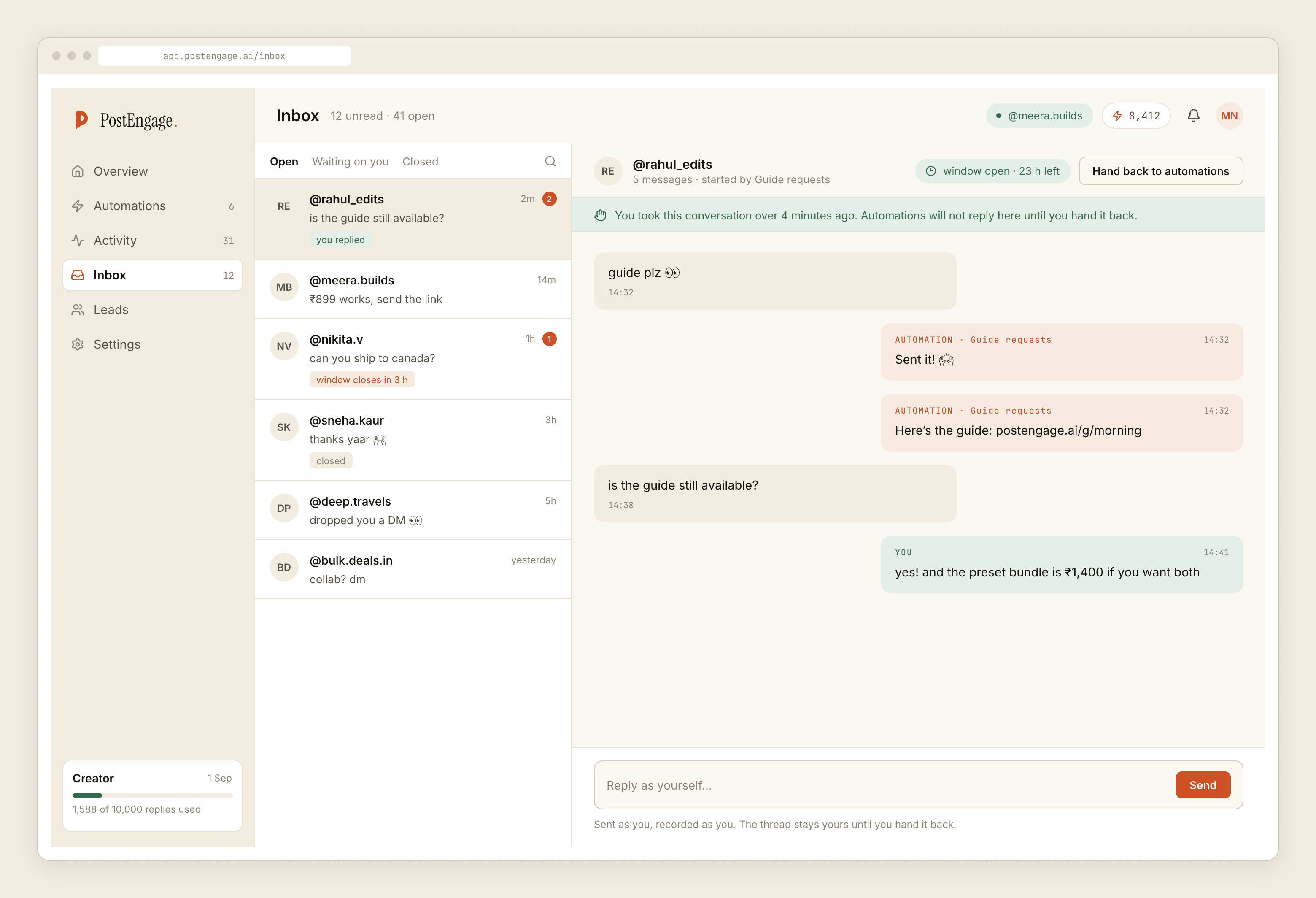
A reply to somebody who just wrote to you is the cheapest, safest, most welcome message on this channel. A broadcast to people who last spoke to you in March is the most expensive in every sense.
So the strategy that ages well is: be extremely good at the first, extremely selective about the second. Concretely, that means investing in the answers — writing them once, properly, in your own register — rather than in campaign tooling.
The three messages most businesses should actually build
Concrete, because "name your three" is easy advice to nod at and skip.
- The answer to the question you get most. Whatever it is — timings, delivery area, whether you have something in a size. It is asked constantly, the answer never changes, and answering it instantly costs nothing.
- The change to an arrangement. The class is cancelled, the order is delayed, the appointment moved. This is the message with the highest welcome-to-effort ratio on the entire channel, because the person's day depends on it.
- The thing they explicitly asked to be told. Not inferred interest — an actual request. "Message me when this is back" is a permission with a scope, and the scope is that one thing.
Notice that none of the three is a campaign. Businesses that stop here tend to keep their number healthy indefinitely; the ones that get into trouble almost always got there by adding a fourth that nobody asked for.
What to measure without a dashboard
There is no analytics product here on any channel, and the numbers worth watching are countable by hand anyway:
- How many people wrote to you.
- How many got an answer.
- How many asked to stop.
- How many blocked you, which you infer from delivery failing rather than from a report.
That third number is the one to watch obsessively. It is the earliest honest signal that the right-hand column has grown too large, and it moves before anything Meta tells you does.
Where we actually are
PostEngage answers Instagram comments and DMs. There is no WhatsApp in the product, so none of the above is a description of a feature — it is how the channel works and how we think a business should approach it.
If Instagram is also part of the picture, the strategy post for that side is here, and it differs in one important way: there you cannot initiate at all, which removes the entire right-hand column and the temptation with it.
For the consent question underneath all of this, the opt-in post goes deeper.