Playbooks · 5 min read
Retention on Instagram Starts With Being Right the First Time

Retention content is mostly about the leaving. Lapsed-customer sequences, win-back offers, "we miss you" emails with a discount stapled on.
None of it is available here. You cannot message someone who has not messaged you, so there is no lapsed-customer campaign on Instagram, no day-sixty nudge, no loyalty drip. The window belongs to them: 24 hours from their DM, 7 days from their comment, restarted only when they write again. Every retention idea that begins with "then we reach out to" is dead on this platform before it is built.
What remains is unglamorous and, on any account we have watched, larger: the quality of the answer somebody gets the one time they do write to you.
You do not get to chase them later. You get the message they sent you today.
The four properties of an answer that keeps someone
Not warmth. Warmth is the cheap part and everybody has it.
Correct. A wrong delivery estimate does not stay a wrong delivery estimate. It becomes a chase, a complaint, sometimes a return, and a person who now checks everything you say. The cost of one confident wrong sentence is a fortnight of thread.
Grounded. There is a difference between a reply drawn from something you wrote down and a reply that sounds plausible. A model that has nothing to draw on will still produce a sentence, because producing sentences is what it does. The design that matters is what happens when it has nothing: it should decline rather than compose.
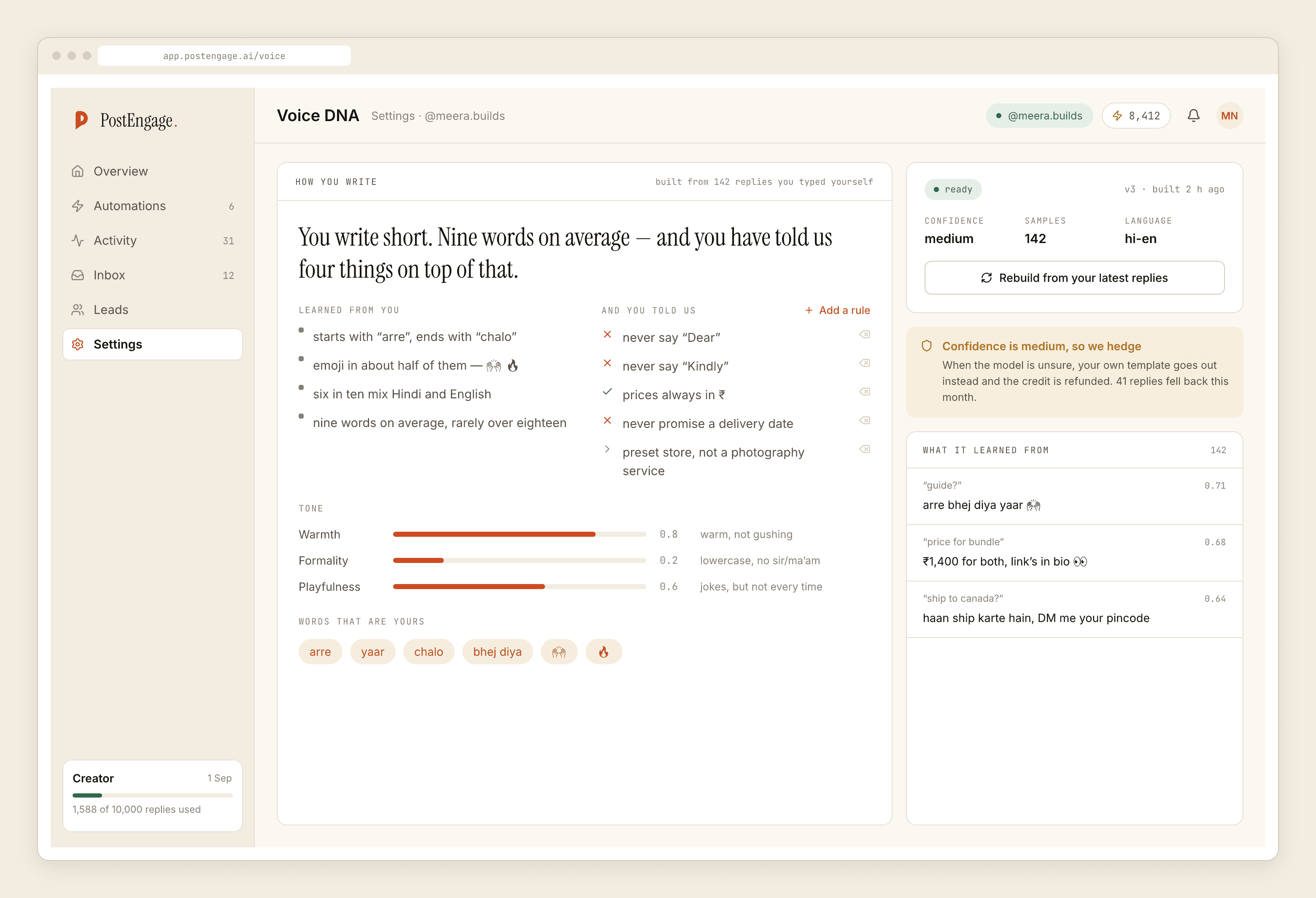
Yours. A voice profile is built from replies you actually sent, not from a tone setting. The realistic result is a slightly flatter version of you, which is a far better outcome than a slightly polished version of nobody.
Fast enough to still matter. Not instant for its own sake. Fast enough that the person has not already opened a competitor's DMs, which on Instagram is roughly the length of one scroll.
The fallback is the whole design
This is the part worth understanding properly, because it is where tools genuinely differ and it is invisible in a feature list.
Model writes, model sends
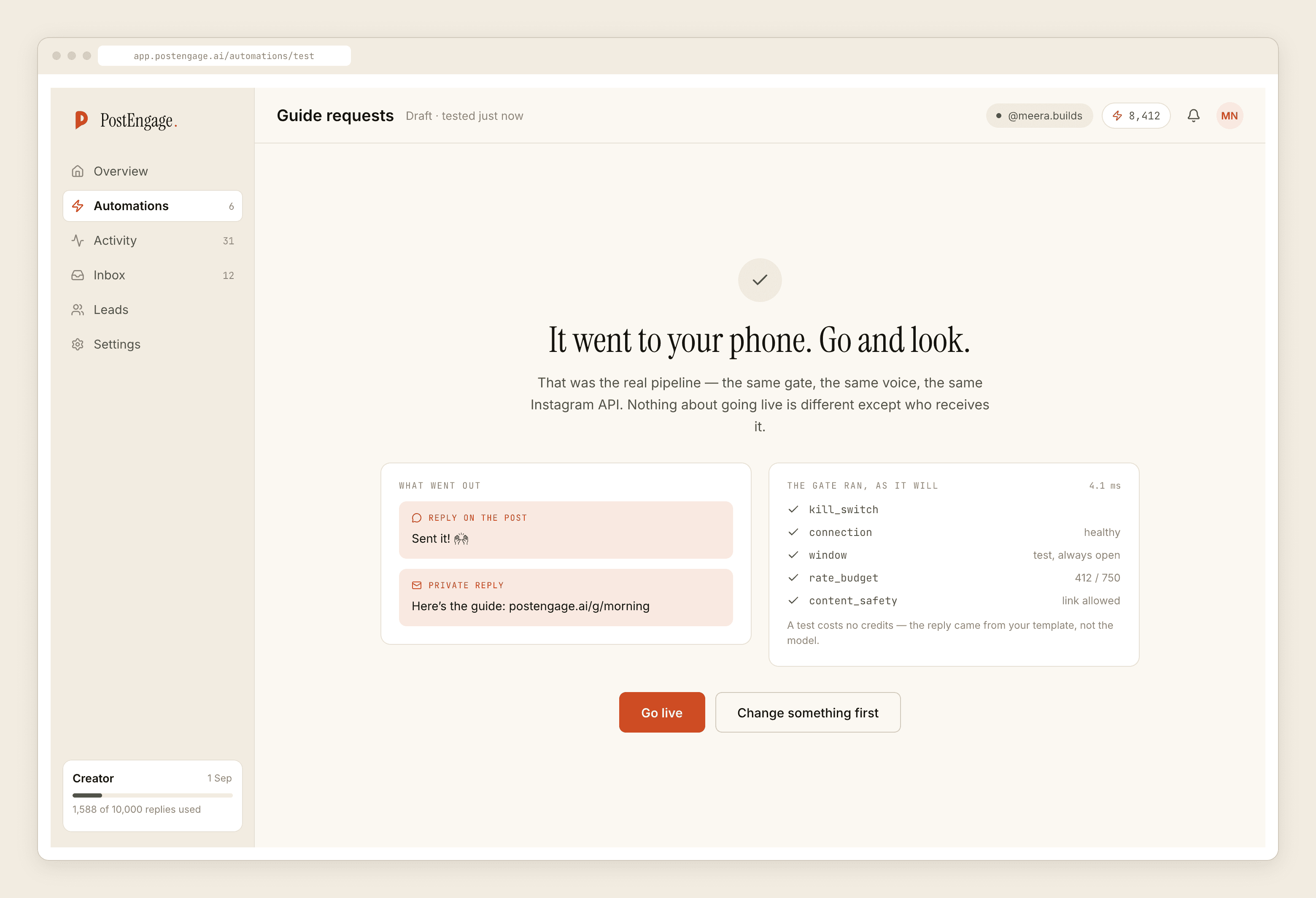
Model writes, checks decide
A generic true answer in four seconds retains a customer. A specific false answer in four seconds costs you one. That asymmetry is the entire argument for building the fallback before building the cleverness.
Where credits should and should not go
The economics push you in the right direction here, which is unusual.
Templated replies are free and unlimited. A credit is spent only when the AI writes something new — one credit, one reply. Your highest-volume questions are also your most repetitive, which means the traffic that would cost most is exactly the traffic a hand-written template answers for free, instantly, in your own words.
So the correct spend pattern is: templates carry the questions you have answered a hundred times, and credits go to the genuinely unusual message that deserves composing. The free tier is 100 credits with no card, and packs start at ₹499 — which is enough to find out whether the unusual messages in your inbox are as frequent as you assume. For most accounts they are not.
Building for correctness rather than coverage
- Write down what is true. The policy, the timelines, the sizes, the exceptions. Not for the model's benefit first — for yours. Most accounts discover during this exercise that two team members answer the same question differently.
- Turn the model off for a week. Templates only. This tells you what your inbox is actually made of, costs nothing, and every reply is exactly right because you wrote it.
- Read what got blocked. Each blocked run names the check that stopped it. The rows where you disagree with the block are your tuning list; if there are none, leave the settings alone.
- Then let the model handle the remainder, with your templates still sitting behind it as the fallback. Not as a safety net for emergencies — as the default output whenever the model is not sure.
- Get out of the way when it matters. The moment you reply by hand,
takeoverremoves automation from that thread. Anyone upset, anyone confused twice, anyone talking about money gets you rather than it.
The measurement that is actually about retention
Reply volume tells you nothing; it goes up the moment you switch anything on.
Two numbers do tell you something, and both require reading rather than a dashboard.
The first: how often a human had to go back into a thread and correct something the automation said. That is your accuracy signal and it should trend to almost never. If it does not, the templates are wrong or the model is answering questions it should be declining.
The second: how many blocked sends you looked at and thought that should have gone out. If you never find one, the checks are calibrated. If you find them constantly, something is set too tight and people are getting silence where they should be getting an answer.
What none of this includes
No loyalty points, no tiers, no referral engine, no scheduled anniversary message. No CRM sync — leads leave as a CSV and that is the extent of the export. No WhatsApp. No ability to reach a customer who has gone quiet, which is the specific thing most retention software is for.
Which leaves this post and the noticing side of the same problem as the two halves that exist: answer well the first time, and read your inbox for the trouble that shows up in writing. For the mechanics of how a generated reply gets tied to a source instead of inventing one, grounding is covered properly here, and where AI holds up against answering by hand draws the line one level lower.